
Join 250,000+
professionals today
Add Insights to your inbox - get the latest
professional news for free.
Join our 250K+ subscribers
Subscribe04 NOV 2025 / EXPERT INSIGHTS

This report advises business owners considering retirement to ensure their companies’ financials are in order before starting the sale process. Organizing financials according to GAAP standards, identifying value-enhancing 'addbacks', and understanding tax implications can not only increase the company's valuation but can prevent a potential sale from falling apart due to complications during due diligence.
Retiring and thinking of selling your business? Congratulations, you’ve earned it. But before you pop the champagne, let’s talk about numbers. Not the “I think we’re doing okay” kind, but the kind that buyers, bankers, and auditors live and breathe. Here’s the deal: your financials aren’t just a formality; they’re the DNA of your company’s value. If they’re messy, incomplete, or too “creative,” you’re basically showing up to a black-tie dinner in sweatpants. Without a solid financial foundation, even the most promising sale can fall apart faster than a bad tax shelter.
The smartest move? Bring in a CPA who specializes in mergers and acquisitions. They’re not just number crunchers; they’re translators between your financial reality and what buyers want to see.
A good CPA can help you:
And yes, you’ll also need a few other heavy hitters:
Sure, they all cost money. But in this arena, cutting corners is like skipping due diligence; it always ends badly.
GAAP is your new best friend. Buyers expect financials that play by the rules; GAAP rules, that is. These aren’t just accounting buzzwords; they’re the common language buyers use to compare companies. If your financials don’t speak GAAP, you’re basically showing up to a business deal without subtitles. Many mid-market businesses never bothered with a CPA audit because, well, the bank didn’t ask. But what flies for tax returns doesn’t fly when a buyer starts due diligence.
A few red flags that can tank a deal faster than you can say “noncompliant”:
And just when you thought it couldn’t get more technical, the new revenue recognition rules added a five-step process that requires analyzing contracts, performance obligations, and timing. Sounds painful, right? But here’s the upside: it can make your numbers more accurate and sometimes even reduce taxes.
Pro tip: For custom manufacturers, revenue is often recognized as work progresses, not just when products ship. If your process has no “alternative use” and the buyer owes you payment as work continues, your books should show revenue over time, not all at once.
Don’t forget the small stuff that can still turn into big issues:
And if you haven’t yet tackled the lease accounting updates, you’re about five years late to the party. Since 2020, operating leases have officially moved onto the balance sheet, complete with a “right-to-use” asset. By 2025, buyers expect this to be standard, skip it, and your financials will look like they’re stuck in a time warp.
Clean up these accounting quirks and sleep easy at due diligence
Getting these five right keeps buyers calm, lenders happy, and your deal on track.
A sharp accountant won’t just clean up your numbers; they’ll hunt down every legitimate “add-back” that increases your company’s value. In real terms, valuation revolves around EBITDA - Earnings before Interest, Taxes, Depreciation, and Amortization. Most middle-market companies sell for 4–6× EBITDA, so every dollar you justify as a one-time or nonrecurring expense can mean serious cash at closing.
Common add-backs include:
But beware: “creative” add-backs can backfire. Claiming $5 million of profit only after $6 millions of adjustments is a quick way to make a buyer suspicious. Also, watch for tax-driven distortions. Some owners understate assets or write off everything short of the office coffee machine to save taxes. While that’s great for April 15th, it hurts when buyers evaluate your company’s earnings.
Other red flags to fix before listing:
And don’t forget, entertainment expenses aren’t deductible anymore under the Tax Cuts and Jobs Act. That golf outing with your client? Great for bonding, terrible for your books. Some sellers even go the opposite way; inflating earnings by overvaluing inventory or deferring expenses. Either extreme scream “audit me!” A qualified CPA helps you keep it honest and defensible.
Let’s say a manufacturing firm is up for sale with reported EBITDA of $2 million. During due diligence, the CPA identifies legitimate add-backs:
That’s a cool $1 million in add-backs, raising adjusted EBITDA to $3 million. At a conservative 5× valuation multiple, that adds $5 million to the sale price; without changing a single operation. Now that’s how you make your CPA earn their fee.
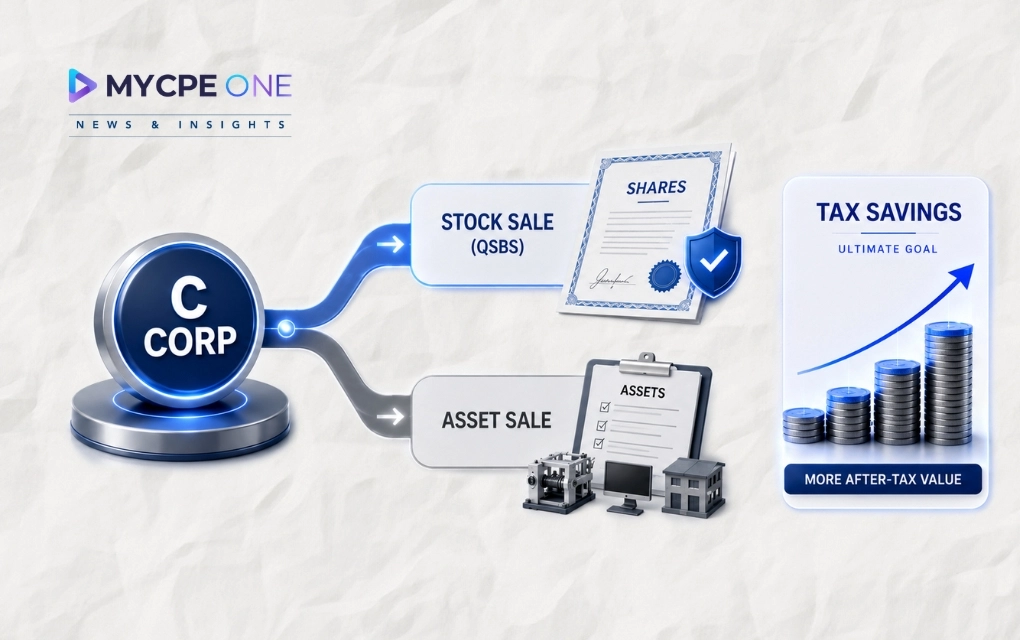
Let’s be honest; in business sales, taxes are where good deals go to die. The 2017 Tax Cuts and Jobs Act reshaped the playing field for everyone. Whether your sale is structured as a stock sale or an asset sale can swing the after-tax proceeds by millions.
Stock vs Asset Sale Comparison
How the deal structure changes your tax bill
Quick takeaway: Sellers love stock sales for tax reasons; buyers prefer asset deals for write-offs. Your CPA’s job? Help both sides meet in the middle; or at least leave the closing table smiling.
Example: In an asset deal, the buyer can immediately write off equipment purchases; nice for them, not for you. The good news? Lower ordinary rates (29.6% for qualifying pass-throughs) have narrowed the gap from the old 39.6%.
Other tax traps lurking in the weeds:
Moral of the story: Before you hang up the “For Sale” sign, call your CPA. A few hours of planning now can save you thousands later; or worse, from watching your deal fall apart during due diligence.
If you’ve been cruising through business ownership ignoring GAAP, brushing off add-backs, or thinking taxes will sort themselves out, selling your company will be a wake-up call. Buyers dig deep, and when they do, you’ll want your financial story to make sense. With the right CPA, a strong legal team, and a little prep work, you can sell your business confidently, maximize your valuation, and keep more of what you’ve earned. Because nothing ruins a retirement plan faster than realizing your “big payday” just went up in tax smoke.
Until next time…
Don’t forget to share this story on LinkedIn, X and Facebook
Subscribe now for $199 and get unlimited access to MYCPE ONE, from CPE credits to insights Magazine
📢MYCPE ONE Insights has a newsletter on LinkedIn as well! If you want the sharpest analysis of all accounting and finance news without the jargon, Insights is the place to be! Click Here to Join
Website Services for CPA & Accounting Firms - Starting $69/month.
Is your website attracting clients—or turning them away? MYCPE ONE’s Website Development Services, starting at just $69/month, create high-converting, professional websites tailored for accounting firms like yours.
With over 400 designs to choose from and a dedicated webmaster, we handle it all for you—no DIY required.
Get started today and create a website that works for your firm with MYCPE ONE!
Make a lasting impression. Boost conversions. Stay secure.
You’ve reached the 3 free-content piece limit. Unlock unlimited access to all News & CPE resources.
Subscribe Today.
Already have an account?
Sign In