Join 250,000+
professionals today
Add Insights to your inbox - get the latest
professional news for free.
Join our 250K+ subscribers
Subscribe28 JAN 2026 / EXPERT INSIGHTS
The right structure for a growing business benefits in managing taxes, protecting assets, and creating cleaner paths to funding, acquisitions, and exits, according to tax and legal advisors. Key factors to consider include growth trajectory, ownership goals, risk tolerance, potential end goal, and compliance, reporting, and financing implications. Additionally, there are options of entities such as C corporations, S corporations, and Limited Liability Companies, each offering different tax outcomes and exit flexibility. While structure may initially seem complex, it is a strategic tool that can prove beneficial in the long run.
Running a growing business without revisiting its structure is a bit like driving the Millennium Falcon with warning lights flashing and trusting the hyperdrive anyway. It may work for a while. But when something fails, it usually does so at the worst possible moment.
In the early stages, structure feels academic. Founders are busy playing Rocky, focused on surviving the next round, not reorganizing the locker room. But as a business scales, structure quietly becomes strategic. The right setup protects assets, manages taxes, and creates clean paths to funding, acquisitions, and exit. The wrong one adds risk, cost, and complexity that would make Kafka proud.
There is no universal blueprint. The right structure depends on ownership goals, growth trajectory, risk tolerance, and how the final chapter is supposed to read. That is why effective planning almost always involves close coordination with tax and legal advisors. Adding entities can unlock real advantages, but every entity brings compliance, reporting, and financing implications. What follows is a practical guide to how middle-market businesses use structure as a strategic tool rather than a compliance afterthought.
Most closely held businesses operate as one of three entities:
All provide liability protection, but their tax outcomes and exit flexibility differ materially.
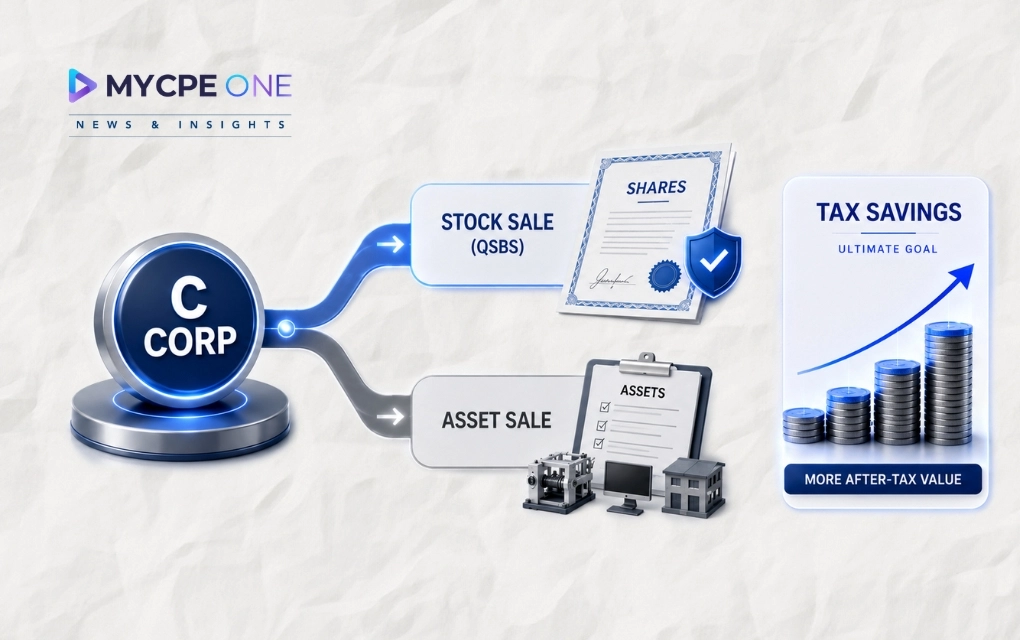
C corporations are taxed separately from their owners. The corporate tax rate is 21 percent, but distributions to shareholders are taxed again at up to 23.8 percent. The combined effective rate of roughly 39.8 percent is the highest among common entity types.
Why would anyone choose this structure?
For the right business, especially one targeting growth or venture investment, these advantages can outweigh the double-tax cost.
To avoid double taxation, many owners choose pass-through entities, most commonly S corporations or LLCs. Income flows directly to owners via Schedule K-1 while still preserving liability protection.
Key advantages include:
S corporations are predictable but restrictive.
Key limitations include:
Loss deductions are limited to the shareholder’s equity basis, excluding debt. When a shareholder exits, remaining owners do not receive a basis step-up, which can increase future taxable gains.
S corporations work best when ownership is stable, compensation is structured carefully, and simplicity is a priority.
LLCs are designed for flexibility.
They allow:
The tradeoff is self-employment tax. Active LLC members generally pay self-employment tax on pass-through income. Exit treatment is another concern, since selling an LLC interest is often treated as selling underlying assets, which can convert expected capital gain into ordinary income. LLCs also limit fringe benefits for owners, similar to S corporations.
One important advantage is tax flexibility. LLCs can elect to be taxed as partnerships, S corporations, or C corporations. However, converting an existing C corporation into an LLC generally triggers taxable liquidation, while converting from a C corporation to an S corporation is typically tax-free after a five-year holding period.
| Entity Type | Entity Level Tax | Owner Level Tax | Exit Profile |
| C Corporation | 21 percent | 23.8 percent on dividends | Potential QSBS exclusion |
| S Corporation | None | Ordinary income up to 37 percent | Capital gain on stock sale |
| LLC Partnership | None | Ordinary income plus SE tax | Often treated as asset sale |
| LLC taxed as S Corp | None | Wages plus pass-through | Reduced SE tax if compliant |
Key takeaway: The best entity is rarely the one with the lowest headline rate. Exit strategy, flexibility, and compliance risk often matter more.
Liability protection only works if formalities are respected. Owners must:
Failure to follow these rules can allow creditors to pierce the corporate veil and reach other entities or personal assets.
Holding company structures can often be created tax-free and offer meaningful planning advantages.
These can:
Receive dividends from wholly owned subsidiaries without double taxation
These are far more limited. Subsidiaries must be 100 percent owned by an S corporation holding company to preserve S status.
LLC holding companies with LLC subsidiaries offer maximum flexibility:
LLCs can also be paired with C corporation blockers to accommodate foreign or institutional investors.
Mark owned a 12-million-dollar distribution business structured as a single LLC taxed as a partnership. The structure worked operationally, so exit planning was postponed.
When a strategic buyer appeared, the buyer insisted on an asset purchase. Because the LLC interest was treated as a bundle of assets, a large portion of the gain was taxed as ordinary income. Between federal, state, and self-employment taxes, the after-tax proceeds were far lower than expected.
A peer company told a different story. That owner had separated operations, real estate, and intellectual property years earlier and used a C corporation for operations. The sale qualified as a stock sale, with partial QSBS benefits. Complexity was higher along the way, but the after-tax exit was materially better.
Lesson: Structure rarely hurts until it suddenly matters a lot.
Many businesses isolate valuable assets outside the operating company.
Real estate is often held in LLCs to:
Removing real estate from a corporation later can trigger taxable gain at fair market value, with double taxation for C corporation owners.
Equipment leasing entities can be useful, but caution is required. New equipment acquired in 2025 may qualify for immediate expensing. However, passive activity rules can limit deductions unless proper grouping elections are made.
IP is frequently placed in a separate LLC that licenses it to operating affiliates. This works well when:
Some states disallow related-party royalty deductions, so state tax rules must be reviewed.
Management companies centralize payroll, benefits, and administrative costs. When structured correctly, an S corporation management company can reduce self-employment tax exposure for active owners.
Key requirements include:
This structure delivers value only when compliance is airtight.
Owners often regret:
Most problems are not caused by complexity, but by delay.
State taxes can materially alter outcomes. C corporations may benefit from state incentives or lower rates. Flow-through owners typically pay tax based on their home state rate, regardless of where the business operates.
For example, a pass-through owner living in Illinois effectively pays the 4.95 percent state rate even if operations occur in lower-tax states.
Business structure should evolve as the company grows, attracts capital, adds assets, and plans for exit. While complexity brings cost, the right structure protects wealth, improves tax outcomes, and preserves flexibility when it matters most. In the long run, structure done right is not just protection. It is strategy.
Until next time…
Don’t forget to share this story on LinkedIn, X and Facebook
Subscribe now for $199 and get unlimited access to MYCPE ONE, from CPE credits to insights Magazine
📢MYCPE ONE Insights has a newsletter on LinkedIn as well! If you want the sharpest analysis of all accounting and finance news without the jargon, Insights is the place to be! Click Here to Join
You’ve reached the 3 free-content piece limit. Unlock unlimited access to all News & CPE resources.
Subscribe Today.
Already have an account?
Sign In