MYCPE ONE
MYCPE ONE LOGO

Join 250,000+
professionals today

Add Insights to your inbox - get the latest
professional news for free.

MYCPE ONE insights

How $1.06 Million Tax Fraud Led to Prison

Join our 250K+ subscribers

Join our 250K+ subscribers

Subscribe

17 APR 2026 / ACCOUNTING & TAXES

How $1.06 Million Tax Fraud Led to Prison

How $1.06 Million Tax Fraud Led to Prison

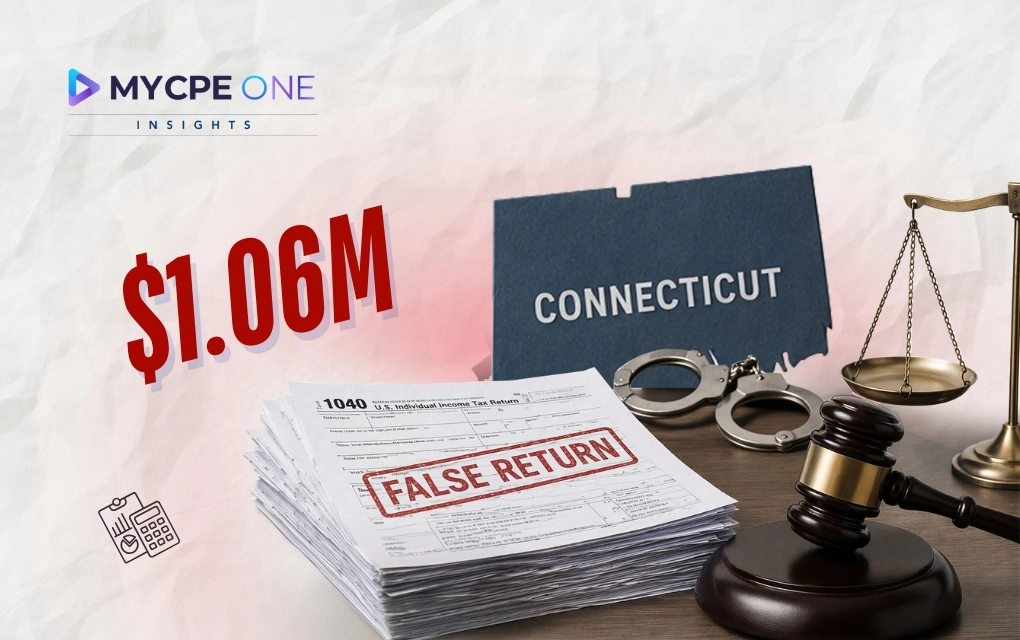
When the person you trust to handle your taxes starts writing fiction instead of returns, the fallout rarely stays limited to numbers. A Connecticut-based tax preparer who promised clients large refunds is now heading to prison for turning routine filings into a multi-year fraud scheme. The case of Diana Miller-Lloyd is not just another enforcement headline. It is a reminder that in today’s compliance environment, aggressive positions can cross into criminal exposure faster than most expect. Between 2016 and 2021, Miller-Lloyd ran a tax preparation business that appeared to deliver exactly what clients want: large federal refunds. Underneath, though, was a pattern of deliberate manipulation. Instead of relying on actual financial data, she fabricated deductions and ignored verified income information, producing returns that did not reflect reality.

Inside the Scheme

At its core, the scheme was straightforward: inflate deductions, ignore real data, and maximize refunds. Miller-Lloyd routinely inserted false entries across multiple categories. These included charitable contributions and business expenses such as travel, meals, utilities, insurance, and legal services. Many were not just exaggerated, they were completely fabricated. What stands out is the client base. Many had annual incomes above $500,000. High-income returns often come with complexity, and that complexity can be exploited if a preparer decides to push the envelope. Another key issue was the disregard for source documents. Returns were not aligned with employer data or client disclosures. At that point, this is not aggressive interpretation. It is intentional misstatement. Then there is the detail that makes you pause. Miller-Lloyd at times used the credentials of a certified public accountant to respond to IRS audits. That move was meant to add credibility to filings that were already compromised.

Following the Money

The numbers tell a clear story. Across multiple tax years, the preparer attempted to generate more than $1.06 million in fraudulent refunds or reductions in tax liability. The IRS did not sit idle. Its Criminal Investigation Division flagged irregularities in several filings before refunds were issued. That brought the actual loss down to about $472,913. That gap between attempted fraud and actual loss is worth noting. It reflects how far enforcement has come. Pattern recognition, data matching, and preparer-level monitoring are doing more of the heavy lifting. Still, the financial damage was real. The court ordered restitution of $467,717, reinforcing that even partially prevented fraud carries consequences.

History Still Matters

This was not a one-off situation. Miller-Lloyd had a prior conviction in 2010 for grand larceny tied to false tax returns. That history shaped how the case was viewed. Repeat behavior shifts the narrative. It signals awareness of the rules and a conscious decision to ignore them. For prosecutors and regulators, that changes everything. It strengthens arguments around intent and reduces any room for benefit of the doubt.

Beyond the Courtroom Impact

The case ended with a guilty plea to two counts of aiding and assisting in the preparation of false tax returns. The sentence: 18 months in prison, followed by one year of supervised release. On paper, that might not look massive compared to the attempted fraud. But the real impact goes beyond the sentence. There is restitution. There is reputational damage. There is loss of professional standing. And there are long-term restrictions that follow. Once you add it up, it is a full reset, not just a penalty.

This case also reflects where enforcement is heading:

  • Regulators are shifting focus toward preparers, not just taxpayers.
  • One preparer can influence hundreds of returns, making this a high-impact enforcement point.
  • Expect continued investment in analytics and cross-checking of preparer activity.
  • Repeat patterns across filings are being monitored more closely.
  • High refund ratios and recurring deduction categories are key red flags.
  • Mismatches with third-party data are increasingly triggering scrutiny.

If you are thinking this sounds familiar, you are probably right. The IRS has been building toward this approach for years, and it is now showing up clearly in enforcement actions.

Lessons for Professionals

This is where it hits home.

  • Documentation is everything. If a position cannot be supported, it is not defensible, no matter how common it may seem.
  • Client pressure is real. Everyone wants a better outcome, but drawing a line and sticking to it is part of the job.
  • Step back and review your own book of business. Are there recurring deduction patterns that feel too consistent? Are returns being reviewed with enough skepticism?
  • The IRS is no longer looking at returns in isolation. It is connecting dots across filings, across years, and across preparers.
  • And once those patterns connect, things can escalate quickly.

Final Takeaway

The story of Diana Miller-Lloyd is not just about one preparer going too far. It is about how easily that line can blur when results take priority over accuracy. In a system that now watches patterns as much as numbers, the old approach to aggressive filings does not hold up. No shortcuts, no assumptions that small changes go unnoticed. At the end of the day, integrity is not just ethical. It is practical.

Until next time…

Don’t forget to share this story on LinkedIn, X and Facebook

Subscribe now for $199 and get unlimited access to MYCPE ONE, from CPE credits to insights Magazine

📢MYCPE ONE Insights has a newsletter on LinkedIn as well! If you want the sharpest analysis of all accounting and finance news without the jargon, Insights is the place to be! Click Here to Join

Unlock Annual Access to News & CPE Subscription

You’ve reached the 3 free-content piece limit. Unlock unlimited access to all News & CPE resources.
Subscribe Today.

News & Updates

  • Exclusive News & Insights
  • Latest Regulatory Updates
  • Accounting Industry Trends
  • Expert Insights
  • AI-Driven Audio & Summaries
  • Infographics & Videos
  • CPE-Approved Articles
  • Digital Magazine
  • Benchmarking Blogs

Unlimited CPE Access for 1 Year

  • 15,000+ Hours of Content
  • 500+ Subject Areas
  • Mandatory Ethics Courses
  • 250+ Compliance Packages
  • 50+ Virtual Conferences and Events Access
  • Format: Live, Audio, Video, E-Books
  • Audio Based Courses & Podcasts
  • Add External Certificates with AI
  • AI Compliance Tracking and Report
  • Instant Certification and Fast Reporting
  • Mobile App Access (iOS and Android)
  • Dedicated Support System
  • Practical Training Programs
  • AI Academy Access
  • Tax Academy Access
  • Audit Academy Access
  • Leadership Academy Access