Join 250,000+
professionals today
Add Insights to your inbox - get the latest
professional news for free.
Join our 250K+ subscribers
Subscribe30 APR 2026 / ACCOUNTING & TAXES
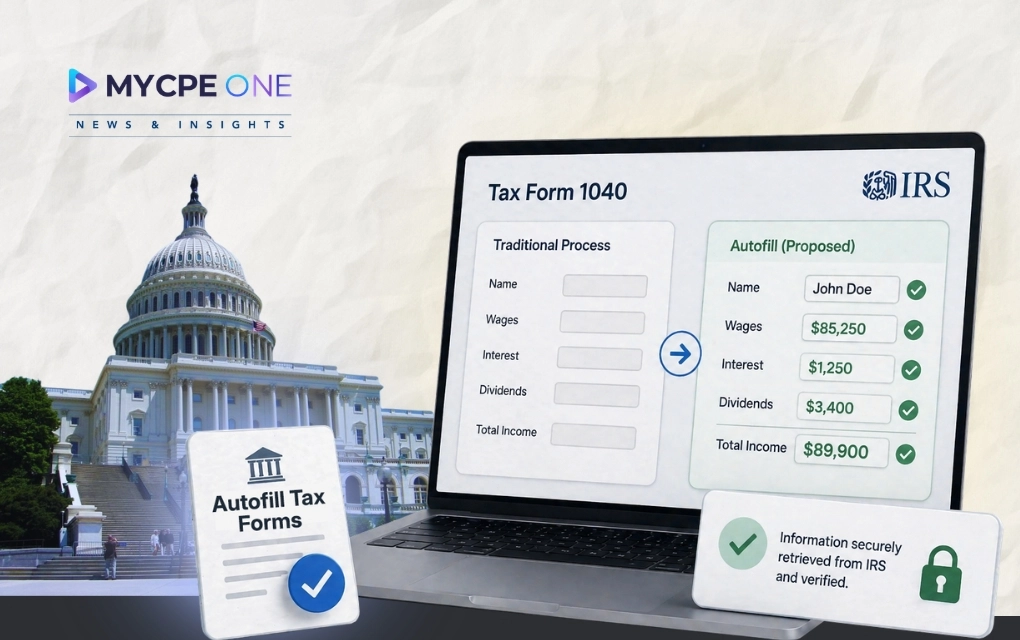
The Autofill Act, introduced by Rep. Bill Foster, could simplify the tax filing process by enabling taxpayers to download pre-filled tax forms filled with data already reported by their employers and financial institutions. If passed, this bill could potentially reduce errors, speed up the filing process, and decrease dependency on paid services. However, professionals will still be needed for complex tax-related topics, turning the role of tax professionals towards advisory services rather than data entry. The bill's success is uncertain and concerns about data security must also be addressed.
Tax season has always felt like déjà vu. You gather forms the IRS already has, re-enter numbers it already knows, and cross your fingers nothing blows up. It’s not filing, it’s rebuilding a puzzle from memory. Now, a new proposal out of Washington might flip that script. The Autofill Act, introduced by Rep. Bill Foster, is aiming to turn tax filing into something radically simpler: review, confirm, and move on. And if this sticks, it’s not just taxpayers who need to pay attention. The entire tax ecosystem, especially professionals, could be in for a quiet but meaningful shake-up.
Here’s the core idea: taxpayers could log into a secure IRS portal and download a pre-filled tax return populated with data already reported by employers, banks, and the Social Security Administration. We’re talking W-2s, 1099s, standard income data, all sitting there waiting. Rep. Foster put it bluntly: “It’s long past time to make the tax filing process more efficient and less expensive for the American people.” And honestly, he’s not wrong. This isn’t about replacing tax software. It’s about shifting the starting point. Instead of asking “Where do I begin?”, taxpayers ask “Does this look right?” That’s not just convenience. That’s a complete UX reset.
Let’s call it like it is, this system isn’t built for everyone. If your finances are clean and predictable, think salaried employees, early-career professionals, retirees, this could be a massive win. Why?
Because prefilled returns mean:
Even policy experts are backing the logic. Jeff Bush noted that pre-populated data could reduce “avoidable errors” that the IRS currently spends time fixing. Translation: less back-and-forth, fewer notices, smoother processing. Not bad at all.
Now here’s where people get it twisted. This isn’t a threat to professionals, it’s a filter. Yes, basic returns might shrink. The easy, low-margin filings could start disappearing. But let’s be real, those were never the real value drivers anyway. Because here’s what the IRS can’t autofill:
That’s where professionals step in. What this bill really does is push the industry from compliance work to advisory work. Less data entry, more decision-making. And for firms? That’s actually a solid upgrade.
If this sounds familiar, that’s because it is. The IRS previously rolled out the Direct File program, a free filing system that expanded to 25 states. A Government Accountability Office report even found it to be a successful, no-cost alternative, with users saying it made filing easier. But then, boom, it got shut down. The official line? Low usage and cost concerns. Treasury Secretary Scott Bessent said there were “better alternatives” and pointed to private sector solutions. Critics weren’t buying it. Sen. Ron Wyden argued the shutdown was influenced by lobbying from major tax prep companies, calling it a move that increased costs for everyday Americans. So yeah, politics is very much in the room here.
This is where things get interesting.
That’s a big shift in control. It positions the IRS as the origin point of truth, not just the final authority. Tax software? It becomes more of an editor than a creator. For professionals, this opens doors:
In plain terms, less grunt work, more brain work.
Before we start celebrating, let’s pump the brakes. This bill still has to survive Washington. Similar ideas have floated around for years and quietly died. Without strong bipartisan backing, this could easily end up in the “nice idea, wrong timing” bucket. Even if it passes, the timeline points to 2027 or later. And then there’s the elephant in the room: data security. A system where millions of taxpayers download sensitive financial data from a government portal? That’s a massive trust exercise. Because let’s be honest, convenience is great… until phishing emails start flying.
Until next time…
Don’t forget to share this story on LinkedIn, X and Facebook
Subscribe now for $199 and get unlimited access to MYCPE ONE, from CPE credits to insights Magazine
📢MYCPE ONE Insights has a newsletter on LinkedIn as well! If you want the sharpest analysis of all accounting and finance news without the jargon, Insights is the place to be! Click Here to Join
You’ve reached the 3 free-content piece limit. Unlock unlimited access to all News & CPE resources.
Subscribe Today.
Already have an account?
Sign In