Join 250,000+
professionals today
Add Insights to your inbox - get the latest
professional news for free.
Join our 250K+ subscribers
Subscribe30 APR 2026
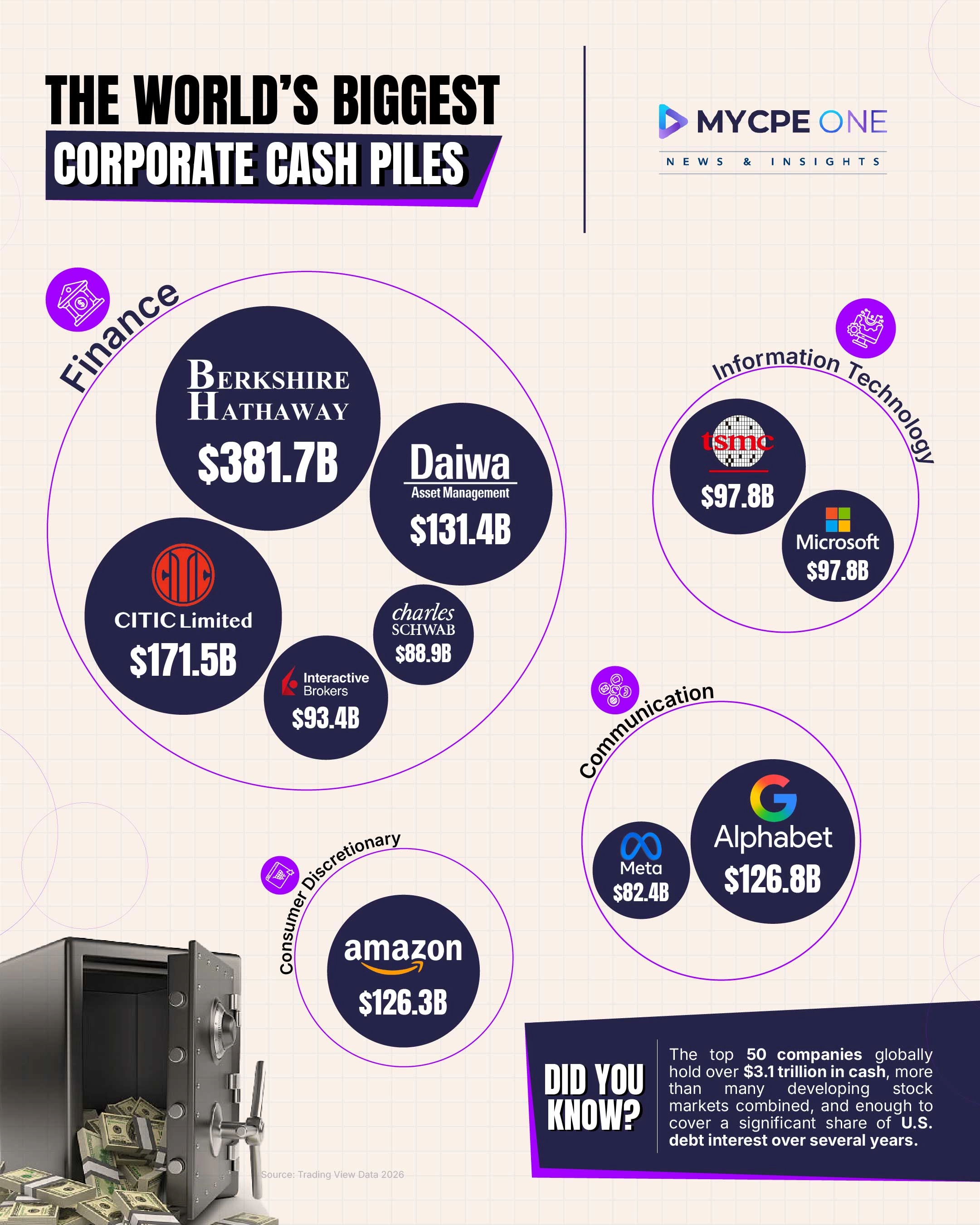
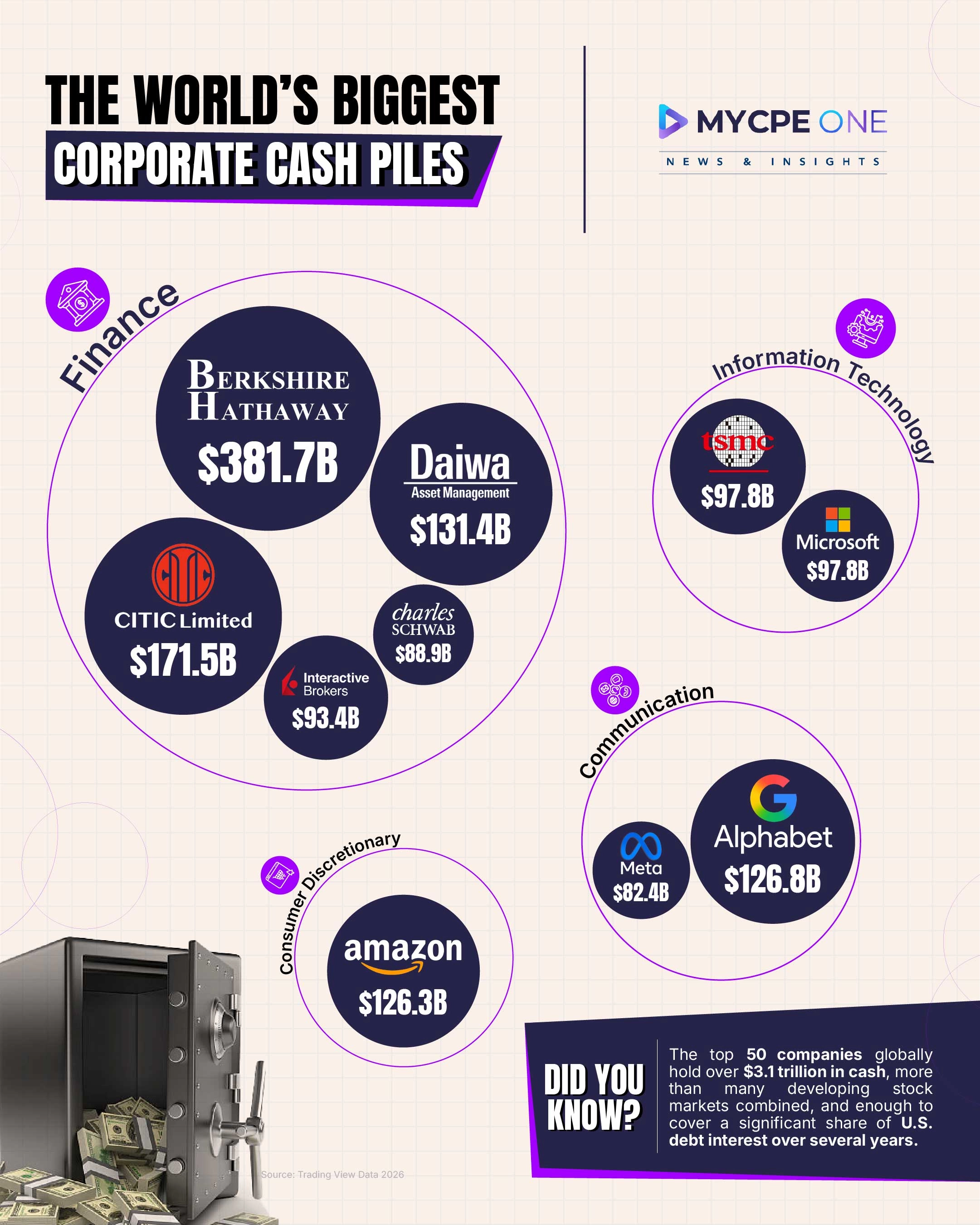
The top 50 global companies, including Berkshire Hathaway, Alphabet, Amazon, Microsoft, and Meta, hold over $3.1 trillion in cash and liquid assets as of 2026, a sum that rivals the GDP of major economies. This significant amount of capital, strategically held to navigate interest rate uncertainty, geopolitical risks and potential market corrections, underscores a trend in global corporate behaviour prioritising liquidity for flexibility and quick action on undervalued assets or large-scale acquisitions.
Corporate cash levels have reached historic highs, with the top 50 global companies holding over $3.1 trillion in cash and liquid assets as of 2026. This figure rivals the GDP of major economies and highlights how much capital is currently sitting on corporate balance sheets rather than being deployed into the market. The concentration is striking. Financial institutions account for nearly $1.2 trillion, while technology giants dominate the remainder. Unlike financial firms, whose liquidity is often driven by regulation, non-financial companies are choosing to hold cash strategically. Berkshire Hathaway alone holds around $380 billion, after more than 12 consecutive quarters of net stock selling, signaling a cautious stance toward current market valuations. Meanwhile, Big Tech firms, including Alphabet, Amazon, Microsoft, and Meta, collectively hold over $400 billion, contributing to nearly $600 billion across the Magnificent Seven.
Despite aggressive spending on AI and infrastructure, many of these companies continue to preserve cash while issuing debt, indicating a preference for flexibility over immediate capital deployment. This trend reflects a broader shift in corporate behavior. Companies are prioritizing liquidity as a hedge against interest rate uncertainty, geopolitical risks, and potential market corrections. At the same time, these cash reserves position them to act quickly on undervalued assets, distressed opportunities, or large-scale acquisitions. In today’s environment, cash is no longer idle. It represents strategic optionality, allowing companies to defend during downturns and strike when markets reset.
Until next time…
Don’t forget to share this story on LinkedIn, X and Facebook
Subscribe now for $199 and get unlimited access to MYCPE ONE, from CPE credits to insights Magazine
📢MYCPE ONE Insights has a newsletter on LinkedIn as well! If you want the sharpest analysis of all accounting and finance news without the jargon, Insights is the place to be! Click Here to Join
You’ve reached the 3 free-content piece limit. Unlock unlimited access to all News & CPE resources.
Subscribe Today.
Already have an account?
Sign In