Join 250,000+
professionals today
Add Insights to your inbox - get the latest
professional news for free.
Join our 250K+ subscribers
Subscribe11 DEC 2025 / TECHNOLOGY
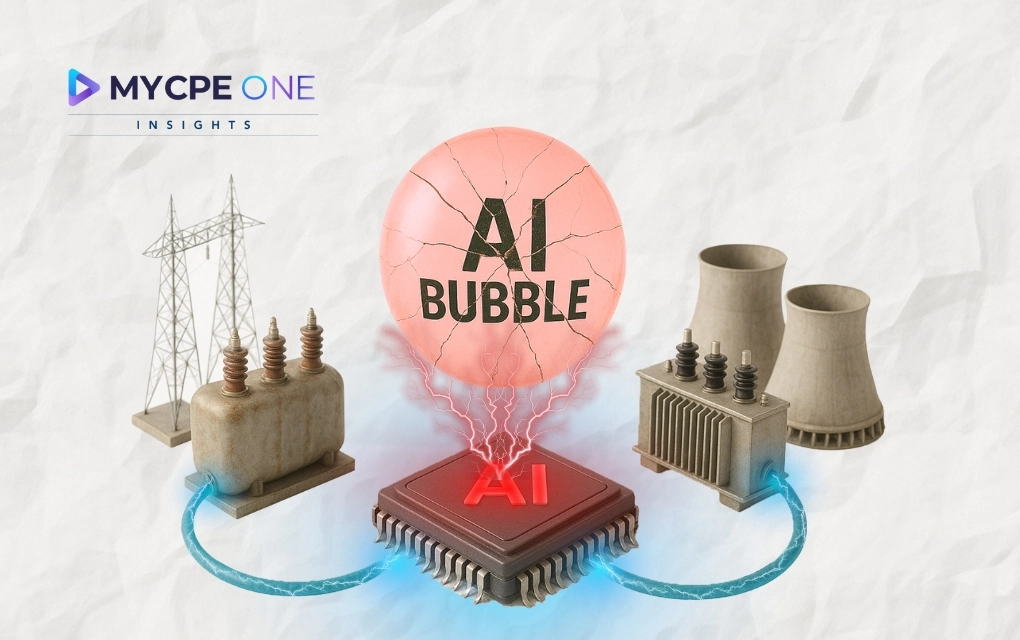
Investors are becoming worried about the possibility of an AI bubble akin to the dot-com bubble; however, unlike the dot-com era, today's AI buildouts are backed by real usage, cash flow, and customers. Furthermore, advancements like 'agentic AI' - models capable of reasoning through problems rather than just outputting data, are helping companies maximize capabilities and keep momentum. The article suggests the most significant bubble risk is in software, with traditional SaaS models now under pressure to deliver results rather than just provide access. A downturn would likely lead to layoffs and budget cuts within the industry, but also provide an opportunity for companies with real business models to emerge stronger.
If the past year felt like a joyride on a tech rocket ship, the mood today is closer to white-knuckle turbulence. Wall Street went from “AI to the moon” to “hold up, are we heading for another dot-com face-plant?” almost overnight. The buzz has flipped into worry as investors stare at giant capex numbers and fear an overinflated market ready to pop. But here is the twist. Much of the panic is pointing in the wrong direction. The AI buildout today is connected to real usage, real cash flow and real customers, not the “clicks and dreams” economy of 1999. So, before everyone freaks out and jumps ship, let’s break down what is real, what is hype and what this next chapter actually means for the AI economy.
Despite the doom talk, capex is not being lit on fire. Meta, Microsoft, and other hyperscalers are seeing their spending convert directly into revenue acceleration. Return on invested capital is visible right now. This is not the “build it and pray” playbook of the dot-com bubble. It is a “build it because customers already want more” cycle. Fears that models were hitting a wall faded fast once Gemini 3 landed. Scaling laws remain intact. More computing still equals more capable systems. That alone keeps AI infrastructure economically rational. Meanwhile, CIOs across industries are pulling budgets toward solutions that show measurable value. Lofty experimentation is getting pushed aside for real ROI. This shift from hype to outcome is not a collapse. It is discipline.
Another big difference from the dot-com era is the rise of agentic AI. Models like OpenAI’s o1 are reasoning their way through problems instead of just spitting out text. That means companies can squeeze more capability out of existing hardware. There is no industry-wide stall while waiting for Nvidia’s Blackwell chips. Software is carrying the load and keeping momentum alive. This interplay of smarter models and evolving hardware is why analysts say the AI engine still has gas in the tank.
The hardware puzzle behind AI is becoming a fortress. Liquid-cooled systems, high-density racks, and massively complex thermal designs are separating the true leaders from everyone else. Nvidia is not just selling chips. It is selling a physics problem that only a few companies on earth can solve. So, the old claim that AI hardware will commoditize like PCs is falling apart. The moat is deeper, wider, and harder to cross. This protects margins and signals durability for the infrastructure side of the AI economy. Even pension funds and institutional investors are wrestling with this. Many UK pension schemes have cut exposure to US equities over fears of an AI bubble, while others are hedging but staying invested because the fundamentals of Big Tech are still strong. When trillion-dollar earnings machines are driving the cycle, the story looks very different from 2000.
Here is where things get spicy. The true bubble risk is in software, not infrastructure. Traditional SaaS models rely on sky-high margins and per-seat pricing. But AI shifts value from access to outcomes. Customers want work completed by AI agents, not another login screen. Delivering outcomes costs money and crushes margins. Companies that refuse to adapt may become the next Blockbuster. AI-native startups with agent-first architecture are already gobbling up early market share. Layer on circular financing, where big AI players fund each other’s growth in loops that inflate perceived demand, and you get another flashing yellow light. Analysts also warn that some AI companies are spending more than two dollars to generate one dollar of revenue. No dot-com company survived that math.
A correction is coming. The question is how big. From your research plus major outlets:
Economists warn that without AI investment, the US may already be in a recession. That means AI is holding up parts of the economy, not destabilizing it. But it also means any slowdown hits hard.
If the bubble deflates, here is the playbook.
For tech, finance, and strategy leaders:
A reset is not a wipeout. It is a filter
AI is not dying. It is maturing. The fundamentals driving this cycle are stronger than anything we saw in 1999. Trillion-dollar giants with real earnings are powering the boom. Demand is real. The tech curve is rising. The bottleneck now is physical: power, grids, and hardware complexity. The correction ahead will pop the hype, not the industry. Companies with discipline will keep climbing. Companies with vibes-only strategies will fade. AI is evolving into a value economy, and the winners will be the ones who prove their impact, not just promise it.
Until next time…
Don’t forget to share this story on LinkedIn, X and Facebook
Subscribe now for $199 and get unlimited access to MYCPE ONE, from CPE credits to insights Magazine
📢MYCPE ONE Insights has a newsletter on LinkedIn as well! If you want the sharpest analysis of all accounting and finance news without the jargon, Insights is the place to be! Click Here to Join
Earn CPE Credits by Simply Reading Articles – Starting at Just $199/Year!
50 of the Top 200 Accounting Firms trust MYCPE ONE for their team’s learning—why not you? With 15,000+ approved content hours, 500+ emerging subject areas, and automated compliance tracking, staying ahead has never been easier.
We don’t just create boring tax, accounting, and audit content—our platform offers engaging, insightful, and trending material that your team will actually enjoy while earning CPE credits.
Sign up today, go through the comprehensive list of features and unlock unlimited learning!
You’ve reached the 3 free-content piece limit. Unlock unlimited access to all News & CPE resources.
Subscribe Today.
Already have an account?
Sign In