Join 250,000+
professionals today
Add Insights to your inbox - get the latest
professional news for free.
Join our 250K+ subscribers
Subscribe06 JAN 2026 / TECHNOLOGY
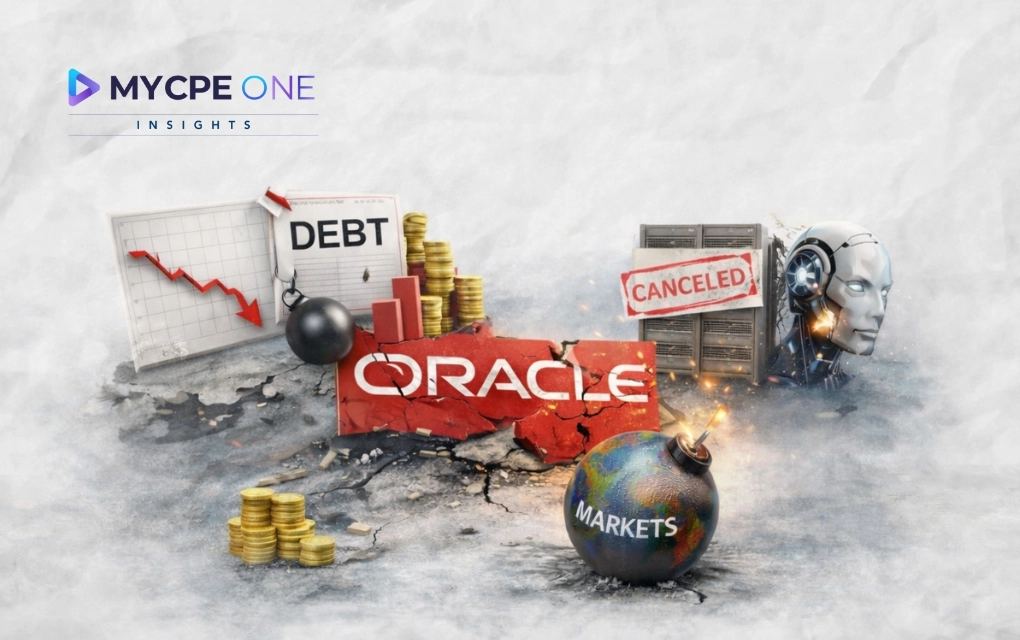
Oracle, a leading technology company, is facing significant financial problems due to overcommitting to the artificial intelligence (AI) sector. The company's decision to enter a massive cloud infrastructure partnership tied to OpenAI, reportedly worth over $300 billion, has impacted its balance sheet unfavorably and this has led to a slump in investor confidence, with its shares falling roughly 30% in a quarter; the steepest drop since the dot-com era.
Oracle’s problems did not start with a bad quarter or a missed forecast. They started with confidence. The kind that signs commitments measured in hundreds of billions, assumes capital will always be available, and believes scale alone can outrun cost. For a moment, it worked. The stock ripped higher, the AI story clicked, and Oracle looked ready to rewrite its place in cloud computing. Then the spending plan hit the balance sheet, the debt markets blinked, and investors started asking the one question that always matters in the end: who’s paying for all of this?
A few years back, Oracle had a problem. It was solid, profitable, and increasingly ignored. Cloud infrastructure has turned into a three-horse race led by Amazon, Microsoft, and Google. Oracle was the fourth guy at the table, still good at databases, still respected, but rarely invited to the after-party. Then came AI. In September, Oracle stunned the market by locking in a massive cloud infrastructure partnership tied to OpenAI, a commitment rumored to be north of $300 billion over time. Investors saw a redemption arc. Oracle stock surged roughly 36% and briefly touched $345.72. Larry Ellison looked vindicated again. The pitch was simple: build enormous data centers packed with Nvidia GPUs, rent them out to AI leaders, and finally matter in hyperscale cloud. So, what went wrong? Money. A lot of it. And fast.
The present problem is not AI demand. It is how Oracle chose to fund it.
By December, Oracle disclosed it would need about $50 billion in capital expenditures for fiscal 2026 alone, up 43% from forecasts made just three months earlier. That number sits alongside roughly $248 billion in lease commitments for data center capacity. This is not discretionary spending. This is money Oracle is on the hook for. To get there, Oracle raised $18 billion in debt through one of the largest tech bond sales on record. Credit markets noticed. Bond yields rose. Credit default swap prices climbed. Translation for non-traders: lenders started charging more for the risk. Then Blue Owl Capital walked away from a $10 billion data center financing deal. When a firm whose entire job is writing big checks says hard pass, that is not noise.
Investors followed suit. Oracle shares fell roughly 30% in the quarter, its worst stretch since the dot-com era. One five-day period alone shaved nearly 20% off the stock. This is not a vibes problem. This is math. Add another wrinkle. OpenAI itself is not expected to be cash generative until around 2030, with some estimates projecting more than $140 billion in cumulative cash burn by 2029. Oracle’s growth story leans heavily on a customer that is still lighting money on fire. That makes analysts itchy. Gross margins tell the rest of the story. Oracle’s legacy software business runs near 77%. AI infrastructure does not. Consensus estimates point to margins sliding toward 49% by 2030. Infrastructure eats cash first and asks questions later. At some point, markets hit the brakes.
It is tempting to call this an AI bubble moment. That misses the mark. Alphabet is expected to generate roughly $225 billion in free cash flow between 2025 and 2028 while ramping capital spending. Microsoft and Amazon fund AI internally from cash machines that throw off billions every quarter. They have skin in the game, but they also own the game. Oracle does not. It is building for others, with debt, and hoping volume outruns interest expense. That is a thinner margin for error.
Even within AI infrastructure, pressure is building. NVIDIA-powered clusters are expensive to run, power-hungry, and increasingly commoditized. Analysts project Nvidia-heavy cloud margins compressing meaningfully by the end of the decade. When costs rise faster than pricing power, spreadsheets start sweating. This is why markets are treating Oracle differently. Same AI theme. Different balance sheet.
If Oracle delivers data centers on time, keeps OpenAI solvent, and protects its investment-grade rating, confidence returns. Analysts like Wells Fargo’s Michael Turrin argue that successful delivery could turn Oracle into a trusted hyperscale alternative. That is the upside-down case. The downside is simpler. Cash outflows of roughly $60 billion between 2026 and 2028 strain credit. A downgrade raises borrowing costs. Capital gets tighter. Contracts get renegotiated. Growth slows. Stocks do not forgive that easily. Markets are not betting on collapse. They are betting on friction. And friction is expensive.
Here is some good news. Most accounting, tax, and advisory firms are not Oracle. They do not need billion-dollar bets to benefit from AI.
Finally, remember the boring rule. Cash flow beats ambition. Every time. AI rewards discipline more than bravado. The smartest firms will adopt steadily, measure results, and keep the checkbook under control.
Oracle did not fail at AI. It overcommitted to winning fast. Debt magnifies outcomes. When things go right, it looks brilliant. When assumptions slip, the market does not wait around. For professionals watching from the sidelines, this is not a cautionary tale about innovation. It is a reminder that scale does not excuse fundamentals. Whether you run a trillion-dollar tech company or a 20-person firm, the rules still apply. AI can change how work gets done. It cannot refinance bad timing.
Until next time…
Don’t forget to share this story on LinkedIn, X and Facebook
Subscribe now for $199 and get unlimited access to MYCPE ONE, from CPE credits to insights Magazine
📢MYCPE ONE Insights has a newsletter on LinkedIn as well! If you want the sharpest analysis of all accounting and finance news without the jargon, Insights is the place to be! Click Here to Join
You’ve reached the 3 free-content piece limit. Unlock unlimited access to all News & CPE resources.
Subscribe Today.
Already have an account?
Sign In