Join 250,000+
professionals today
Add Insights to your inbox - get the latest
professional news for free.
Join our 250K+ subscribers
Subscribe24 DEC 2025 / TECHNOLOGY
Developer Andrej Karpathy has created the LLM Council, an AI project that uses multiple AI models to answer a request, review each other's response then collectively produce a final answer. This process, akin to an audit review, is expected to reduce errors in AI interpretations, making it relevant to fields like accounting, where unchecked opinions can result in major costs.
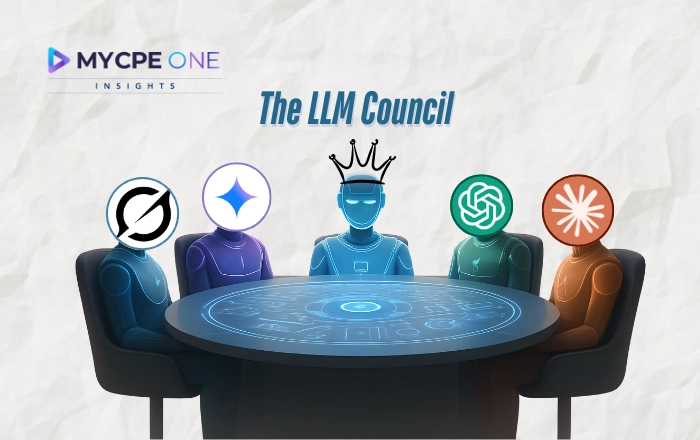
I picture it like a late-night audit room. Coffee cooling. Whiteboard half-erased. Five sharp minds are arguing over the same numbers, each convinced they see something the others missed. Now replace the humans with AI models, give them rules, and tell them to debate. That is the oddly satisfying idea behind Andrej Karpathy’s LLM Council. The project popped up recently, trended fast, and lit up developer corners of the internet. Not because it promised magic, but because it formalized something many of us already do on the fly. Ask one system, doubt the answer, ask another, then play referee. Karpathy just turned that habit into code. For accountants, tax professionals, and finance teams who live by review, challenge, and sign-off, this felt familiar. Almost comforting.
Most of us treat AI like a junior analyst. Ask a question. Get a memo. Hope it is right. The problem is that every model has blind spots. Some are cautious to a fault. Others sound confident while quietly drifting off course. That is a head-scratcher when the topic is depreciation rules or cross-border withholding. LLM Council flips the setup. Instead of trusting one model, it polls several. GPT. Claude. Gemini. Grok. Each gives its own answer. Then comes the twist. They anonymously review and rank each other’s responses before a designated “Chairman” model writes the final answer. Think less Oracle, more committee. No titles. No brand bias. Just arguments and counterarguments.
Karpathy describes the code as mostly “vibe coded,” meaning fast, loose, and intentionally disposable. That phrase alone caused some engineers to clutch their pearls. But the structure underneath is serious. Three stages. Generate. Review. Synthesize. Clean. Linear. Predictable. Sound like a familiar control process?
Accounting already runs on ensembles. Staff prepares. Senior reviews. Manager challenges. Partner signs. Nobody wants a single unchecked opinion, especially when dollars, filings, or reputations are on the line. Ironically, when accountants use AI today, they often do the opposite. They jump between ChatGPT, Claude, Gemini, or Grok, ask the same prompt, and get four different answers, each delivered with full confidence and occasional hallucinations. No shared context. No accountability. Just competing outputs and guesswork about which one to trust.
An LLM Council flips that risk on its head. Instead of pretending one model is “right,” multiple models answer independently, then critique each other. Weak logic gets attacked. Hallucinations get flagged. Overconfident assumptions get called out. A final synthesis layer delivers a single, battle-tested response, not a menu of opinions. That mirrors the accounting review stack almost perfectly. This matters when AI creeps into tax research, technical memos, or internal policy drafts. Do you really want one model with no skin in the game deciding how you interpret a grey-area rule? Here’s the quiet insight. Errors cost more than computing. Paying for multiple models instead of one can be a no-brainer if it reduces the risk of sending a client, or your firm, down a very expensive wild goose chase.
The other debate sparked by this project is not about AI at all. It is about code. Karpathy openly treats the software as temporary scaffolding. Prompts matter. Flow matters. The glue code does not. He even says the code is meant to be changed by another AI later. That idea makes traditional software teams uneasy. Clean architecture. Test coverage. Style guides. All important. But here is the uncomfortable parallel for finance leaders. We already accept that spreadsheets are fragile, temporary, and rewritten constantly, yet we still trust the process around them. Controls beat perfection. LLM Council leans on structure instead of polish. The structure is what keeps it honest. Anonymous reviews. Clear stages. One final synthesis. No loops. No wandering agents doing who-knows-what. For risk-minded professionals, that discipline is the real story.
This project also highlights a bigger shift. AI is moving away from single-answer machines toward systems that reason collectively. Less monologue. More debate. In finance, we already know the value of that. Investment committees exist for a reason. So do valuation review panels. So do audit committees. Group judgment catches what individuals miss. The question worth asking is simple. If we would not trust one human expert without review, why do we keep trusting one model? LLM Council does not eliminate bias or hallucinations. Nothing does. But it reduces them the same way teams do by forcing disagreement into the open. And yes, it costs more. It is also slower than a single response. That trade-off feels familiar, too.
LLM Council is not a product. It is not a platform. It is barely a framework. It is proof of mindset. For accounting and finance professionals watching AI inch closer to real decision support, the lesson is clear. The future is not smarter single tools. It is a structured disagreement. So next time an AI gives you an answer that sounds a little too sure of itself, maybe ask a better question. What would another model say? And who gets the final vote?
Until next time…
Don’t forget to share this story on LinkedIn, X and Facebook
Subscribe now for $199 and get unlimited access to MYCPE ONE, from CPE credits to insights Magazine
📢MYCPE ONE Insights has a newsletter on LinkedIn as well! If you want the sharpest analysis of all accounting and finance news without the jargon, Insights is the place to be! Click Here to Join
Scale Your Accounting Firm the Smart Way with MYCPE ONE!
Your Trusted Offshore Partner for CPAs and Accounting Firms.
Struggling to scale? Let MYCPE ONE’s offshore accounting team help you grow faster and more efficiently.
With 500,000+ vetted professionals across 40 offices in 2 countries, we provide you access to top talent and advanced technology, all while handling the hiring process for you.
Trusted by 3,000+ firms, including 45+ BDO Alliance Firms and 40+ of the Top 200 Accounting Firms!
Start building your offshore dream team today with MYCPE ONE!
Scale smarter. Save bigger. Stay ahead.
You’ve reached the 3 free-content piece limit. Unlock unlimited access to all News & CPE resources.
Subscribe Today.
Already have an account?
Sign In