MYCPE ONE
MYCPE ONE LOGO

Join 250,000+
professionals today

Add Insights to your inbox - get the latest
professional news for free.

MYCPE ONE insights

FASAB’s New Rule Could Kill the Lease Scavenger Hunt

Join our 250K+ subscribers

Join our 250K+ subscribers

Subscribe

05 MAY 2026 / FASB REPORTING

FASAB’s New Rule Could Kill the Lease Scavenger Hunt

FASAB’s New Rule Could Kill the Lease Scavenger Hunt

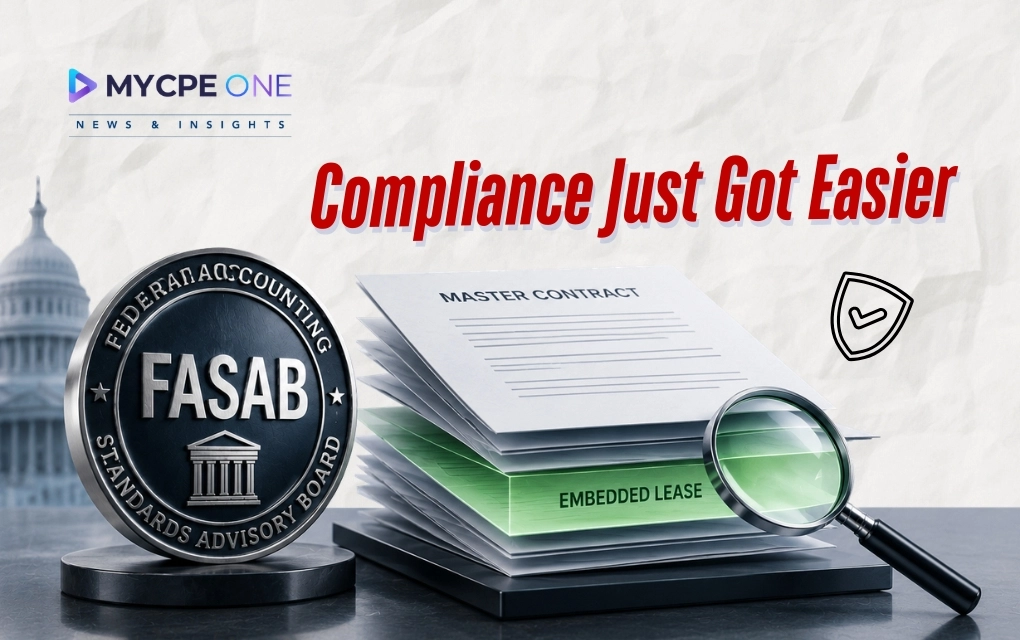
A federal contract walks into your inbox. Looks harmless. A service agreement, maybe IT support or transportation. Then someone squints at a clause and says, “Hold on… is that a lease?” Suddenly, you’re knee-deep in terms, controls, and asset rights, trying to decode what should’ve been routine. If that feels like a familiar grind, FASAB just stepped in with a practical fix.

The hidden lease problem nobody signed up for

Embedded leases have been the accounting equivalent of a wild goose chase. They don’t announce themselves. They hide inside service, supply, or exclusive-use contracts, quietly granting control over an asset in exchange for payment. Under SFFAS 54, that still counts. So, agencies have been doing the legwork. Digging through contracts. Building new workflows. Updating systems. Testing internal controls. And let’s be honest, it’s been a slog. One recurring issue? Time. Another? Resources. A third? “Wait, we missed that one too?” Some agencies even flagged audit findings and control weaknesses during FY 2024 tied to lease implementation. Not exactly the kind of headline you want when closing the books. So, here’s the real question: Is every buried lease worth the chase?

FASAB’s shortcut, with guardrails

FASAB’s proposed Embedded Leases Practical Expedient offers a simple idea. If certain contracts meet eligibility criteria, you can treat the entire agreement as a nonlease. Yes, the whole thing. No need to split components. No need to test every clause. No need to overthink immaterial pieces. Even better, this can apply to groups of similar contracts. So if you’ve got a stack of near-identical agreements, you’re not stuck repeating the same analysis like it’s Groundhog Day. But don’t get too comfortable. If a contract doesn’t qualify, the usual SFFAS 54 guidance still applies. Paragraphs 72 through 77 are still very much in play. This isn’t a free pass. It’s a filter.

The cost wasn’t adding up

FASAB didn’t pull this out of thin air. The board’s reasoning is pretty straightforward. Most embedded leases are expected to be immaterial. The effort to identify, separate, and measure them often outweighs the benefit. In other words, agencies were spending serious time chasing small-dollar impacts. That’s like using a microscope to find spare change. The expedient acknowledges that mismatch. It reduces the need to scan every contract while still preserving the integrity of financial reporting. As FASAB chair Terry Patton noted, the goal is to align standards with user needs while keeping implementation costs in check. Translation: get the job done without burning through resources.

A familiar headache across the board

If this sounds like déjà vu, it should.

When ASC 842 hit the private sector, companies ran into the same issue. Finding leases was harder than accounting for them. GASB 87 brought a similar challenge to state and local governments, and many entities dragged their feet. Some didn’t fully grasp the requirements. Others got stuck in procurement cycles, RFP processes, or system upgrades. And a lot simply underestimated the effort. One industry voice summed it up best: everyone has a day job, and lease adoption became the side project that kept getting pushed. Now layer in embedded leases, and things got messy fast. So FASAB’s move feels less like a surprise and more like a course correction.

What this actually changes

Agencies can skip the most resource-heavy part of compliance for qualifying contracts, identifying embedded lease components. That alone cuts down hours of manual review. It also gives breathing room. Teams can focus on strengthening controls, standardizing contract language, and improving systems without being overwhelmed by volume. Instead of tackling every contract at once, they can prioritize what matters. But there’s a catch. This is temporary relief. The transitional accommodation runs through October 1, 2026. After that, agencies need to be ready for full compliance. So, the question becomes: are you using this time wisely?

The trade-off nobody can ignore

Let’s not pretend this is all upside. Simplifying treatment always raises one concern. Are we losing precision? If embedded leases are small and scattered, the risk is low. But if assumptions are off, or contracts are misclassified, it could create blind spots. So, judgment still matters. Controls still matter. Documentation still matters. This expedient doesn’t replace discipline. It just trims the workload.

The final thought

FASAB is trying to fix a problem everyone felt but few enjoyed talking about. Embedded leases were eating up time, stretching teams thin, and adding complexity that didn’t always deliver value. This proposal says, “Let’s be practical.” Not perfect. Practical. As the saying goes, time is money. And right now, this expedient is giving agencies a chance to save both. The comment deadline is July 30, 2026. So if you’ve been in the trenches, now’s your moment. Because if you’ve ever spent hours hunting for a lease that barely moves the needle, you already know the answer.

Until next time…

Don’t forget to share this story on LinkedIn, X and Facebook

Subscribe now for $199 and get unlimited access to MYCPE ONE, from CPE credits to insights Magazine

📢MYCPE ONE Insights has a newsletter on LinkedIn as well! If you want the sharpest analysis of all accounting and finance news without the jargon, Insights is the place to be! Click Here to Join

Unlock Annual Access to News & CPE Subscription

You’ve reached the 3 free-content piece limit. Unlock unlimited access to all News & CPE resources.
Subscribe Today.

News & Updates

  • Exclusive News & Insights
  • Latest Regulatory Updates
  • Accounting Industry Trends
  • Expert Insights
  • AI-Driven Audio & Summaries
  • Infographics & Videos
  • CPE-Approved Articles
  • Digital Magazine
  • Benchmarking Blogs

Unlimited CPE Access for 1 Year

  • 15,000+ Hours of Content
  • 500+ Subject Areas
  • Mandatory Ethics Courses
  • 250+ Compliance Packages
  • 50+ Virtual Conferences and Events Access
  • Format: Live, Audio, Video, E-Books
  • Audio Based Courses & Podcasts
  • Add External Certificates with AI
  • AI Compliance Tracking and Report
  • Instant Certification and Fast Reporting
  • Mobile App Access (iOS and Android)
  • Dedicated Support System
  • Practical Training Programs
  • AI Academy Access
  • Tax Academy Access
  • Audit Academy Access
  • Leadership Academy Access