MYCPE ONE
MYCPE ONE LOGO

Join 250,000+
professionals today

Add Insights to your inbox - get the latest
professional news for free.

MYCPE ONE insights

Why PCAOB Registered Firms Are Sitting Out Public Audits

Join our 250K+ subscribers

Join our 250K+ subscribers

Subscribe

17 APR 2026 / PCAOB UPDATES

Why PCAOB Registered Firms Are Sitting Out Public Audits

Why PCAOB Registered Firms Are Sitting Out Public Audits

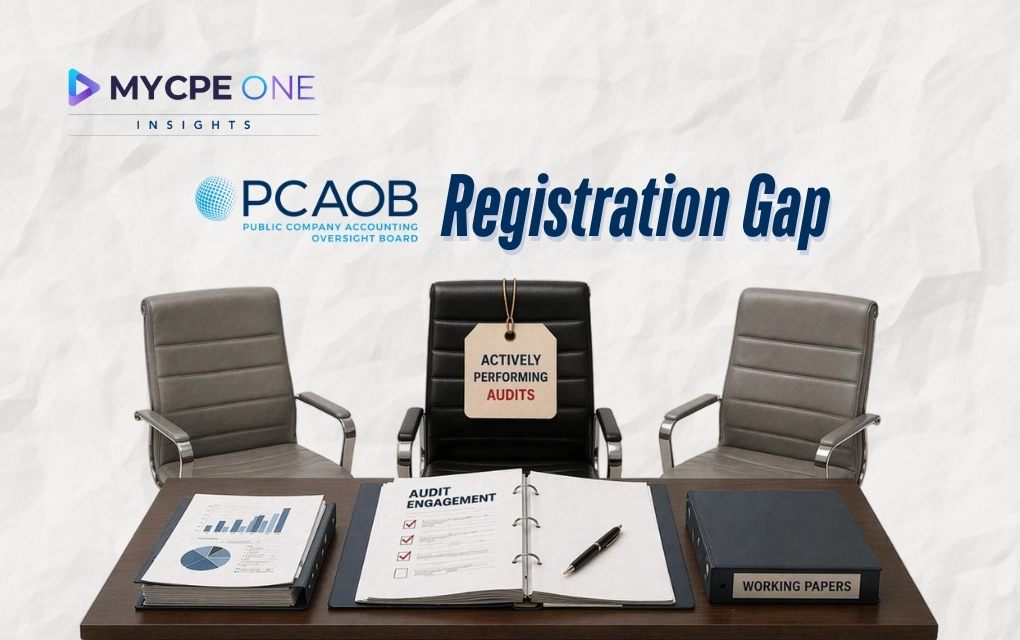
If you signed up for a gym membership, never showed up, and still kept paying dues, you'd at least get a few side-eye looks from the front desk. Turns out, about 863 audit firms are doing something structurally similar with the PCAOB, and the board is quietly done looking the other way. The 2025 annual report didn't come with a press conference, but the data inside it is worth a serious read.

The Stark Registration Reality

The PCAOB's 2025 annual report confirmed that of 1,444 registered firms, 863 (60%) performed zero issuerbroker-dealer, or substantial-role audits. Domestically, 340 of 646 U.S. firms (53%) sat completely idle. Non-U.S. firms were worse, at 523 of 798 (66%). Total registered firm count fell 6%, from 1,544 at end of 2024 to 1,444 by end of 2025. Of firms that withdrew, 58% cited performing no registration-required work, 12% cited business combinations or dissolutions, 7% pointed to increased regulation, and 20% gave no reason at all. Worth remembering: under Section 102 of the Sarbanes-Oxley Act of 2002, any firm preparing or issuing audit reports for U.S. public companies or SEC-registered broker-dealers must register with the PCAOB. Registration is not optional. Staying registered while doing nothing, though, apparently is.

Why Firms Avoid Public Audits

The reasons are more structural than most realize.

  • Compliance burden: Firms must maintain quality control systems aligned with AS 2101 through AS 2901, invest in ongoing training, and stay inspection-ready at all times. For smaller firms, that overhead simply does not pencil out without a steady pipeline of issuer clients.
  • Firm economics: Public company audits require significantly more resources, documentation, and partner time than private engagements. Without scale, the margin on issuer audits is thin at best.
  • Litigation exposure: Auditing public companies puts firms directly in the line of SEC enforcement actions, shareholder suits, and PCAOB disciplinary proceedings under Rule 5300. The downside risk is asymmetric for smaller practices.
  • Concentrated market: The Big Four and a handful of large regional firms dominate issuer audit work. Breaking into that market without an established reputation, deep sector expertise, or existing issuer relationships is a long road most smaller registered firms are not equipped to travel.

Inside the Board's Actions

The PCAOB's enforcement and oversight numbers from 2025 tell the fuller story:

  • 37 public disciplinary orders issued for audit failures and quality control violations under PCAOB Rule 5300.
  • 200-plus firms inspected, with over 880 audit engagements reviewed across public companies and SEC-registered broker-dealers.
  • 70 inspected firms (35%) were non-U.S., reflecting the board's continued push under its cooperative agreements with foreign regulators, a front that sharpened considerably after the 2022 HFCAA standoff with Chinese-based issuers.
  • Net operating revenue hit $376.1 million, up 4% from $360.1 million, driven by accounting support fees assessed under SOX Section 109.
  • Personnel costs consumed 76% of operating expenses, more than half tied to registration and inspections.

What Comes Next

The PCAOB is not going to let dormant registrations sit quietly forever. Proposed rules targeting misleading registration claims signal that the board wants PCAOB status to reflect actual, inspected audit work, not a credential collecting dust. Firms that cannot demonstrate active compliance under PCAOB auditing standards should seriously weigh whether continued registration is worth the cost and exposure. For CPAs advising on audit firm selection, the practical takeaway is straightforward: pull the firm's inspection report on the PCAOB's public database, check for Part I.A deficiency findings, and treat a thin or absent inspection history as a real flag. Registration is the entry ticket under SOX. Active, clean inspection records are the actual measure of quality. The board's own 2025 numbers make that case better than any proposed rule could.

Until next time…

Don’t forget to share this story on LinkedIn, X and Facebook

Subscribe now for $199 and get unlimited access to MYCPE ONE, from CPE credits to insights Magazine

📢MYCPE ONE Insights has a newsletter on LinkedIn as well! If you want the sharpest analysis of all accounting and finance news without the jargon, Insights is the place to be! Click Here to Join

Unlock Annual Access to News & CPE Subscription

You’ve reached the 3 free-content piece limit. Unlock unlimited access to all News & CPE resources.
Subscribe Today.

News & Updates

  • Exclusive News & Insights
  • Latest Regulatory Updates
  • Accounting Industry Trends
  • Expert Insights
  • AI-Driven Audio & Summaries
  • Infographics & Videos
  • CPE-Approved Articles
  • Digital Magazine
  • Benchmarking Blogs

Unlimited CPE Access for 1 Year

  • 15,000+ Hours of Content
  • 500+ Subject Areas
  • Mandatory Ethics Courses
  • 250+ Compliance Packages
  • 50+ Virtual Conferences and Events Access
  • Format: Live, Audio, Video, E-Books
  • Audio Based Courses & Podcasts
  • Add External Certificates with AI
  • AI Compliance Tracking and Report
  • Instant Certification and Fast Reporting
  • Mobile App Access (iOS and Android)
  • Dedicated Support System
  • Practical Training Programs
  • AI Academy Access
  • Tax Academy Access
  • Audit Academy Access
  • Leadership Academy Access