Join 250,000+
professionals today
Add Insights to your inbox - get the latest
professional news for free.
Join our 250K+ subscribers
Subscribe06 OCT 2025 / ACCOUNTING & TAXES
CPE Approved
Former IRS leaders Charles Rettig and Tom Cullinan, among others, are advocating for a shift from citizenship-based taxation (CBT) to residency-based taxation (RBT) for American expatriates. The move, supported by a proposed bill, would reduce double-taxation and unnecessary financial burdens experienced by the nearly nine million Americans living abroad, if they can certify five years of US tax compliance and prove foreign residency.
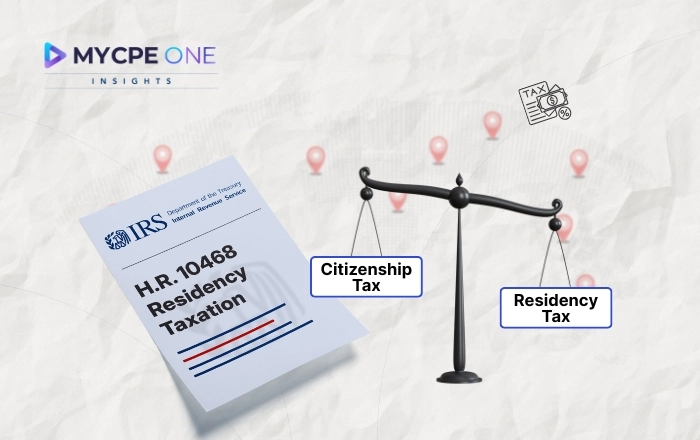
For over a century, Americans living overseas have been stuck in a tax nightmare that makes “Groundhog Day” look like a dream. Since the Civil War era, the U.S. has taxed citizens based on citizenship, not residency, a system shared only by one other country, Eritrea. Back then, it was about making sure rich Americans abroad chipped in for wartime funding. But in 2025’s globally mobile economy, that logic feels as outdated as a fax machine. Now, a growing number of former IRS leaders are saying it is time to end that double tax burden and move toward a fairer, more modern system called residency-based taxation (RBT).
This citizenship-based taxation (CBT) system dates back to the Civil War era, when the government wanted to ensure wealthy Americans abroad contributed to wartime funding. In today’s globally mobile world, that logic feels like a relic from another age. Under CBT, Americans abroad must file U.S. tax returns and report global income, even when they’ve already paid full taxes in their country of residence. The 2010 Foreign Account Tax Compliance Act (FATCA) only made things worse, requiring foreign banks to report U.S. account holders or face stiff penalties. Many banks simply refused to serve American clients, locking them out of mortgages, retirement products, or even checking accounts.
Former IRS leaders Charles Rettig and Tom Cullinan have called this system “a matter of fairness.” They emphasize that Americans abroad aren’t tax dodgers but “ambassadors” who deserve to compete and live globally without unnecessary penalties. Advocacy groups like American Citizens Abroad and Tax Fairness for Americans Abroad have been pushing for reform for decades, and now, momentum is building.
In a notable shift, several prominent IRS veterans, including Rettig, Cullinan, and former National Taxpayer Advocate Nina Olson, have publicly endorsed the move toward residency-based taxation. Their message is simple: the current system is outdated, inefficient, and unfair. Their endorsement supports Representative Darin LaHood’s landmark proposal, the Residence-Based Taxation for Americans Abroad Act (H.R. 10468). Introduced in late 2023 and gaining traction in 2025, the bill would let qualifying Americans living overseas elect to be treated as nonresidents for U.S. tax purposes, meaning they’d pay tax only on U.S.-source income.
To qualify, taxpayers must certify five years of U.S. tax compliance and prove foreign residency. The IRS would then issue a Certificate of Nonresidency, freeing them from FATCA and other redundant filing requirements. For many, that could finally restore access to normal banking abroad. The proposal also includes a departure tax for high-net-worth individuals (assets exceeding $13.99 million in 2025) to prevent abuse, alongside exemptions for long-term residents abroad. According to Rettig and Cullinan, the reform would “modernize America’s outdated approach” while maintaining fairness and compliance safeguards. The bill has gained rare bipartisan interest and the support of tax experts like Nina Olson, former National Taxpayer Advocate, who has long argued that RBT is both fair and necessary to reflect global realities.
If enacted, RBT could change the lives of nearly nine million Americans living abroad. Teachers in Tokyo, entrepreneurs in Berlin, and retirees in Portugal would all finally escape double taxation and the costly maze of annual compliance. Even the IRS would benefit. By no longer monitoring already compliant taxpayers overseas, it could focus enforcement on genuine domestic noncompliance, cutting administrative costs and improving efficiency. Critics warn of modest short-term revenue losses, but proponents argue that over time, simplified compliance and voluntary participation could boost long-term revenue. Former non-filers might even rejoin the system once the burden lifts.
The biggest winners would include:
High-net-worth individuals with significant U.S.-sourced income would still be liable for taxes on that income. Congress will likely include guardrails to prevent anyone from claiming foreign residency purely to dodge taxes.
Under the current regime, an American living in Singapore or Berlin must file a full Form 1040, claim foreign tax credits (Form 1116), possibly use Form 2555 for the foreign earned income exclusion, and comply with FATCA and FBAR reporting. RBT would simplify this dramatically. If an individual meets residency criteria, they would no longer need to file a U.S. return unless they earn income from U.S. sources. FATCA obligations would shrink or vanish entirely, lifting the burden for both taxpayers and foreign banks. Compliance costs could drop by thousands of dollars per household each year. For the first time in generations, filing from abroad might feel straightforward and fair.
If RBT becomes law, tax and accounting professionals will play a crucial role in guiding Americans abroad through this transition. Here’s how they can prepare:
For CPAs and enrolled agents, this is a chance to build trust and expand their advisory footprint in the global marketplace.
Residency-based taxation isn’t just a policy update; it’s a moral correction. It acknowledges that Americans living overseas aren’t tax evaders but global professionals contributing to both their local economies and America’s reputation abroad. As former IRS leaders noted, this reform is about fairness, efficiency, and modernization. If Congress follows through, the United States could finally align with the rest of the developed world, and millions of Americans could stop choosing between their citizenship and their financial sanity.
Get Your CPE Credit From Here
Until next time…
Don’t forget to share this story on LinkedIn, X and Facebook
Subscribe now for $199 and get unlimited access to MYCPE ONE, from CPE credits to insights Magazine
📢MYCPE ONE Insights has a newsletter on LinkedIn as well! If you want the sharpest analysis of all accounting and finance news without the jargon, Insights is the place to be! Click Here to Join
Transforming Finance & Accounting Operations for Enterprises!
We help 100+ clients streamline F&A operations with our full-suite outsourcing services—eliminating the need for in-house teams. Partner with us for Top-tier finance & accounting talent, Cutting-edge technology, and World-class infrastructure.
Our Full-Suite F&A Services Include:
We collaborate with CPA and accounting firms to drive real business value.
Schedule a no-obligation discovery callYou’ve reached the 3 free-content piece limit. Unlock unlimited access to all News & CPE resources.
Subscribe Today.
Already have an account?
Sign In