Join 250,000+
professionals today
Add Insights to your inbox - get the latest
professional news for free.
Join our 250K+ subscribers
Subscribe19 MAY 2026 / ACCOUNTING & TAXES
Governor Gavin Newsom has proposed that California begin taxing cloud-based software and digital services, aiming to generate billions in state revenue. The initiative could impact the bottom line of SaaS companies, CFOs, finance teams, and digital service firms alike, as they grapple with the potential added tax responsibility in an already complex compliance environment.
Buying software in California may soon feel a little like ordering stadium beer in the seventh inning. You knew it would cost a lot, but the final number still makes you blink twice. Governor Gavin Newsom wants California to start taxing cloud-based software and digital services, aiming to pull billions into state coffers while Silicon Valley rides the AI money train straight into the stratosphere. For CFOs, tax pros, SaaS companies, and finance teams already juggling inflation, compliance headaches, and AI spending, this one deserves a closer look. And yes, Sacramento is once again betting big on tech cash. What could possibly go wrong?
Sort of.
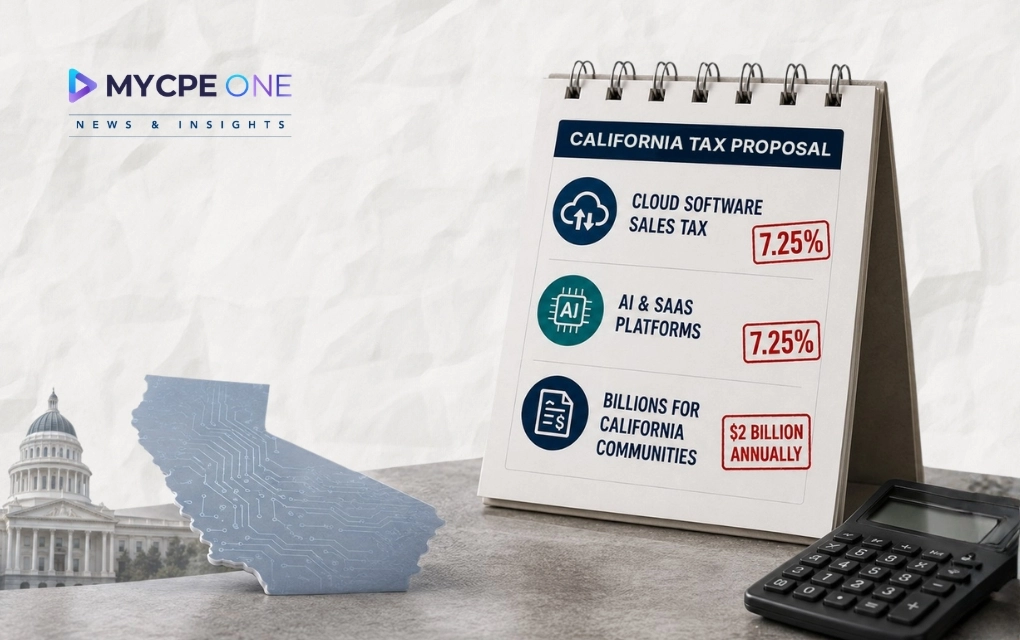
California already taxes prewritten software sold with physical products or transferred through tangible property. Buy software at Best Buy? Sales tax applies. Download similar software online? Not so much. Newsom says that gap no longer makes sense. During his May budget revision press conference, he joked about paying tax at Best Buy while others download software tax-free from home. His proposal would apply California’s 7.25% base sales tax, plus local add-ons in many areas, to cloud-based software transactions. That means SaaS subscriptions, enterprise cloud tools, AI platforms, and certain digital business services could soon cost more across the board.
Microsoft, Oracle, Salesforce, and AI-heavy firms are all sitting in the splash zone here. Streaming services like Netflix appear excluded for now, which probably saved a few dinner-table arguments in Los Angeles.
California’s updated budget suddenly looks healthier than expected. Revenue came in $16.5 billion above projections, largely thanks to personal income tax collections tied to soaring capital gains and tech wealth. Translation? AI mania is printing money for California. The state says $13.6 billion of the surplus came from personal income taxes alone, with massive April cash receipts tied to stock gains and wealthy taxpayers cashing in. Sacramento is also eyeing future IPOs from OpenAI, Anthropic, and SpaceX like a fantasy football manager watching waiver wire updates. If even one of those IPOs lands big, California could collect a serious haul in capital gains taxes.
Still, economists are waving a yellow flag. California’s Legislative Analyst’s Office warned the stock market may be drifting into speculative bubble territory, comparing current conditions to the dot-com era and even the Roaring Twenties. That’s not exactly calming language for budget planners.
The proposed software tax is expected to raise about $1.1 billion in the upcoming budget year and roughly $2 billion annually afterward. That’s real money, especially as cities and counties brace for federal funding pressure and long-term deficits. But businesses are already asking the obvious question: who actually eats this cost? Will SaaS companies absorb it? Pass it through? Split it with customers? Add “regulatory recovery fees” nobody understands? You know the drill.
For accounting and finance teams, this creates another layer of sales tax complexity in an area already messier than airport Wi-Fi. Multi-state SaaS taxation has been a headache for years because states treat digital products differently. Some tax software-as-a-service. Some don’t. Some partially tax it. Some make auditors feel like they need aspirin and a walk outside. California joining the club could push other holdout states to rethink their rules too. That’s the part many finance leaders are quietly watching.
Newsom’s proposal arrives while California lawmakers are also fighting over a possible billionaire tax initiative that may appear on the November ballot. That debate has turned into a full-on family Thanksgiving argument among Democrats. Some want the ultra-wealthy to pay more as AI fortunes explode. Others worry California already relies too heavily on high earners and risks pushing wealthy residents elsewhere. Google co-founder Sergey Brin reportedly opposes the billionaire tax idea. Former Representative Katie Porter has raised concerns too. Billionaire Tom Steyer, meanwhile, said he’d support it if voters get the chance.
Meanwhile, the California Chamber of Commerce is basically saying, “Can we all chill for a second before adding more taxes?” Business groups argue lawmakers should wait until broader tax and policy fights settle down before piling on new measures. Fair point. Companies already face uncertainty around AI regulation, labor costs, interest rates, and federal policy changes. Tossing digital taxes into the mix could make budget forecasting feel like trying to predict gas prices before a holiday weekend.
This proposal is not just about software taxes. It’s about California trying to future-proof a budget that depends heavily on wealthy taxpayers, capital gains, and tech optimism. Newsom is effectively saying: if AI and cloud software are becoming the backbone of modern business, California wants a larger cut of the transaction flow. The irony? The same AI boom rescuing California’s budget is also exposing how fragile that budget can become when markets swing. That leaves tax professionals, CFOs, and controllers in familiar territory: preparing for rules that are still moving while leadership asks for “quick projections by Friday.” Classic. The proposal still faces negotiations before California’s fiscal year begins July 1. So, nothing is locked yet. But one thing feels pretty clear already: the era of lightly taxed digital growth may be starting to close shop, at least in California.
Until next time…
Don’t forget to share this story on LinkedIn, X and Facebook
Subscribe now for $199 and get unlimited access to MYCPE ONE, from CPE credits to insights Magazine
📢MYCPE ONE Insights has a newsletter on LinkedIn as well! If you want the sharpest analysis of all accounting and finance news without the jargon, Insights is the place to be! Click Here to Join
You’ve reached the 3 free-content piece limit. Unlock unlimited access to all News & CPE resources.
Subscribe Today.
Already have an account?
Sign In