MYCPE ONE
MYCPE ONE LOGO

Join 250,000+
professionals today

Add Insights to your inbox - get the latest
professional news for free.

MYCPE ONE insights

Trump’s $10B IRS Settlement and the Mystery of Audit Exemptions

Join our 250K+ subscribers

Join our 250K+ subscribers

Subscribe

20 MAY 2026 / ACCOUNTING & TAXES

Trump’s $10B IRS Settlement and the Mystery of Audit Exemptions

Trump’s $10B IRS Settlement and the Mystery of Audit Exemptions

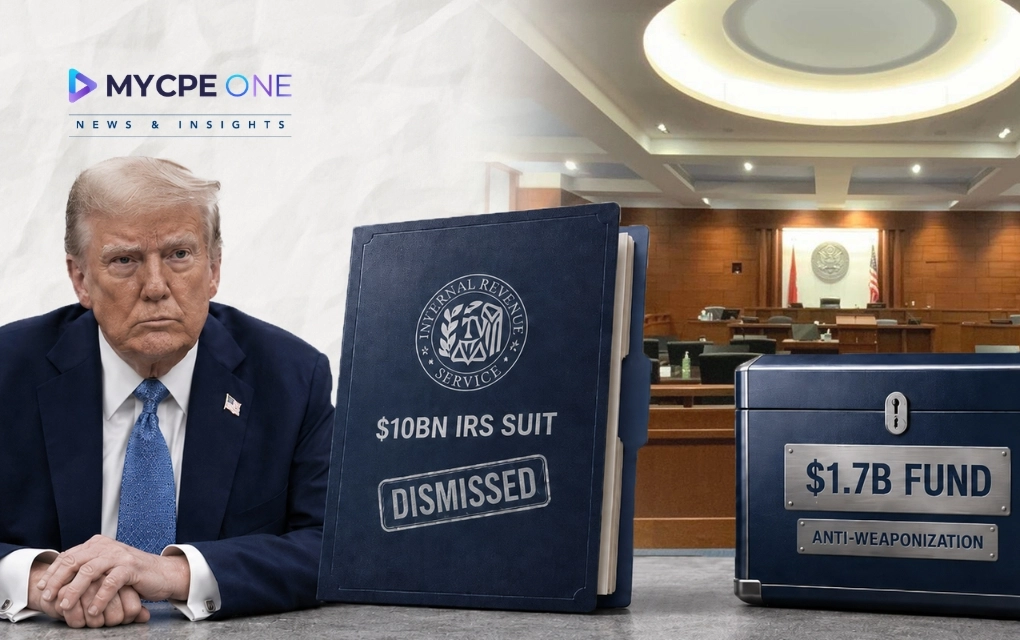
A $10 billion IRS lawsuit was already one of the most unusual legal battles in modern Washington. But what happened next turned it into something far bigger than a dispute over leaked tax returns. President Donald Trump has now dropped the case, while the Justice Department is rolling out a new “anti-weaponization” compensation fund worth roughly $1.7 billion to $1.776 billion. What began as a tax privacy lawsuit has evolved into a broader debate about government accountability, executive authority, and how future administrations may respond to claims of political targeting. Supporters see the move as an effort to address alleged misuse of federal power. Skeptics' see serious constitutional and ethical questions about how taxpayer money could be used. Either way, the story has quickly moved beyond the IRS itself.

How This Whole Story Started

The case traces back to the 2019 leak of Donald Trump’s confidential tax information by former IRS contractor Charles Littlejohn. The leak exposed tax data tied not only to Trump, but also to other wealthy individuals including Elon Musk, Jeff Bezos, and Ken Griffin. Littlejohn later pleaded guilty and received a five-year prison sentence for unlawfully disclosing taxpayer records. Trump, along with members of his family and Trump Organization entities, responded by filing a $10 billion lawsuit against the IRS earlier this year. The lawsuit argued that the agency failed to properly protect private taxpayer information and caused major financial and reputational harm.

At its core, the lawsuit focused on taxpayer privacy and government responsibility. But the situation became more complicated once Trump returned to office because the IRS and the Justice Department both operate under the executive branch he now leads. That immediately raised questions about whether the case could proceed normally in federal court.

Why Trump Decided to Drop the Lawsuit

The timing of the dismissal appears closely tied to growing legal scrutiny around the case itself. Judge Kathleen Williams, who oversaw the lawsuit in Florida, had asked both sides to explain whether the court even had jurisdiction to hear the dispute. Legal experts appointed to advise the court described the situation as highly unusual because the president effectively controlled both the plaintiff side and the government agencies defending the lawsuit. Federal courts generally require a genuine legal conflict between opposing parties. That requirement became harder to define once Trump returned to office. Rather than continue toward a potentially difficult constitutional ruling, Trump’s legal team chose to dismiss the lawsuit and move toward a broader settlement arrangement with the Justice Department.

That shift also allowed the administration to frame the issue in a wider context. Instead of focusing only on leaked tax records, the administration repositioned the matter as part of a larger conversation about alleged government “weaponization” during prior administrations. Acting Attorney General Todd Blanche described the move as an effort to ensure that: “The machinery of government should never be weaponized against any American.” That message now sits at the center of the administration’s broader strategy.

The New “Anti-Weaponization” Fund Explained

As part of the agreement, the Justice Department announced plans to establish an “anti-weaponization” fund valued at approximately $1.776 billion. According to the administration, the fund would compensate individuals who believe they were unfairly targeted by previous government actions, investigations, prosecutions, or enforcement decisions. The exact structure is still being finalized, but reports indicate the fund may be overseen by commissioners appointed largely through the attorney general’s office. Claims would reportedly be evaluated based on evidence, legal circumstances, and other factors deemed appropriate by the fund administrators. The administration has stated that Trump himself will not personally receive money from the fund, though he may receive a formal apology tied to the original IRS leak. Still, the proposal has triggered strong reactions across Washington.

Democrats and watchdog organizations argue that the arrangement raises concerns about oversight, transparency, and the use of taxpayer funds. Some legal experts have also questioned whether the executive branch should have broad authority to oversee compensation tied to politically sensitive disputes. Supporters of the plan, meanwhile, argue that individuals who were improperly targeted by government agencies deserve a formal path for compensation and review.

This Is Bigger Than One IRS Case

What makes this situation especially important is how quickly it expanded beyond tax enforcement. The Trump administration has repeatedly argued that federal agencies were used unfairly against conservatives during prior administrations. That broader political argument now provides the foundation for the new compensation framework.

The fund could potentially involve claims tied to a wide range of investigations and disputes, including matters connected to Jan. 6 defendants, former administration officials, whistleblowers, and others who allege political targeting. That possibility is why legal scholars and government watchdogs are paying such close attention.

The debate is no longer simply about whether Trump’s tax returns were improperly leaked. It is now about how government accountability should work when political disputes become tied to federal compensation systems. For financial professionals, attorneys, and compliance experts, this development matters because it touches directly on public trust in federal institutions.

Uncle Sam Also Hit Pause on Trump’s Tax Disputes

One of the biggest developments in the settlement received less attention than the compensation fund itself. Under a separate agreement signed by Acting Attorney General Todd Blanche, the IRS reportedly agreed to stop pursuing certain “known and unknown” tax claims, audits, and related actions tied to Trump before the settlement date. That represents a major legal victory for Trump against an agency he has publicly criticized for years over audits and investigations into his finances. Critics argue the agreement raises concerns about the independence and neutrality of tax enforcement, especially because the settlement was reached while Trump oversees the executive branch agencies involved. Supporters counter that the agreement helps close a long-running cycle of politically charged investigations and legal battles. Either way, it adds another layer to an already historic case.

Is This Kind of IRS Protection Normal? 

One of the biggest questions now surrounding the settlement is whether this type of protection from IRS enforcement has ever been granted before. Public reporting suggests the answer is largely no. There is no standard legal category that gives taxpayers broad immunity from IRS audits or future tax claims. Even sitting presidents have historically remained subject to annual IRS review under internal agency policy. 

That is why the Trump arrangement is drawing so much scrutiny. Legal experts say the agreement appears less like a traditional tax settlement and more like a DOJ-driven restriction tied to claims of political targeting and unlawful disclosure of confidential tax records. Critics warn it could weaken confidence in the independence of federal tax enforcement, while supporters argue it closes a politically charged chapter stretching across multiple administrations.

Could This Deal Affect State Revenue or Face Legal Challenges?

The potential financial impact may extend beyond the federal government. Many states rely on federal tax findings when calculating their own tax assessments and collections. If federal audits or adjustments never move forward, states could lose opportunities to collect additional revenue tied to those filings. Tax professionals say the ripple effects could eventually reach state budgets as well.

Legal analysts also note that the arrangement may not be untouchable. Settlement-based protections can still face challenges if courts determine they exceeded executive authority, violated public policy, or conflicted with federal tax law. Allegations involving fraud, omitted income, or unauthorized government action could also reopen scrutiny later, leaving the long-term durability of the agreement uncertain. 

The IRS Faces Another Challenge

The IRS has already spent years dealing with criticism over audits, enforcement priorities, staffing concerns, and political scrutiny from both parties. This case adds another layer of pressure. The agency suffered a major reputational setback after the Littlejohn leak exposed confidential taxpayer information belonging to thousands of Americans. Now, the settlement surrounding Trump’s lawsuit raises fresh questions about how politically sensitive cases involving tax enforcement should be handled in the future.

The broader concern for many tax professionals is institutional confidence. The U.S. tax system depends heavily on public trust, voluntary compliance, and the perception that enforcement decisions remain independent from political influence. Any development that weakens confidence in that neutrality can have long-term consequences for the broader tax system.

What Comes Next

Even though the lawsuit is being dismissed, the debate around the new compensation fund is just beginning. Lawmakers, watchdog groups, and legal experts are already questioning how the fund will operate and whether it could face constitutional challenges in court. At the same time, the administration is continuing to push its broader argument that certain federal investigations unfairly targeted conservatives. That means this case could shape future discussions around executive authority, government accountability, and how taxpayer-funded compensation programs are handled in politically sensitive situations. What started as a tax-return leak dispute has now become part of a much larger national conversation about the limits of government power.

Until next time…

Don’t forget to share this story on LinkedIn, X and Facebook

Subscribe now for $199 and get unlimited access to MYCPE ONE, from CPE credits to insights Magazine

📢MYCPE ONE Insights has a newsletter on LinkedIn as well! If you want the sharpest analysis of all accounting and finance news without the jargon, Insights is the place to be! Click Here to Join

Unlock Annual Access to News & CPE Subscription

You’ve reached the 3 free-content piece limit. Unlock unlimited access to all News & CPE resources.
Subscribe Today.

News & Updates

  • Exclusive News & Insights
  • Latest Regulatory Updates
  • Accounting Industry Trends
  • Expert Insights
  • AI-Driven Audio & Summaries
  • Infographics & Videos
  • CPE-Approved Articles
  • Digital Magazine
  • Benchmarking Blogs

Unlimited CPE Access for 1 Year

  • 15,000+ Hours of Content
  • 500+ Subject Areas
  • Mandatory Ethics Courses
  • 250+ Compliance Packages
  • 50+ Virtual Conferences and Events Access
  • Format: Live, Audio, Video, E-Books
  • Audio Based Courses & Podcasts
  • Add External Certificates with AI
  • AI Compliance Tracking and Report
  • Instant Certification and Fast Reporting
  • Mobile App Access (iOS and Android)
  • Dedicated Support System
  • Practical Training Programs
  • AI Academy Access
  • Tax Academy Access
  • Audit Academy Access
  • Leadership Academy Access