Join 250,000+
professionals today
Add Insights to your inbox - get the latest
professional news for free.
Join our 250K+ subscribers
Subscribe03 SEP 2025 / ACCOUNTING & TAXES
CPE Approved
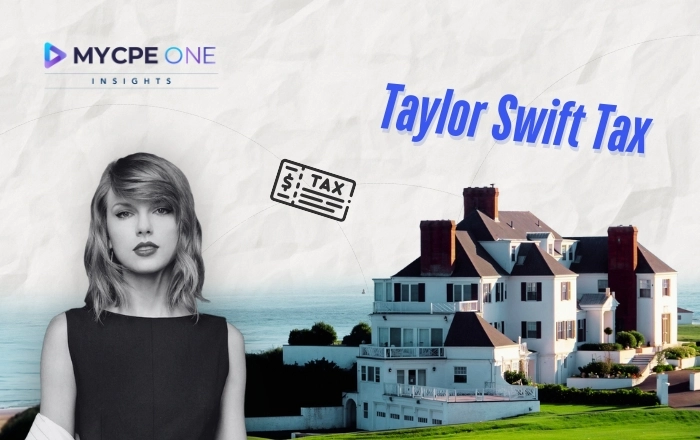
The so-called "Taylor Swift Tax," a surtax on luxury second homes initially enacted in Rhode Island, is spreading across the US, affecting celebrities and high-net-worth individuals. This development, named after Taylor Swift's $17 million Rhode Island mansion, highlights states' attempts to generate income by capitalizing on high-end real estate, with implications for accountants, brokers, and wealthy clients.
Taylor Swift has already rewritten the record books with her Eras Tour, her re-recorded albums. Now she’s unwittingly lending her name to a new hit: the “Taylor Swift Tax,” a surtax on luxury second homes that’s spreading faster than a chart-topping single. Rhode Island coined it, Montana remixed it, and California threw in a bonus track. The result? A coast-to-coast earworm that’s giving accountants, brokers, and high-net-worth clients a serious case of déjà vu: every time they think the bill is settled, the chorus drops again.
In July 2013, Taylor Swift closed High Watch, a seven-bedroom, 11,000-square-foot mansion perched above the Atlantic in Watch Hill, Rhode Island. The price tag was $17 million, about 1 % of the fortune she would later build off 1989, Folklore, Midnights, and the record-smashing Eras Tour. At the time, Rhode Island simply levied its standard 1.2 % annual property tax on the assessed value. Even at the 2013 assessment of $18 million, the bill was a manageable $216 k for a singer whose catalog and touring machine were just warming up.
Fast-forward twelve years. Swift’s net worth now sits at $1.6 billion, built almost entirely on her songs and performances. Her real-estate ledger, roughly $120 million across Nashville, New York, Beverly Hills, and Rhode Island, is a rounding error in comparison. Yet the $28 million current assessment on High Watch has turned the house into Exhibit A for lawmakers who see second-home owners as untapped ATMs.
Rhode Island’s Non-Owner Property Tax Act, signed in June 2025 and effective in 2026, adds $2.50 per $500 of assessed value above the first $1 million for any non-primary residence. On High Watch, that translates to an extra $136,442 on top of the existing $ 201,000 base bill, for an annual total of $337,442. The state expects to receive roughly $37 million annually from an estimated 5,000 affected properties, earmarked for low-income housing tax credits and first-time buyer grants.
Copycats are already on the set list:
Los Angeles’ 2022 “mansion tax” on sales of $5 million or more was a rehearsal: projected at $1 billion a year, it has delivered only $785 million over two-plus years as luxury deals stalled. Brokers from Bozeman to Watch Hill say buyers are “waiting for the dust to settle” before signing contracts, code for shopping in Connecticut, Florida or any ZIP code without the surcharge.
Tax economists see three plausible encores:
Swift herself is unlikely to lose sleep. Her upcoming album, “The Life of a Showgirl”, drops this fall, and industry chatter suggests another stadium leg could add another half-billion to her already historic $2.3 billion touring haul. Even paying the new Rhode Island surtax, her effective tax rate on the property is a fraction of one basis point of her net worth. As she wrote on Folklore’s “The Last Great American Dynasty,” “I had a marvelous time ruining everything.” State lawmakers are simply remixing the line.
Model the all-in cost: A $3 million beach shack can rack up $60 k base tax plus $45 k surtax plus a 0.75 percent transfer levy at sale. Run ten-year cash flows before the client brags about the sunset view.
The “Taylor Swift Tax” isn’t really about one superstar’s beach house; it’s a proof-of-concept for turning high-end real estate into a recurring revenue stream. States have watched the L.A. mansion tax underperform, seen Montana buyers hit pause, and still hit replay, because the politics of taxing “someone else’s beach palace” poll better than budget cuts or broad-based hikes. Swift can afford the new tab; most clients cannot. The next time a legislature needs a headline, it won’t borrow a lyric; it’ll borrow the whole song. Make sure your client’s balance sheet isn’t the chorus. Stay ahead of the Swift Tax ripple, subscribe to our newsletter, and get sharp tax insights delivered before the next bill drops.
Until next time…
Don’t forget to share this story on LinkedIn, X and Facebook
Subscribe now for $199 and get unlimited access to MYCPE ONE, from CPE credits to insights Magazine
📢MYCPE ONE Insights has a newsletter on LinkedIn as well! If you want the sharpest analysis of all accounting and finance news without the jargon, Insights is the place to be! Click Here to Join
Website Services for CPA & Accounting Firms - Starting $69/month.
Is your website attracting clients—or turning them away? MYCPE ONE’s Website Development Services, starting at just $69/month, create high-converting, professional websites tailored for accounting firms like yours.
With over 400 designs to choose from and a dedicated webmaster, we handle it all for you—no DIY required.
Get started today and create a website that works for your firm with MYCPE ONE!
Make a lasting impression. Boost conversions. Stay secure.
You’ve reached the 3 free-content piece limit. Unlock unlimited access to all News & CPE resources.
Subscribe Today.
Already have an account?
Sign In