Join 250,000+
professionals today
Add Insights to your inbox - get the latest
professional news for free.
Join our 250K+ subscribers
Subscribe04 JUN 2026 / ACCOUNTING & TAXES
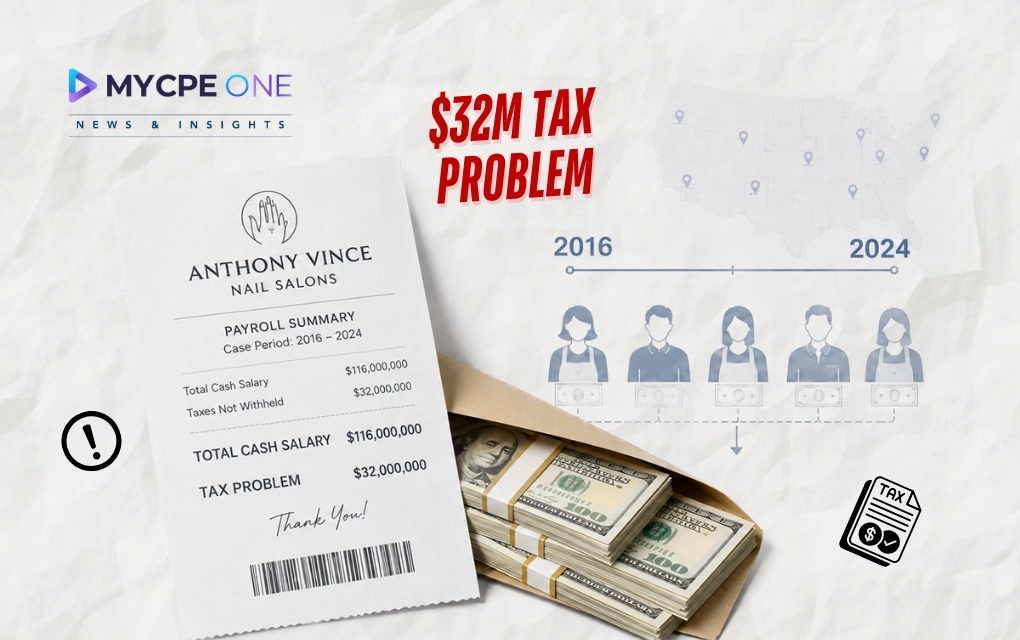
Texas residents Vinh Q. Ho and Thanh Lan Do pleaded guilty to tax crimes tied to their nationwide salon business, which included more than 60 high-end nail salons and resulted in an estimated $32 million in tax loss. Prosecutors claim the business paid over $116 million in cash compensation from 2016 through 2024 that was never reported on worker tax forms, with the duo training salon managers to run this under-the-table cash payroll.
A nail salon receipt usually tells a simple story: polish, tip, maybe a little regret over choosing neon green. Federal prosecutors say this one told a much bigger story, one involving more than 60 salons, years of hidden cash payroll, and at least $32 million in estimated tax loss. Vinh Q. Ho, 53, and Thanh Lan Do, 34, both Texas residents, pleaded guilty to tax crimes tied to a nationwide salon business operating under Anthony Vince Nail Salons, Prive Nail Spas, and Zen Nail & Spas. According to prosecutors, the business paid more than $116 million in cash compensation from 2016 through 2024 that never made it onto worker tax forms. That is not a bookkeeping oops. That is a full-on paper trail problem.
Ho, described by prosecutors as the de-facto CEO, and Do, who oversaw salon management, operated more than 60 high-end nail salons across the United States. A significant portion of nail technicians’ compensation was paid in cash. At year-end, the business prepared tax forms reporting technician compensation, but those forms left out the cash pay. The result? False Forms 1099, understated worker income, and a payroll system that looked cleaner on paper than prosecutors say it actually was.
The government also said Ho and Do trained salon managers to run the under-the-table cash payroll and instructed employees to keep the real payroll hidden. That detail matters. This was not framed as one location going rogue or one manager making a bad call after a long Tuesday. Prosecutors described a system. Ho also pleaded guilty to tax evasion for underreporting income on his 2020 and 2021 individual tax returns. So, the case was not just about worker reporting. It also reached his personal filings. As the old accounting saying goes, “Cash is king.” In tax enforcement, cash is also a giant red flag when controls are weak, records are thin, and tax forms do not match economic reality.
According to Do’s plea agreement, the salons paid more than $116 million in unreported cash compensation during that period. Prosecutors estimated the actual tax loss at at least $32 million. For perspective, that is not a missing petty cash envelope. That is enough money to turn a payroll issue into a criminal tax case with serious prison exposure. Both defendants pleaded guilty to conspiracy to defraud the United States. Ho also pleaded guilty to tax evasion. Ho faces a maximum penalty of 10 years in prison, while Do faces up to five years. Sentencing will come later, and a federal judge will weigh the U.S. Sentencing Guidelines and other statutory factors.
So, what changed from past to present? The business allegedly ran a cash payroll system for years. Now the guilty pleas have shifted the story from investigation to accountability. The next major chapter is sentencing.
For accountants, tax advisers, payroll specialists, and finance teams, this case is a reminder that cash-heavy businesses need more than a tidy P&L and a friendly smile.
This is where strong internal controls earn their keep. Daily cash reconciliations, payment logs, clear worker classification reviews, owner distribution tracking, and independent payroll reviews are not just admin chores. They are the seatbelts.
The future of this case will likely turn on sentencing, restitution, and whether prosecutors pursue related parties or additional compliance fallout. The plea agreements already lock in the central story: a nationwide salon operation concealed substantial cash compensation from the IRS over several years. For the broader market, the message is simple. The IRS and DOJ continue to look closely at cash-intensive service businesses, especially when payroll reporting appears incomplete or coordinated across multiple locations. A manicure should last two weeks. A bad payroll scheme can last years, right up until federal prosecutors start reading the receipts.
Until next time…
Don’t forget to share this story on LinkedIn, X and Facebook
Subscribe now for $199 and get unlimited access to MYCPE ONE, from CPE credits to insights Magazine
📢MYCPE ONE Insights has a newsletter on LinkedIn as well! If you want the sharpest analysis of all accounting and finance news without the jargon, Insights is the place to be! Click Here to Join
You’ve reached the 3 free-content piece limit. Unlock unlimited access to all News & CPE resources.
Subscribe Today.
Already have an account?
Sign In