Join 250,000+
professionals today
Add Insights to your inbox - get the latest
professional news for free.
Join our 250K+ subscribers
Subscribe22 JUN 2026 / ACCOUNTING & TAXES
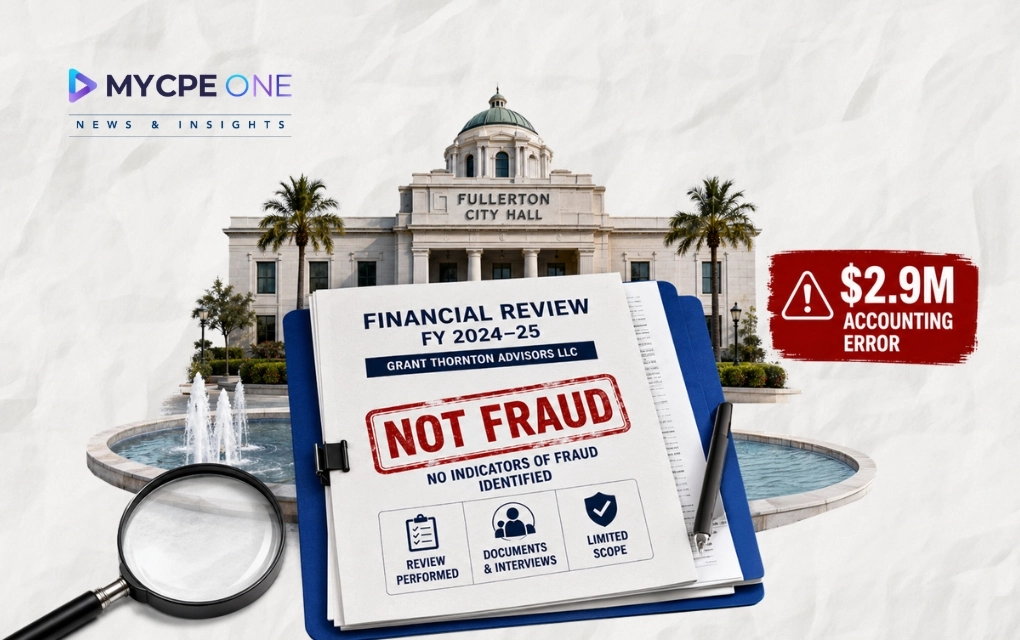
Independent auditors from Grant Thornton Advisors LLC found that Fullerton’s $10 million reserve controversy stemmed from weak oversight, poor budget presentation, and an accounting error rather than fraud. The firm's review revealed a series of control failures, inadequate reporting, and governance issues within the city’s budgeting process.
A city budget can look healthy until someone asks one basic question: “Can we reconcile that number?” That question now sits at the center of Fullerton’s $10 million reserve controversy. An independent review by Grant Thornton Advisors LLC found that the city’s depleted unassigned fund balance and $2.9 million accounting error came from weak oversight, poor budget presentation, and accounting mistakes, not fraud. That sounds reassuring. It also raises the more important issue: Fullerton’s finances did not need fraud to create public confusion. Basic controls, clean reporting, and experienced review should have caught the problem earlier.
Grant Thornton found no indicators of fraud or intentional misconduct. But the firm also made clear it was not hired to conduct a fraud investigation or forensic review. That distinction matters. A limited financial review can say what its procedures found. It cannot answer every question about motive, intent, or broader misconduct. Council Member Ahmad Zahra pressed that point directly, asking how the firm could rule out fraud indicators without investigating fraud itself. Grant Thornton’s answer was narrow: based on the documents, communications, interviews, and transactions reviewed, the issues pointed to accounting treatment and governance failures, not intentional wrongdoing. For CPAs and auditors, that is the key takeaway. “No fraud indicators found” is not the same as a forensic clean bill of health.
The $2.9 million issue came from property tied to Fullerton’s former redevelopment agency. When city staff recorded the transfer into the General Fund, they did not use the proper interfund accounting treatment. Instead of using “due to/from” accounts, the entries moved through a claims on cash account and ultimately affected fund balance. That overstated the General Fund’s fund balance and claims on cash by $2.9 million. Staff later tried to reverse the entry, but the correction did not fully fix the fund balance impact. The error remained until the FY 2025 external audit caught it. That is not a Hollywood fraud plot. It is a journal entry problem that survived too many review points.
Grant Thornton found that the roughly $10 million unassigned fund balance depletion came from several factors: a $7.4 million operating deficit, $4.5 million in net transfers out of the General Fund, the $2.9 million correction, and about $2.8 million reclassified into assigned, committed, or restricted categories. The biggest driver was the planned deficit. That is where the budget presentation becomes the real issue. The FY 2024 to 2025 budget included a planned deficit above $9.4 million, but the materials did not make the fund balance impact clear enough. Beginning fund balance did not cleanly reconcile to audited financials. A $5 million road maintenance reserve had not been properly classified. Transfers mixed with operating results, making the General Fund’s true performance harder to read.
In plain English: the money was not missing, but the reporting made it hard to see what was actually available.
Grant Thornton recommended hiring a qualified CFO or chief accountant with governmental accounting experience, creating a finance oversight committee, standardizing interfund accounting, improving budget presentation, and using regular fund balance roll forwards. That is not window dressing. It is basic financial governance. Government accounting is not something a city can run on vibes and late corrections. Fund balance classifications, interfund transfers, restricted resources, and prior period adjustments need experienced eyes. Fullerton also faced turnover in key finance and city leadership roles. That matters because turnover weakens institutional memory. When no one fully owns the numbers, mistakes sit longer, reports get murkier, and trust takes the hit.
Fullerton’s case shows how financial credibility can break without fraud. For auditors, scope language must stay precise. For CFOs and controllers, fund balance rollforwards and reconciliations cannot wait until year end. For public finance teams, budget documents must show what money is unrestricted, what money is already spoken for, and what operating deficit is eating into reserves. A budget can be technically assembled and still fail its audience. Fullerton’s problem was not stolen money. It was weak reporting discipline, thin oversight, and a budget process that did not make the city’s financial position clear enough. Fraud gets the headline. Poor controls do the quieter damage.
Until next time…
Don’t forget to share this story on LinkedIn, X and Facebook
Subscribe now for $199 and get unlimited access to MYCPE ONE, from CPE credits to insights Magazine
📢MYCPE ONE Insights has a newsletter on LinkedIn as well! If you want the sharpest analysis of all accounting and finance news without the jargon, Insights is the place to be! Click Here to Join
You’ve reached the 3 free-content piece limit. Unlock unlimited access to all News & CPE resources.
Subscribe Today.
Already have an account?
Sign In