
Join 250,000+
professionals today
Add Insights to your inbox - get the latest
professional news for free.
Join our 250K+ subscribers
Subscribe17 NOV 2025 / ACCOUNTING & TAXES
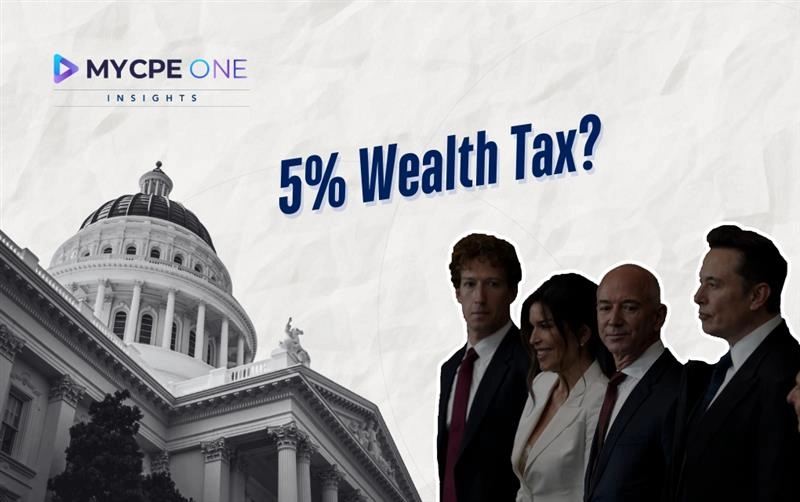
California labor leaders have proposed the 2026 Billionaire Tax Act, which envisions a one-time 5% tax on the wealth of Californians worth more than $1 billion. This plan aims to bridge the gap in health care and education spending caused by federal cuts, but skepticism remains about the feasibility and repercussions of the act, including potential wealthy taxpayer migration.
Mark Zuckerberg probably didn’t pencil this into his 2026 planner. One minute you’re juggling a few metaverse goggles, the next the state you call home floats a one-time 5 percent tax on your net worth. Imagine opening your mail and seeing a bill with ten zeroes. Even wealthy people would spill their cold brew over that one. But California’s new idea isn’t about drama. It’s about plugging a hole the size of a football field in health care and education spending. The question bouncing around Sacramento right now: can tapping 200 billionaires fix it or spark a stampede toward private jets headed east?
Here’s the pitch in simple terms. Labor leaders filed the 2026 Billionaire Tax Act to charge a one-time 5 percent tax on the wealth of Californians worth more than $1 billion. Wealth, not income. That means stocks, business stakes, bonds, collectibles, and even intellectual property. Real estate is mostly exempt, and retirement accounts are off the table. Still, the reach is wide. Supporters say this isn’t some vague wishlist. The math is right there. California has roughly 200 billionaires holding close to 2 trillion dollars. A 5 percent tap on wealth above the thresholds could raise about 100 billion dollars spread over five years. Ninety percent would patch health care spending gaps. Ten percent would support education budgets hammered by federal grant cuts.
And the push is not random. California expects to lose about 30 billion dollars a year in Medicaid funding thanks to recent federal cuts under President Trump. That’s the kind of hit that keeps state budget analysts up at night. SEIU-UHW, the union behind the measure, argues this tax is the only way to stop millions from losing Medi-Cal access. As one organizer put it, without the money, the health system could break. Not bend. Break.
California’s billionaire club isn’t exactly short on cushion. Four of the world’s richest tech names, including Zuckerberg, Jensen Huang, Larry Page and Sergey Brin, hold more than 840 billion dollars combined. If the measure passed, they could owe around 40 billion dollars collectively. To put that in perspective, Zuckerberg alone owns more homes in Palo Alto than most people have sets of house keys. Supporters say the tax won’t change billionaires’ lifestyles. They’ll still have their Gulfstreams, their ranches, their island vacations. The idea is simple: a 5 percent skim is barely a mosquito bite inside a fortune that grows by billions when the market has a good Tuesday. But will they stay put and pay or take a page from Elon Musk’s book and hit the freeway toward Texas? That’s the billion-dollar question.
Skeptics warn that this plan comes with complications. A big one is valuation. Stocks and bonds? Easy. Real estate? Depends on who you ask. Artwork? Have fun with that. Private company shares? Bring snacks. This stuff takes teams of advisers, lawyers, and appraisers. And if you think California’s billionaires won’t challenge every inch of those numbers, you’re dreaming. Economists are split. Some, like Berkeley’s Emmanuel Saez, say the tax is modest compared to the gains the ultra-rich have enjoyed. Others argue it could backfire fast. Research from Denmark and Sweden shows even small wealth tax hikes push wealthy taxpayers to move. Closer to home, Jeff Bezos shifted from Washington to Florida shortly after a wealth tax proposal appeared. Musk left before that.
California already has the highest income tax rates in the country. Add a wealth levy, even a one-time one, and some fear the state could lose tax giants whose contributions keep the budget afloat year after year. The phrase “don’t poke the bear” comes to mind.
The ballot measure needs around 875,000 signatures to land on the November 2026 ballot. Supporters are optimistic. Opponents are warming up. And Governor Gavin Newsom hasn’t committed, though he has shut down wealth tax ideas before. His silence feels loud. Some commentators see this proposal as a preview of what Democrats could attempt nationally if they regain full control in Washington. Others call it the only lifeline California has right now. As one analyst put it, the real crisis is the Medicaid funding cut. Everything else is noise. But here’s the curiosity: if this passes, does it become a one-time miracle fix or a doorway to future attempts? Once a state tastes 100 billion dollars, will it resist asking again?
If voters approve the measure in 2026, the tax would apply to fortunes measured in the 2025 tax year, with payment spread over five years starting in 2027. Supporters promise tough audits to prevent gamesmanship. Critics think enforcement will be a circus. California is stuck balancing two fears. Let the funding shortfall stand and millions could lose access to care. Pass the tax and risk losing taxpayers so valuable that they make up a huge share of the state’s revenue base. It’s a classic “pay now or pay later” dilemma. And no one seems fully confident about which option hurts less. As one economist put it, the state is trying to repair a leaking roof during a storm while hoping the homeowners don’t walk out the back door.
California loves being first. First in tech, first in culture, first to try big ideas. Now it may be the first to test a true wealth tax on billionaires. The stakes are huge. The concerns are real. The potential upside is enormous. And the whole thing could reshape how states treat wealth for decades. So yes, the richest Californians might be checking Zillow in Austin a little more often. And yes, the state might be betting heavily on a group of people who can afford to leave if they feel pushed. But when a state needs 100 billion dollars and it’s staring at 2 trillion sitting at the top, the temptation to try is strong. The next two years will tell us whether California’s newest idea becomes a blueprint or a cautionary tale. Either way, accountants, tax pros, and finance folks better buckle up. This story is only getting started.
Until next time…
Don’t forget to share this story on LinkedIn, X and Facebook
Subscribe now for $199 and get unlimited access to MYCPE ONE, from CPE credits to insights Magazine
📢MYCPE ONE Insights has a newsletter on LinkedIn as well! If you want the sharpest analysis of all accounting and finance news without the jargon, Insights is the place to be! Click Here to Join
Website Services for CPA & Accounting Firms - Starting $69/month.
Is your website attracting clients—or turning them away? MYCPE ONE’s Website Development Services, starting at just $69/month, create high-converting, professional websites tailored for accounting firms like yours.
With over 400 designs to choose from and a dedicated webmaster, we handle it all for you—no DIY required.
Get started today and create a website that works for your firm with MYCPE ONE!
Make a lasting impression. Boost conversions. Stay secure.
You’ve reached the 3 free-content piece limit. Unlock unlimited access to all News & CPE resources.
Subscribe Today.
Already have an account?
Sign In