
MYCPE ONE
MYCPE ONE LOGO

Join 250,000+
professionals today

Add Insights to your inbox - get the latest
professional news for free.

MYCPE ONE insights

Why Hedge Funds on Wall Street Are Prioritizing Tax Savings

Join our 250K+ subscribers

Join our 250K+ subscribers

Subscribe

16 APR 2026 / ACCOUNTING & TAXES

Why Hedge Funds on Wall Street Are Prioritizing Tax Savings

Why Hedge Funds on Wall Street Are Prioritizing Tax Savings

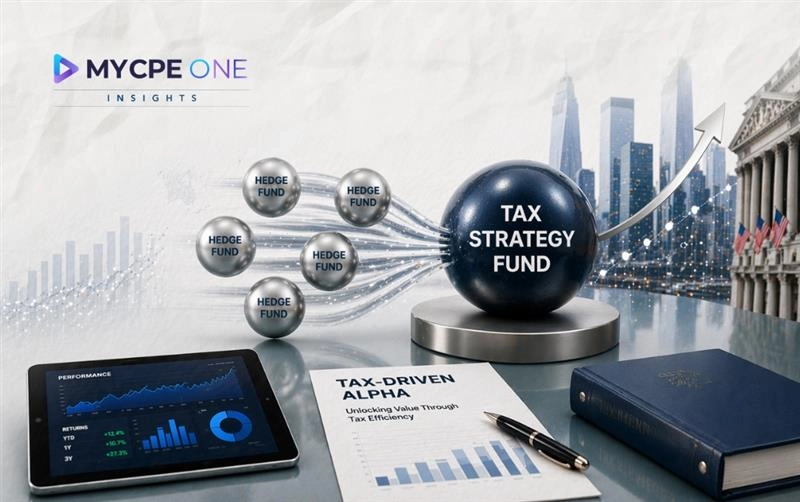
A few years ago, hedge funds pitched one simple promise: beat the market. Today, the pitch sounds a little different, and honestly, a little more clever. “Keep more of what you make.” That subtle shift is driving a quiet but massive change across Wall Street. Instead of chasing raw returns, some of the biggest quant shops are now engineering portfolios to minimize taxes, sometimes as aggressively as they pursue gains. It sounds neat on paper. In practice, it’s turning into one of the fastest-growing and most debated corners of modern finance. Let’s break down how we got here, what’s happening now, and where this might land.

What exactly is “Tax Alpha”?

At its core, tax alpha is simple: increase your after-tax return by reducing the tax bill, not just boosting performance. If two portfolios earn the same 10% pre-tax, but one loses less to taxes, that one wins. No fancy math, just better net outcomes. Historically, this meant basic tax-loss harvesting. Sell a losing stock, offset gains elsewhere, move on. Pretty standard stuff in wealth management. What’s different now is scale and intent. Firms like AQR and Quantinno are building strategies where loss generation is not a side effect; it’s part of the design. These portfolios go long and short thousands of securities, use swaps and derivatives, and actively create losses that investors can use to offset capital gains, and in some cases even ordinary income.

We’re talking about a market where over $1 trillion is now tied to tax-aware strategies, spanning ETFs, direct indexing, and hedge fund structures. Tax-aware long-short funds alone have crossed the $100 billion mark and are growing fast. That’s not a niche anymore. That’s a trend with teeth.

Why are hedge funds suddenly playing the tax game?

Here’s the interesting part. Hedge funds did not care much about taxes for decades. Why? Their biggest clients were pension funds, endowments, and sovereign wealth funds. These entities are tax-exempt. No need to get fancy. So why now? Three things changed.

  • First, the client base shifted: High-net-worth individuals now control a much larger share of investable assets. Many are sitting on massive unrealized gains after a decade-long bull run. These investors care deeply about taxes, sometimes more than raw returns.
  • Second, technology caught up: Algorithmic trading, direct indexing, and automation allow managers to track and harvest losses at a level that simply wasn’t possible before. What used to require a team of analysts can now run on code.
  • Third, returns got… average: Let’s be honest. The hedge fund industry has struggled to consistently outperform. When alpha is hard to find, you look for it elsewhere.

So, Wall Street did what Wall Street does best. It found a new lever. As one advisor put it, “If you can’t beat the market clean, you beat it after taxes.” Not bad, right?

Are these strategies too clever for their own good?

On paper, tax-aware strategies sound like free money. Generate losses, defer taxes, let compounding do the heavy lifting. In reality, there’s no free lunch. Most of these strategies rely on leverage, short selling, and complex derivatives. That introduces real risk. Losses can pile up fast in stressed markets. And the tax benefit itself is not always consistent. Take AQR’s more advanced offerings. Some have shown strong pre-tax returns, around low double digits in certain years, while also generating sizable deductible losses. But those results depend heavily on market conditions and execution. Then there’s the bigger question: economic substance.

Tax law generally allows deductions when there is real economic activity. If a strategy looks like it exists mainly to manufacture losses, regulators start asking questions. And they already are. The IRS and policymakers have begun paying closer attention, especially as these strategies scale. Some tax rules in play today were written decades ago, long before high-frequency trading or complex swaps became mainstream. As one tax expert put it, the system is “an old framework trying to keep up with modern engineering.” That gap rarely stays open forever.

Why is Wall Street chasing tax tricks?

On one side, you have Warren Buffett sitting on roughly $381-$382 billion in cash, waiting patiently for the right opportunities. His philosophy is simple: focus on value, ignore the noise. On the other side, you have hedge funds building highly engineered portfolios to squeeze out tax advantages. So, what’s going on? Part of it comes down to market uncertainty.

Global conditions are not exactly calm right now. Interest rates remain elevated compared to the last decade. Geopolitical risks are hanging around. Equity valuations still feel stretched in certain sectors. In that environment, traditional return drivers look less predictable. So, managers look for certainty elsewhere, and tax deferral feels more controllable than market timing. It’s a bit like saying, “I may not know where the market goes next, but I can control how much I give up in taxes.” Still, Buffett’s approach raises a fair question: Are we overengineering returns instead of waiting for better opportunities?

What does this mean for CPAs, advisors, and audit teams?

If you’re advising high-net-worth clients, these products are going to show up. If they haven’t already, they will. A typical scenario might look like this: A client with a concentrated stock position, say from tech equity compensation, wants diversification but fears a large tax hit. A tax-aware long short strategy promises to offset gains while staying invested.

Sounds appealing. But now you’re dealing with:

  • Complex K-1 reporting
  • Timing differences between book and tax income
  • Potential wash sale issues
  • Ordinary versus capital loss classification
  • Future tax liabilities that are deferred, not eliminated

And if regulations change, some of those benefits could unwind. From an audit or compliance perspective, the key question becomes: Does the tax treatment match the underlying economics? That’s not always a straightforward answer.

So, where does this go from here?

The short answer: it depends on Washington as much as Wall Street. If current rules stay in place, expect continued growth. Demand is strong, fees are high, and advisors have a compelling story to tell. If regulators tighten enforcement or Congress revisits some of these provisions, the narrative could shift quickly. There’s also a longer-term philosophical question. Are we moving toward a system where tax efficiency becomes the primary source of investment outperformance? If yes, then portfolio construction starts to look less like investing and more like tax engineering. That might work for a while. But it also raises fairness concerns, especially when the biggest benefits flow to the wealthiest investors.

Takeaway

Tax alpha is not a gimmick. It’s real, and in many cases, it works. But it comes with trade-offs: complexity, cost, regulatory risk, and reliance on rules that may not stay static. For finance professionals, the job is not to dismiss it or blindly accept it. It’s to ask the right questions:

  • Is the after-tax benefit sustainable?
  • Does the risk match the client’s profile?
  • What happens if the rules change?

And most importantly, are we solving a real problem or just getting clever with the tax code? Because at the end of the day, markets change, laws evolve, and strategies come and go. But clean, understandable returns still matter. Even if they’re a little less exciting.

Until next time…

Don’t forget to share this story on LinkedIn, X and Facebook

Subscribe now for $199 and get unlimited access to MYCPE ONE, from CPE credits to insights Magazine

📢MYCPE ONE Insights has a newsletter on LinkedIn as well! If you want the sharpest analysis of all accounting and finance news without the jargon, Insights is the place to be! Click Here to Join

Unlock Annual Access to News & CPE Subscription

You’ve reached the 3 free-content piece limit. Unlock unlimited access to all News & CPE resources.
Subscribe Today.

News & Updates

  • Exclusive News & Insights
  • Latest Regulatory Updates
  • Accounting Industry Trends
  • Expert Insights
  • AI-Driven Audio & Summaries
  • Infographics & Videos
  • CPE-Approved Articles
  • Digital Magazine
  • Benchmarking Blogs

Unlimited CPE Access for 1 Year

  • 15,000+ Hours of Content
  • 500+ Subject Areas
  • Mandatory Ethics Courses
  • 250+ Compliance Packages
  • 50+ Virtual Conferences and Events Access
  • Format: Live, Audio, Video, E-Books
  • Audio Based Courses & Podcasts
  • Add External Certificates with AI
  • AI Compliance Tracking and Report
  • Instant Certification and Fast Reporting
  • Mobile App Access (iOS and Android)
  • Dedicated Support System
  • Practical Training Programs
  • AI Academy Access
  • Tax Academy Access
  • Audit Academy Access
  • Leadership Academy Access