Join 250,000+
professionals today
Add Insights to your inbox - get the latest
professional news for free.
Join our 250K+ subscribers
Subscribe21 MAY 2026 / ACCOUNTING & TAXES
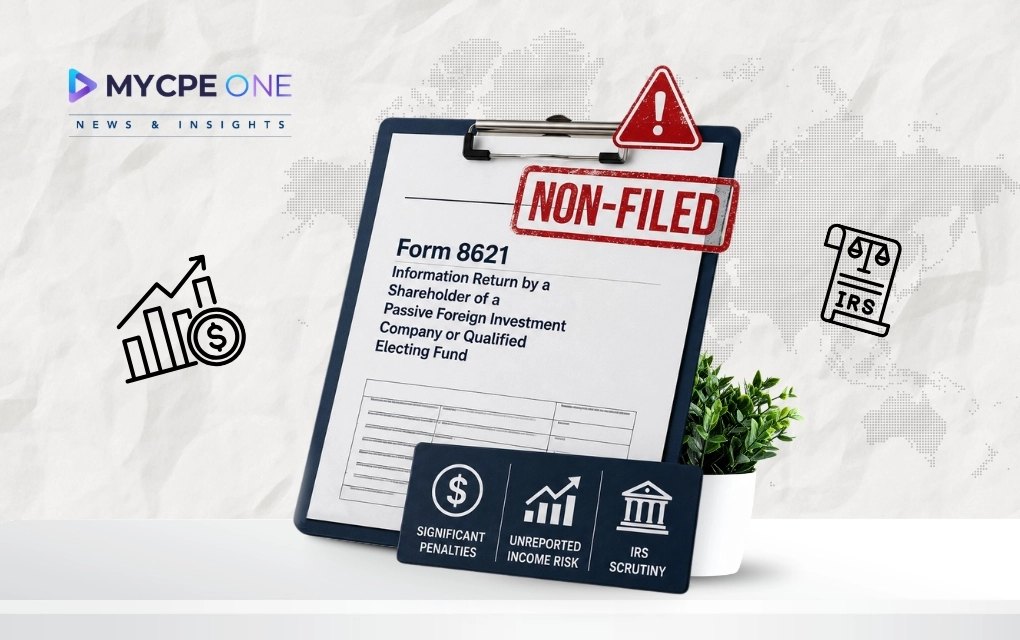
The Internal Revenue Service (IRS) is closely examining Passive Foreign Investment Companies (PFICs), often foreign mutual funds or exchange-traded funds (ETFs) in which US taxpayers have invested. A review is necessary as PFIC rules have a significant impact on investment returns and can reopen tax years, even decades old, with the IRS imposing a default ‘excess distribution’ regime and interest charges on holdings.
The IRS has a special talent for turning something that sounds sleepy into a full-blown migraine. “Passive Foreign Investment Company” sounds like a forgotten finance textbook chapter. In reality, PFIC rules and Form 8621 can torch investment returns, reopen old tax years, and leave taxpayers staring at calculations that look like they were built by a caffeine-fueled mathematician in a basement office at 2 a.m. And here’s the wild part: most people don’t stumble into PFIC trouble through Cayman Islands schemes or Wolf of Wall Street antics. They get there because a bank in Toronto suggested a mutual fund. Or because they moved to Portugal and bought a local ETF. Or because their retirement account overseas quietly held pooled investments they never thought twice about. Now tax pros are paying closer attention, because the IRS sure is.
Under Internal Revenue Code Section 1297, a foreign corporation becomes a PFIC if either 75% of its income is passive or 50% of its assets generate passive income. Sounds technical. The practical version is much simpler: most non-U.S. mutual funds and ETFs are PFICs. That includes Canadian mutual funds, Irish-domiciled ETFs, foreign pension-linked investments, assurance-vie products in France, and plenty of globally diversified investment wrappers sold to expats. Clients usually have zero clue this exists. Honestly, many preparers outside international tax circles don’t either. That’s where Form 8621 enters like an uninvited guest who raids the fridge and never leaves.
Form 8621 is the IRS reporting form used by U.S. taxpayers who own shares or interests in a Passive Foreign Investment Company, better known as a PFIC. The form does two things at once: it reports ownership information and calculates the special tax treatment tied to PFIC investments. The filing is required in many situations, even if there was no sale, no distribution, and no obvious taxable event during the year. Own five foreign mutual funds? That could mean five separate Forms 8621. Some foreign insurance or pension products can hold dozens of underlying funds. Suddenly, a basic return turns into a part-time job. And if the form is missed? That’s where things get spicy.
Normally, the IRS has about three years to audit a return. Miss a required Form 8621 filing, though, and the statute of limitations may stay open indefinitely for the entire tax return. Not just the PFIC section. The whole thing. That detail keeps showing up across tax attorneys, expat advisors, and international compliance specialists because practitioners still underestimate it. A missed PFIC filing from 2014 could theoretically reopen a return in 2026. That old Schedule C issue you forgot about? Still fair game. That underreported income unrelated to the PFIC? Also fair game. Talk about keeping receipts.
Tax attorneys describe this as one of the most dangerous parts of PFIC compliance because the damage isn’t always immediate. Many taxpayers discover the issue years later when selling investments or during broader international reporting reviews tied to FATCA or FBAR filings. By then, reconstructing basis records and historical distributions can feel like trying to assemble IKEA furniture without instructions after three glasses of cabernet.
Congress intentionally made PFIC taxation painful. The policy goal was simple: discourage Americans from parking investments offshore and deferring U.S. tax. Mission accomplished. Under the default “excess distribution” regime, gains are allocated across the holding period and taxed at the highest ordinary income rates applicable in each prior year. Then the IRS adds an interest charge as if taxes had been underpaid the entire time. That compounding interest piece is where taxpayers really get smoked.
One commonly cited example involves a $50,000 foreign fund investment growing to $120,000 over 10 years. Under normal long-term capital gains treatment, federal tax might land near $14,000. Under PFIC default treatment, combined tax and interest charges can climb toward $35,000 or more. That’s not a haircut. That’s getting taken to the cleaners. Sure, elections like Qualified Electing Fund (QEF) or Mark-to-Market (MTM) treatment exist. But those come with their own headaches, timing rules, phantom income issues, and foreign reporting dependencies that many funds simply do not support. As one advisor bluntly put it: PFICs are generally something to avoid, not optimize.
A decade ago, PFIC issues mostly lived in niche expat circles. Now? International investing is mainstream. Americans work remotely overseas. Retire abroad. Buy foreign pension products. Open local brokerage accounts. Invest through Golden Visa programs. Inherit overseas assets from relatives. The world got smaller. The tax rules didn’t get friendlier. Meanwhile, the IRS has far more visibility through FATCA reporting, global information-sharing agreements, and increased scrutiny of offshore holdings. Foreign account data moves faster now. Quietly ignoring PFIC exposure and hoping nobody notices is basically the tax equivalent of hiding spinach in your teeth during a Zoom call. Someone’s eventually going to point it out.
That’s why firms are rethinking intake questionnaires, foreign asset reviews, and international referral networks. Many generalist CPAs simply don’t handle enough PFIC work to manage it efficiently, and the learning curve is steep. Honestly, this is one of those areas where bringing in a specialist early can save everybody a truckload of pain later.
Not every small foreign investment automatically creates a catastrophe. Certain reporting exceptions exist for smaller holdings, particularly where no distributions or dispositions occurred. Some taxpayers may also qualify for reasonable cause relief in late-filing situations. Still, the biggest mistake is pretending the issue will magically disappear. PFIC compliance sits in that uncomfortable zone where ordinary financial behavior collides with deeply technical international tax law. Clients think they bought a diversified retirement investment. The IRS sees a passive foreign corporation triggering one of the harshest anti-deferral regimes in the code. Different movie. Same popcorn.
For accounting and tax professionals, the takeaway is pretty straightforward: ask more questions about foreign investments before the return gets finalized. Because once Form 8621 enters the chat, things can go sideways in a hurry.
Until next time…
Don’t forget to share this story on LinkedIn, X and Facebook
Subscribe now for $199 and get unlimited access to MYCPE ONE, from CPE credits to insights Magazine
📢MYCPE ONE Insights has a newsletter on LinkedIn as well! If you want the sharpest analysis of all accounting and finance news without the jargon, Insights is the place to be! Click Here to Join
You’ve reached the 3 free-content piece limit. Unlock unlimited access to all News & CPE resources.
Subscribe Today.
Already have an account?
Sign In