


Join 250,000+
professionals today
Add Insights to your inbox - get the latest
professional news for free.
Join our 250K+ subscribers
Subscribe26 NOV 2025 / TECHNOLOGY
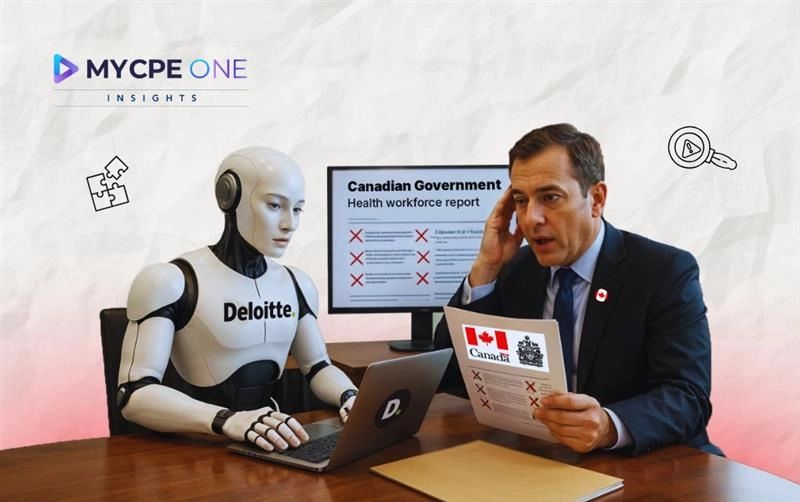
Deloitte has faced scrutiny over alleged errors in an AI-assisted health workforce report created for the government of Newfoundland and Labrador in Canada, which contained non-existent citations and misattributed authors. The incident follows a similar fiasco earlier this year involving the firm’s AI-assisted welfare review for the Australian government, raising concerns regarding the validity and reliability of AI applications in policy research.
Before Deloitte could even catch its breath from the last AI citation fiasco, the firm is back in the spotlight like it accidentally wandered into the wrong Zoom meeting. Earlier this year, its AI assisted welfare review for the Australian government turned into a 237 page headache packed with fake citations, a fabricated court quote, and a partial refund that made headlines across the globe. We broke down that saga in our earlier piece, How Deloitte’s AI Error Mistake Sparked Global Debate. Now the plot has a Canadian sequel. A 526 page, almost 1.6 million dollar health workforce report for Newfoundland and Labrador is catching heat for allegedly AI flavored citations that do not exist, misattributed authors, and several academics wondering why they have been credited with research they never touched.
Quick recap of episode one. In Australia, Deloitte was hired for a welfare compliance review, delivered a report that used Azure OpenAI, and eventually admitted that some references and even a court quote were wrong. A revised 237 page report was posted and Deloitte agreed to partially refund a contract worth roughly 290,000 US dollars.
Episode two trades kangaroos for Atlantic wind chill. Newfoundland and Labrador’s former Liberal government commissioned Deloitte to build a 10 year Health Human Resources Plan, modeling supply and demand for 21 health occupations and 36 physician specialties. The final report, released in May 2025, runs 526 pages and cost about 1.6 million Canadian dollars, paid over eight installments between March 2023 and March 2025.
The province expected a grounded roadmap to fix chronic shortages of nurses and doctors, plus guidance on virtual care, recruitment incentives, and COVID era staffing strain. What it actually got, according to local investigations, included citations that do not exist, mismatched author lists, and papers no one can seem to find. If you are thinking this sounds a lot like AI hallucinations slipping into high priced policy work, you are not the only one.
The Independent, a Newfoundland outlet, dug into the 526 page report and discovered at least four citations that simply do not exist. One was supposedly published in the Canadian Journal of Respiratory Therapy, but no trace of it appears in the journal’s database. Several researchers listed as coauthors say they have never worked together, and others say the cited paper credited to them is pure fiction. Health scholar Gail Tomblin Murphy, who appeared on one of these phantom citations, said the errors look like heavy AI involvement and warned that anything used in public planning must be validated and reliable. Deloitte has acknowledged the four incorrect references, agreed to review every citation in the report, and still maintains that the overall conclusions remain solid.
Here is how the fallout is stacking up:
Maybe you are thinking this is interesting but far removed from your own work. Spoiler: it is not. If a marquee consultancy and a provincial government can end up with AI tinged fiction in a flagship workforce plan, your next strategy report, risk memo, or valuation deck is not magically immune.
For CFOs, controllers, tax leaders, and internal auditors, this is a real time lesson in:
For a profession powered by evidence, this should be a heads up moment.
A few practical moves are basically a no brainer right now.
At the end of the day, this is not just a Deloitte problem or an AI problem. It is a trust problem. Governments, boards, and finance teams are paying real money for reports meant to anchor staffing plans, policy decisions, and public spending. If the footnotes wobble, everything stacked on top starts to wobble too. For accounting, tax, and finance pros, the message is clear. Use AI to speed up the work, but tighten your guardrails so your evidence chain stays clean. Ask uncomfortable questions, demand clarity on tool use, and write AI clauses that actually have teeth. The teams that get this right will not just avoid embarrassment. They will be the ones clients call when everyone else is scrambling to explain why their research cites studies that never existed in the first place. For more sharp analysis and stories that keep finance pros a step ahead, explore MYCPE ONE Insights.
Until next time…
Don’t forget to share this story on LinkedIn, X and Facebook
Subscribe now for $199 and get unlimited access to MYCPE ONE, from CPE credits to insights Magazine
📢MYCPE ONE Insights has a newsletter on LinkedIn as well! If you want the sharpest analysis of all accounting and finance news without the jargon, Insights is the place to be! Click Here to Join
Unlimited CPE for Just $199/Year!
Get CPE credits by reading or listening to approved content. Enjoy unlimited CPE for CPA (US), EA, CMA, CIA, CFE, SHRM, HRCI, and 100+ other designations—all for just $199 per year! (Learn More)
Team Subscriptions Available – Starting at Just $199/Year!
Schedule a no-obligation callYou’ve reached the 3 free-content piece limit. Unlock unlimited access to all News & CPE resources.
Subscribe Today.
Already have an account?
Sign In