
Join 250,000+
professionals today
Add Insights to your inbox - get the latest
professional news for free.
Join our 250K+ subscribers
Subscribe10 OCT 2025 / TECHNOLOGY
CPE Approved
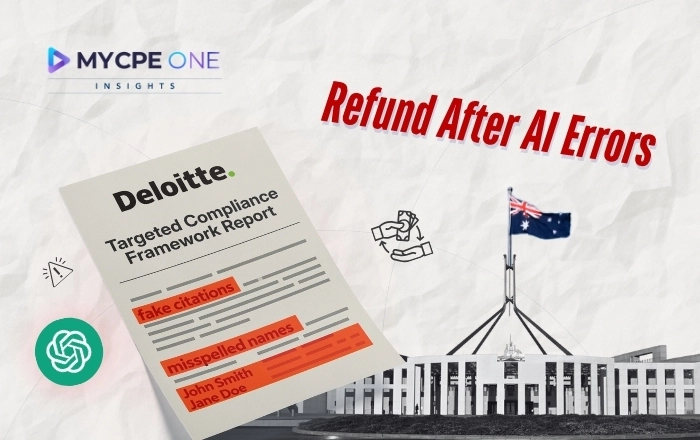
The Australian government hired Deloitte to review part of its welfare system in 2024, however the final report, which was co-drafted by artificial intelligence (AI), contained false citations and invented quotes. The error, which forced Deloitte to refund part of their fees, calls into question the reliability of AI in producing professional work, while also highlighting the need for adequate oversight when using AI in sensitive sectors.
When the Australian government hired Deloitte in 2024 to review one of its welfare compliance systems, it expected the usual thoroughness and professionalism from a Big Four consultancy. Instead, it received a 237-page report riddled with fabricated citations, invented quotes, and non-existent academic studies. What added fuel to the fire was the revelation that Deloitte had used artificial intelligence to assist in drafting parts of the report. This story became even more complex when it was revealed that Deloitte was rolling out Anthropic's Claude AI assistant to more than 470,000 employees worldwide. It marked the largest enterprise deployment of the AI tool to date, signaling the firm's commitment to AI in its operations. However, this move, while exciting, also raised important questions about the risks of AI in consulting, as the Australian blunder demonstrated.
In December 2024, Deloitte was tasked with reviewing Australia’s Targeted Compliance Framework, an automated system that penalized job seekers for missing welfare obligations. The company delivered a detailed 237-page report in July 2025, which initially received little attention. But Dr. Chris Rudge, a Sydney University researcher, soon flagged troubling discrepancies. He noticed fabricated citations to non-existent academic studies and a misattributed quote from a federal court judge. Upon review, Deloitte confirmed that parts of the report had been drafted using Azure OpenAI GPT-4o. Although the firm insisted that the report's core findings remained valid, it could not deny the errors uncovered. In response, Deloitte published a revised version of the report in September 2025, with a disclaimer acknowledging the AI's involvement and removing the erroneous references.
Interestingly, this wasn’t the first time a Big Four firm had leaned heavily into AI. Just as Deloitte has, PwC has embraced AI to increase efficiency and lower costs. PwC’s Chief AI Officer stated that AI has improved the efficiency of their systems integration by 30%, with some of these gains being passed on to clients in the form of price reductions. But as Deloitte’s case reveals, AI in professional services comes with its own set of challenges, particularly when human oversight is lacking.
The fallout was swift and significant. Deloitte publicly apologized and agreed to refund the final installment of the A$439,000 (US$290,000) fee paid by the Australian government. While the report's findings remained intact, the incident raised serious questions about AI’s reliability in producing professional work. The issue also sparked criticism from Australian lawmakers. Senator Barbara Pocock called for a full refund, pointing out that the firm had misused AI and failed to meet basic professional standards. This incident highlighted the risks of using AI without adequate oversight, especially in sensitive, high-stakes work like government consulting.
The AI-related mistake also comes at a time when Deloitte is facing some pressure on its financial front. Deloitte UK saw a 1% decline in revenue for FY25, marking its first drop in 15 years. While the company still saw growth globally, especially in the Americas and Asia Pacific, the revenue dip raised concerns about future prospects.
Despite the backlash, Deloitte’s commitment to AI isn’t waning. The company’s recent deal with Anthropic to deploy Claude AI to its global workforce shows how deeply AI is becoming integrated into consulting operations. The goal is clear: speed up operations, boost productivity, and transform consulting services. However, Deloitte’s AI error underscores that using such tools carries serious risks, especially when accuracy is paramount. While AI can streamline processes, it is crucial that firms don’t rely on it as a substitute for human expertise. Deloitte’s experience may prompt changes in how AI is incorporated into future consulting contracts, with stricter disclosure and oversight protocols.
Deloitte’s experience offers several key lessons for professionals across industries that use AI. The primary takeaway is clear: don’t let AI handle critical tasks without robust human oversight. Generative AI tools like GPT-4o can be incredibly efficient, but they are not infallible. AI systems are designed to predict patterns in data, not verify facts against real-world knowledge. As a result, they can sometimes generate plausible-sounding but completely false information. To prevent similar errors in the future, here are some key lessons for professionals:
The Deloitte-AI saga serves as an important guiding example for the consulting world. While AI has immense potential to improve efficiency and productivity, it must be used with caution, particularly in high-stakes projects where accuracy is critical. Deloitte’s case highlights the need for clear protocols, human oversight, and transparency when integrating AI into professional services. As AI becomes more prevalent, the key to successful implementation will lie in balancing the power of technology with the expertise of human professionals. AI should be a tool that supports and enhances human judgment, not a replacement for it. The lesson here is simple: don’t trust the machines too much. If you do, you might end up with a report full of errors and a public refund to process.
Get Your CPE Credit From Here
Until next time…
Don’t forget to share this story on LinkedIn, X and Facebook
Subscribe now for $199 and get unlimited access to MYCPE ONE, from CPE credits to insights Magazine
📢MYCPE ONE Insights has a newsletter on LinkedIn as well! If you want the sharpest analysis of all accounting and finance news without the jargon, Insights is the place to be! Click Here to Join
Website Services for CPA & Accounting Firms - Starting $69/month.
Is your website attracting clients—or turning them away? MYCPE ONE’s Website Development Services, starting at just $69/month, create high-converting, professional websites tailored for accounting firms like yours.
With over 400 designs to choose from and a dedicated webmaster, we handle it all for you—no DIY required.
Get started today and create a website that works for your firm with MYCPE ONE!
Make a lasting impression. Boost conversions. Stay secure.
You’ve reached the 3 free-content piece limit. Unlock unlimited access to all News & CPE resources.
Subscribe Today.
Already have an account?
Sign In