MYCPE ONE
MYCPE ONE LOGO

Join 250,000+
professionals today

Add Insights to your inbox - get the latest
professional news for free.

MYCPE ONE insights

Why Are SaaS Shares Suddenly So Fragile?

Join our 250K+ subscribers

Join our 250K+ subscribers

Subscribe

18 FEB 2026 / TECHNOLOGY

Why Are SaaS Shares Suddenly So Fragile?

Why Are SaaS Shares Suddenly So Fragile?

A few years ago, I rewatched Moneyball. There’s that quiet scene where Billy Beane sits alone in the stadium after everyone’s gone home. No speeches. No dramatic soundtrack. Just the hum of lights and the sense that something structural has shifted. The old scouting logic didn’t collapse overnight. It just stopped feeling permanent. That’s what this recent software selloff reminds me of. Not panic. Not doom. Just that subtle, uncomfortable moment when an industry realizes its assumptions may not be as solid as they looked in the earnings deck. For two decades, enterprise software felt inevitable. Subscription revenue, sticky workflows, renewal cycles that bordered on autopilot. It was the cleanest story on the Street. Recurring revenue plus digital transformation equaled premium multiples. Simple. And then an AI model release note lands on a random Tuesday morning, and suddenly $300 billion of market value evaporates like it was never there. It makes you wonder: what exactly cracked?

Is This About AI?

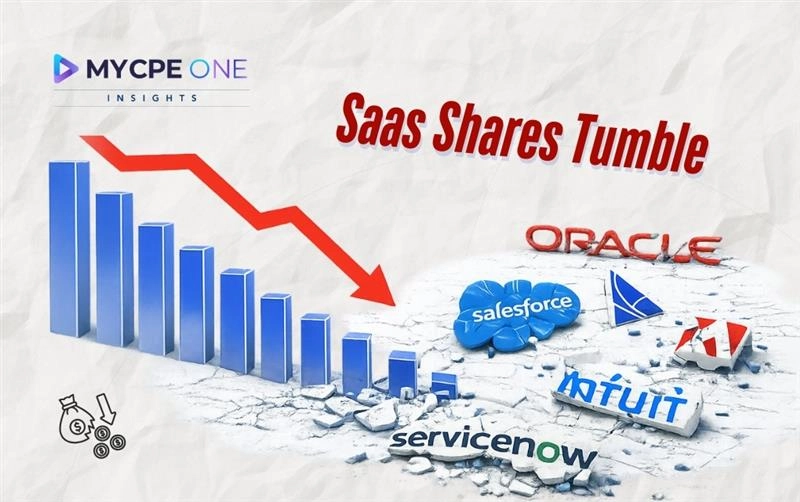
The central question I keep circling back to is this: Did Anthropic and OpenAI actually threaten the software sector’s economics, or did they simply expose how dependent it had become on a fragile pricing model? When Claude Cowork plugins dropped on January 30, 2026, the message was not subtle. Legal review. Financial modeling. Sales prep. Contract analysis. Automated workflows across departments. Within days, Thomson Reuters fell roughly 16%. RELX dropped about 14%. Salesforce, Intuit, Adobe, and ServiceNow all slid into double digits in the following weeks. By early February, forward P/E multiples across much of the sector had compressed from near 39x to roughly 21x. That’s not a gentle repricing. That’s a gut punch. But was the tech revolutionary? Or did investors suddenly realize that charging per human seat in a world of digital labor might not age well? That distinction matters.

The Gym Membership Problem

There’s a mental model I find helpful here. Call it the gym membership problem. A gym makes money when you pay monthly and don’t show up much. The economics depend on the volume of members, not the volume of usage. The real asset is a predictable subscription flow tied to human presence. Per-seat SaaS has always felt similar. Revenue scales with headcount. Five employees need five licenses. Growth equals hiring. Churn is low because once workflows are embedded, ripping them out is a hassle. Now introduce AI agents that let one employee handle the workload of three or five. The software still functions. The workflow still exists. But the number of humans interacting with it shrinks. If revenue is tethered to seats, and seats shrink, something gives. This lens reframes the selloff. Maybe investors weren’t reacting to smarter models. Maybe they were reacting to the idea that the seat-based subscription model quietly relies on inefficiency. And inefficiency just got cheaper to eliminate.

What Actually Happened in January and February?

The timeline is instructive.

  • January 30: Anthropic releases industry-specific Claude Cowork plugins spanning legal, finance, marketing, and enterprise search. Messaging is clear. These are not chatbots helping you draft emails. These are agents executing workflows.
  • February 3 to 5: Goldman Sachs’ basket of software stocks drops around 6% in a single session. The IGV software ETF hits its most oversold level relative to the S&P 500 in decades. Total market cap losses since late January approach $1 trillion at the peak of the panic.
  • February 5: Anthropic releases Claude Opus 4.6 with one-million-token context and multi-agent coordination. The same day, OpenAI launches Frontier, pitching an end-to-end enterprise AI platform. Two frontier labs signal they are stepping directly into enterprise workflows.

Markets hear one thing: disintermediation.

Source: Bloomberg

Add in hyperscaler spending. Amazon, Microsoft, Alphabet, and Oracle collectively project over $600 billion in 2026 capital expenditures. Backlogs for cloud services exceed $1.6 trillion. Microsoft alone reports roughly $625 billion in remaining performance obligations, about 45% tied to OpenAI. Those are eye-watering numbers. At the same time, revenue beats in software earnings season trail the broader tech sector. Roughly 71% of software companies beat revenue expectations versus about 8% across tech overall. So, you have valuation compression, competitive uncertainty, and a whiff of concentration risk in AI demand. That’s enough to make even seasoned portfolio managers mutter, “Get me out.” But here’s the thing. None of this proves the sector is broken.

Source: Bloomberg

Where the Tension Actually Lives

Fragility is not universal. It’s uneven. Companies that own proprietary data, curated and defensible, are different from workflow tools whose value is largely interface-driven. Credit bureaus with data on 1.4 billion people. Tax platforms with tens of millions of historical returns. Clinical databases are used by millions of physicians. These assets don’t evaporate because a model got better at summarizing text. The tension sits in the middle layer. Workflow providers that monetize human interaction face a structural question: if AI reduces the number of humans interacting with software, does pricing follow usage or stay stuck on seats? Some are already experimenting. Salesforce has shifted part of its Agentforce pricing to per-action credits, around $0.10 per action in early iterations. That feels like an early attempt to move from seat economics to unit-of-output economics. But transitions are messy. Adobe’s shift from perpetual licenses to subscriptions in 2013 hurt revenue before it helped. Stock dropped about 16 percent during the transition. Only later did the model prove superior.

Could something similar happen here? A painful reset followed by a more durable pricing logic? Maybe. The deeper uncertainty is behavioral. CFOs facing talent shortages might welcome AI augmentation. But are they ready to reduce headcount materially? Are regulators comfortable with AI reviewing contracts or preparing financial statements without guardrails? And what happens if one of these AI-native companies struggles financially while hyperscalers are sitting on backlogs tied to them? There are circular dependencies here. Big promises. Big capital spending. Big expectations. It’s not crazy to feel uneasy.

So, Is This the End of SaaS?

That feels dramatic. If anything, this moment feels less like extinction and more like an identity crisis. Software has always evolved. On-prem to cloud. License to subscription. Desktop to mobile. Each shift produced winners, laggards, and a few casualties. But the core function of software, organizing and operationalizing business processes, did not disappear. The question now is not whether AI replaces software. It’s whether AI rewires how software captures value. Maybe per-seat pricing fades. Maybe outcome-based pricing grows. Maybe tokens and compute units become line items in enterprise budgets. Or maybe most companies realize that building custom AI-driven systems is more complex than hype suggests and stick with vendors who integrate AI into existing platforms. I don’t know. And I’m not pretending to.

What I do know is that markets hate uncertainty more than disruption itself. When the rules of monetization blur, multiples compress. It’s almost reflexive. We might look back at early 2026 as the moment software stopped feeling invincible and started feeling conditional. And maybe that’s healthy. Billy Beane didn’t kill baseball scouting. He forced it to confront its assumptions. This feels similar. Not an apocalypse. Not salvation. Just a quiet recalibration under the stadium lights, while everyone else is still arguing in the parking lot.

Until next time…

Don’t forget to share this story on LinkedIn, X and Facebook

Subscribe now for $199 and get unlimited access to MYCPE ONE, from CPE credits to insights Magazine

📢MYCPE ONE Insights has a newsletter on LinkedIn as well! If you want the sharpest analysis of all accounting and finance news without the jargon, Insights is the place to be! Click Here to Join

Unlock Annual Access to News & CPE Subscription

You’ve reached the 3 free-content piece limit. Unlock unlimited access to all News & CPE resources.
Subscribe Today.

News & Updates

  • Exclusive News & Insights
  • Latest Regulatory Updates
  • Accounting Industry Trends
  • Expert Insights
  • AI-Driven Audio & Summaries
  • Infographics & Videos
  • CPE-Approved Articles
  • Digital Magazine
  • Benchmarking Blogs

Unlimited CPE Access for 1 Year

  • 15,000+ Hours of Content
  • 500+ Subject Areas
  • Mandatory Ethics Courses
  • 250+ Compliance Packages
  • 50+ Virtual Conferences and Events Access
  • Format: Live, Audio, Video, E-Books
  • Audio Based Courses & Podcasts
  • Add External Certificates with AI
  • AI Compliance Tracking and Report
  • Instant Certification and Fast Reporting
  • Mobile App Access (iOS and Android)
  • Dedicated Support System
  • Practical Training Programs
  • AI Academy Access
  • Tax Academy Access
  • Audit Academy Access
  • Leadership Academy Access