

MYCPE ONE
MYCPE ONE LOGO

Join 250,000+
professionals today

Add Insights to your inbox - get the latest
professional news for free.

MYCPE ONE insights

AICPA Opposes IRS Merger Plan That Mixes Oil and Water

Join our 250K+ subscribers

Join our 250K+ subscribers

Subscribe

20 NOV 2025 / IRS UPDATES

AICPA Opposes IRS Merger Plan That Mixes Oil and Water

AICPA Opposes IRS Merger Plan That Mixes Oil and Water

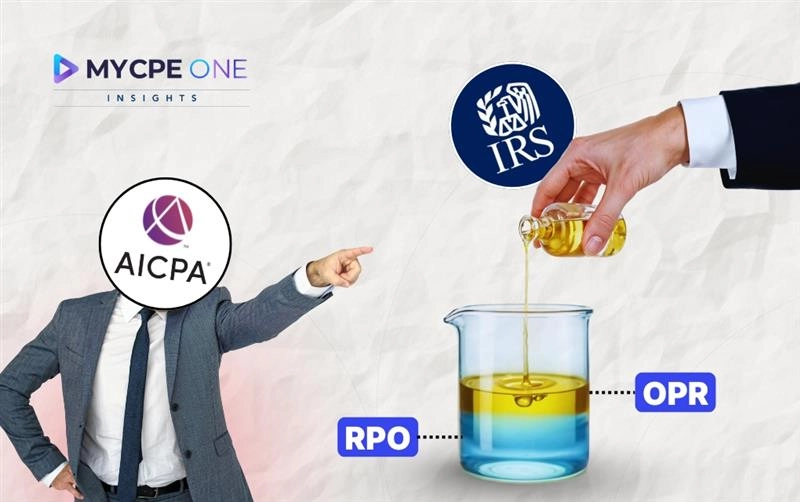
Picture walking into a coffee shop where every drink is labeled simply “coffee.” No latte, no mocha, no cold brew. Just coffee. You would probably stare at the menu like it owes you money. That is roughly the vibe the AICPA says taxpayers will feel if the IRS merges the Office of Professional Responsibility (OPR) with the Return Preparer Office (RPO). Because when every preparer looks the same on paper, trouble shows up faster than a tax form in April. And once you look at what each office actually does, the concern becomes even harder to ignore.

A Tale of Two Offices

The IRS created OPR and RPO for different jobs, different skill sets, and frankly, different types of people. OPR is the watchdog that regulates credentialed pros under Circular 230. Think CPAs, attorneys, and enrolled agents. It handles misconduct referrals, disciplinary proceedings, and the whole serious-business side of tax ethics. RPO, on the other hand, deals with the practical business of registration and entry-level oversight. It manages PTINs, enrolled agent applications, the Annual Filing Season Program, and complaints against uncredentialed preparers. RPO is compliance-focused. OPR is supervisory and regulatory. So why is the IRS considering merging them? Efficiency is the stated reason. But as any accountant who has ever tried to “simplify” a chart of accounts knows, efficiency sometimes forgets the chaos waiting behind the corner.

Why the AICPA Says “Pump the Brakes”

In mid-November, the AICPA sent a firm letter to IRS leaders warning that combining these offices would give taxpayers a false sense of who is qualified to do what. CPAs go through state licensing, continuing education, and strict ethical codes. Uncredentialed preparers need one thing: a PTIN. Mixing the two groups under one roof could make taxpayers think everyone is held to Circular 230 standards. That is like thinking every car on the lot has the same warranty because the dealership shares a roof. As the saying goes, “If you think all accountants are the same, you probably have bigger problems than your tax return.”

And here comes the real kicker: unscrupulous preparers could claim they are overseen by “the Office of Professional Responsibility,” using that title as a badge they have not earned. That is the kind of shortcut that leads to people getting burned, both financially and professionally. The AICPA argues that this confusion would hit taxpayers hard and hit the tax system even harder.

What Happens if the Merger Goes Through

Imagine OPR suddenly responsible for everything from PTIN processing to enrollment appeals. Resources would get stretched thinner than a year-end audit team. The AICPA warns that the core purpose of OPR, enforcing professional standards, would take a hit. And when enforcement weakens, confidence takes a nosedive. Complaints could get muddled. Appeals could lose their independence. Taxpayers might stop understanding the difference between a CPA with state oversight, an enrolled agent with federal authorization, and an unenrolled preparer who simply paid the PTIN fee. So here is a curious question worth asking: How does confusing millions of taxpayers help the tax system? Nobody has a clean answer.

How We Got Here and Where This Could Go

Historically, OPR and RPO have lived separate lives. OPR was born to govern professional practice. RPO was created to manage the growing world of preparer registration. Their responsibilities rarely overlapped, and for good reason. Credentialed and uncredentialed preparers do not operate under the same rulebook, and taxpayers rely on that clarity when choosing who to trust. Today, the IRS is rethinking organizational structure. Some changes make sense in a tightening budget environment. But this one, according to the AICPA, is a “measure twice, cut once” moment. The organization argues that merging oversight with administrative processing is asking for ethical confusion, resource conflicts, and broken expectations.

Looking forward, the AICPA wants continued investment in both offices, but separately. OPR should stay laser-focused on Circular 230 enforcement. RPO should continue managing PTINs, EA enrollment, and entry level compliance programs. Keeping the walls clear between them protects taxpayers, practitioners, and the integrity of the tax profession.

The Takeaway

This is not a turf war. It is about maintaining professional credibility in a field where trust is everything. CPAs and other credentialed practitioners have spent decades building reputations on strict standards. Throwing uncredentialed preparers into the same bucket signals that credentials do not matter. And if credentials do not matter, why bother with licensure, ethics codes, or continuing education? That is the kind of slippery thinking that turns tax season from a headache into a five-alarm fire.

The AICPA is not saying the IRS cannot modernize. It is saying modernization should not erase the distinctions that taxpayers need to protect themselves. OPR enforces the rules. RPO handles registrations and entry-level oversight. Combining them makes about as much sense as merging the audit team with the marketing department. Sure, you save a little space, but nobody wins. The AICPA’s stance is simple. Keep the offices separate. Keep taxpayer expectations clear. Keep the profession credible. Because when it comes to regulating preparers, clarity is not optional. It is the foundation of trust, and trust is what keeps the whole tax system running without grinding its gears.

Until next time…

Don’t forget to share this story on LinkedIn, X and Facebook

Subscribe now for $199 and get unlimited access to MYCPE ONE, from CPE credits to insights Magazine

📢MYCPE ONE Insights has a newsletter on LinkedIn as well! If you want the sharpest analysis of all accounting and finance news without the jargon, Insights is the place to be! Click Here to Join

Transforming Finance & Accounting Operations for Enterprises!

We help 100+ clients streamline F&A operations with our full-suite outsourcing services—eliminating the need for in-house teams. Partner with us for Top-tier finance & accounting talent, Cutting-edge technology, and World-class infrastructure.

Our Full-Suite F&A Services Include:

  • Accounts Payable Services
  • Finance & Accounting Consulting
  • Financial Planning & Analysis (FP&A)
  • Invoice-to-Cash Services
  • Record-to-Report Services
  • Procure-to-Pay Services

We collaborate with CPA and accounting firms to drive real business value.

Schedule a no-obligation discovery call

Unlock Annual Access to News & CPE Subscription

You’ve reached the 3 free-content piece limit. Unlock unlimited access to all News & CPE resources.
Subscribe Today.

News & Updates

  • Exclusive News & Insights
  • Latest Regulatory Updates
  • Accounting Industry Trends
  • Expert Insights
  • AI-Driven Audio & Summaries
  • Infographics & Videos
  • CPE-Approved Articles
  • Digital Magazine
  • Benchmarking Blogs

Unlimited CPE Access for 1 Year

  • 15,000+ Hours of Content
  • 500+ Subject Areas
  • Mandatory Ethics Courses
  • 250+ Compliance Packages
  • 50+ Virtual Conferences and Events Access
  • Format: Live, Audio, Video, E-Books
  • Audio Based Courses & Podcasts
  • Add External Certificates with AI
  • AI Compliance Tracking and Report
  • Instant Certification and Fast Reporting
  • Mobile App Access (iOS and Android)
  • Dedicated Support System
  • Practical Training Programs
  • AI Academy Access
  • Tax Academy Access
  • Audit Academy Access
  • Leadership Academy Access