

Join 250,000+
professionals today
Add Insights to your inbox - get the latest
professional news for free.
Join our 250K+ subscribers
Subscribe07 APR 2026 / IRS UPDATES
CPE Approved
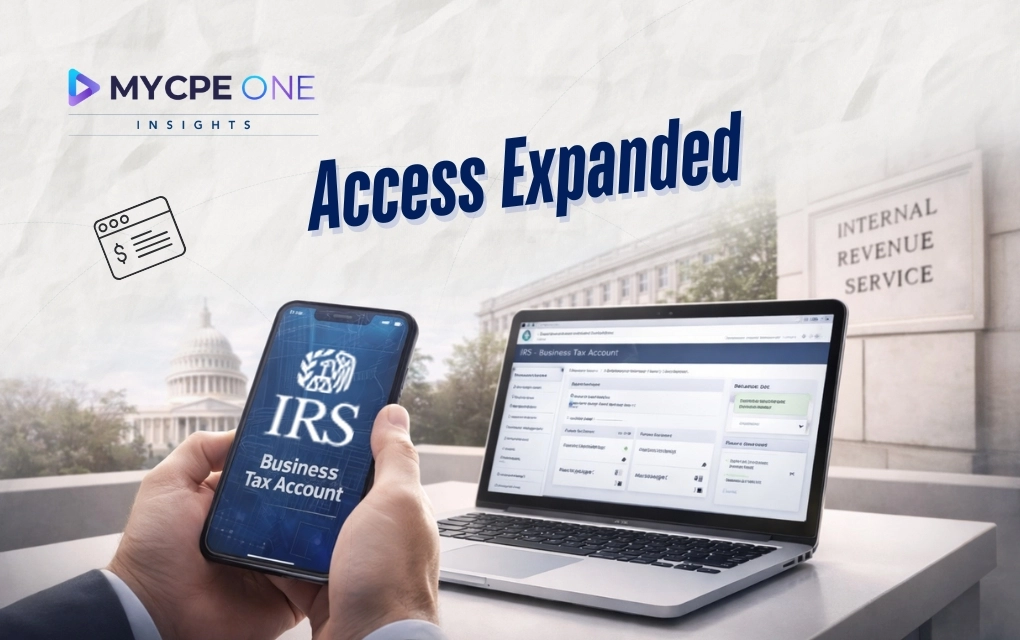
The IRS has expanded its Business Tax Account (BTA) platform to include partnerships, tax-exempt organizations, and governmental entities, aiming to modernize operations and reduce administrative strain. The move allows millions more entities to handle tax matters digitally, however, execution and managing security permissions may present challenges.
Remember the last time you tried calling the IRS for a simple update? You probably aged a little, made coffee twice, and questioned your life choices. Well, the agency seems to have noticed. This week, it decided to cut the cord and push more businesses online. And no, this isn’t just another quiet website tweak. This is a pretty meaningful shift in how millions of entities interact with the IRS.
As of April 6, 2026, the IRS expanded its Business Tax Account, or BTA, to include partnerships, tax-exempt organizations, and federal, state, local, and tribal governments. That’s a big crowd. Until now, the platform was mostly limited to sole proprietors, S corporations, and C corporations. Now, millions of additional entities can log in and handle tax matters without playing phone tag or mailing forms into the void. IRS CEO Frank Bisignano summed it up plainly. Digital access cuts down the hassle. Translation? Less paper, fewer calls, and hopefully fewer headaches.
This isn’t just a “check your balance and leave” portal. The BTA is shaping up to be a central hub for business tax activity.
Once inside, authorized users can:
In short, the IRS is trying to move routine tasks into a self-serve model. Think of it like online banking, but with more acronyms and fewer friendly interfaces. Still, for practitioners juggling multiple clients, this could be a solid time-saver. No more waiting weeks for transcripts or chasing mailed notices. At least, that’s the idea.
Let’s be honest. The IRS didn’t wake up one morning and suddenly love digital tools. This expansion is part of a broader push to modernize operations and reduce administrative strain. Filing seasons have been messy. Call volumes have been brutal. Paper processing has been slow. So, the agency is doing what most organizations eventually do. Move more users online and let them handle basic tasks themselves. And there’s another angle here. Tax professionals are already dealing with new layers of complexity from recent legislation, including changes tied to the One Big Beautiful Bill Act. Add in issues like Section 174 treatment and shifting compliance rules, and you’ve got a system under pressure. So, the question becomes: if compliance is getting more complicated, shouldn’t access get simpler? That seems to be the IRS’s bet.
Here’s where it gets real. Access to the BTA requires identity verification through designated officials. That means Social Security numbers or ITINs, plus proper authorization controls. For large organizations, especially governments or nonprofits, that setup might not be plug-and-play. Someone has to manage permissions, oversee access, and ensure security. And let’s not pretend every IRS platform has a flawless track record. Early adopters will likely run into quirks. You know how this goes. New system launches, everyone logs in at once, something breaks, and suddenly you’re back on hold anyway. So, while the intent is solid, execution will matter.
While the IRS is trying to streamline access, state governments are pouring money into compliance systems tied to the same federal policy environment. Recent reports show states paying firms like Deloitte, Accenture, and Optum millions to update eligibility systems under new federal rules. In just five states, estimated costs exceed $45.6 million. Why? To implement stricter requirements tied to Medicaid and SNAP eligibility. And the impact is not small. The Congressional Budget Office estimates that 7.5 million people could lose Medicaid coverage by 2034, while 2.4 million may lose food assistance. So, on one hand, you have improved digital access for businesses. On the other hand, growing complexity and cost in compliance systems. Kind of makes you wonder: are we simplifying the front end while complicating everything behind the scenes?
If you’re a CPA, advisor, or finance leader, this shift is worth paying attention to.
But here’s the real question. Will this actually reduce workload, or just move it around? Because if the platform works as intended, you save time. If not, you’re explaining to clients why their “simple online task” still isn’t done. Either way, the direction is clear. The IRS is slowly moving out of the paper era. About time, right?
The IRS's expansion of its Business Tax Account is a practical move. It opens digital access to partnerships, governments, and tax-exempt entities, bringing millions into a more modern system. It won’t fix everything overnight. But it’s a step toward reducing friction in everyday tax interactions. And in a profession where time is money and patience is always running low, that’s nothing. Now the real test begins. Will the system hold up when everyone logs in at once?
Get your 1 CPE credit for the above article by opting for the e-book here.
Until next time…
Don’t forget to share this story on LinkedIn, X and Facebook
Subscribe now for $199 and get unlimited access to MYCPE ONE, from CPE credits to insights Magazine
📢MYCPE ONE Insights has a newsletter on LinkedIn as well! If you want the sharpest analysis of all accounting and finance news without the jargon, Insights is the place to be! Click Here to Join
You’ve reached the 3 free-content piece limit. Unlock unlimited access to all News & CPE resources.
Subscribe Today.
Already have an account?
Sign In