Join 250,000+
professionals today
Add Insights to your inbox - get the latest
professional news for free.
Join our 250K+ subscribers
Subscribe10 SEP 2025 / IRS UPDATES
CPE Approved
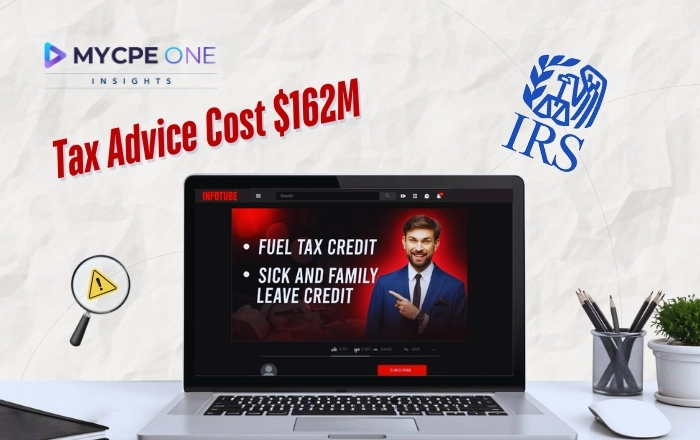
The IRS has levied $162 million in penalties against taxpayers who followed fraudulent tax advice from social media influencers. As these "tax hacks" circulate online, with misinformation primarily focused on Fuel Tax Credits and the Sick and Family Leave Credit, the IRS is also planning to shut down nine Taxpayer Assistance Centers in November, which could leave taxpayers vulnerable to scams.
Tax season just got messier than barbecue sauce at a tailgate. The IRS recently dropped the hammer with $162 million in penalties against taxpayers who chased viral “tax hacks” that turned out to be bogus. Many were misled by influencers promoting credits such as the Fuel Tax Credit and the Sick and Family Leave Credit, even though most filers don’t qualify. Adding to the pressure, the IRS also plans to close nine Taxpayer Assistance Centers this November, trimming in-person help options. Put together, the message is loud and clear: taxpayers need to watch where they get their guidance, or they’ll get burned.
This mess didn’t start overnight. During the pandemic, the government rolled out temporary relief measures like the Employee Retention Credit (ERC) and pandemic-era leave credits. Originally intended for businesses and the self-employed, these programs quickly turned into the Wild West of social media. TikTok, Instagram, and Facebook groups were suddenly flooded with “experts” promising easy refunds. Some urged taxpayers to file amended returns with cookie-cutter language, claiming everyone was eligible. Fast-forward a few years, and the trend morphed into false claims on the Fuel Tax Credit, meant mainly for farmers and “off-highway business” use, and the Sick and Family Leave Credit, which expired after 2021. Bad actors kept the hustle alive, convincing people they could snag “guaranteed refunds” if they just ignored the fine print.
The IRS says it has imposed over 32,000 penalties, totaling $162 million, on taxpayers who fell for the hype. Each frivolous claim can trigger a $5,000 penalty under Section 6702, in addition to delayed refunds, denied claims, and potential future audits. James Clifford, IRS Director of Return Integrity and Compliance Services, didn’t mince words: “These schemes are not only misleading but can cost taxpayers dearly.” The agency is also cracking down on so-called “ERC mills”, shops that mass-produce ineligible refund claims for a fee. As Ex-Commissioner Danny Werfel put it, “If it sounds too good to be true, it probably is.” With in-person TACs closing, the odds of taxpayers leaning on sketchy social media advice instead of IRS professionals are only going up.
But here’s the twist. At the very moment taxpayers are drowning in misinformation, the IRS is also shutting down nine in-person assistance centers. These offices logged 1.6 million face-to-face meetings in 2023, often assisting seniors, low-income households, or individuals without reliable internet access. Critics argue the closures leave taxpayers more vulnerable to scammers, especially when official help becomes harder to reach.
The IRS knows this isn’t just about one credit. Social media is influencing how millions of taxpayers perceive filing, refunds, and credits. To counteract misinformation, expect the agency to lean on technology. That means:
Tax credits, such as the Child Tax Credit and education credits, could be the next targets for misuse. Translation: this $162 million wave is probably just round one.
For CPAs, enrolled agents, and tax advisors, this moment is a wake-up call. Clients are often walking in after being “educated” by social media, and it’s up to professionals to redirect them with facts. Practical steps include:
By positioning themselves as the antidote to misinformation, professionals can both protect clients and build long-term trust.
For everyday taxpayers, the lesson is simple: don’t take financial advice from someone going viral for dance videos. A few street-smart tips:
As tax attorney Adam Brewer summed it up: “If the advice sounds too good to be true, reach out to a CPA or tax attorney; it could save you a big headache in the long run.”
Bad tax advice isn’t just annoying; it’s expensive. With $162 million in penalties already doled out and fewer in-person IRS resources on the horizon, taxpayers and professionals need to stay sharper than ever. Think of it like your health: you wouldn’t trust TikTok for a medical diagnosis, so why gamble your financial future on a viral hack? The cheapest insurance against a tax disaster is simple work with a qualified professional and leave the “too good to be true” tips where they belong, scrolling on your feed. Smart money moves start here. Join thousands of pros reading us weekly.
Until next time…
Don’t forget to share this story on LinkedIn, X and Facebook
Subscribe now for $199 and get unlimited access to MYCPE ONE, from CPE credits to insights Magazine
📢MYCPE ONE Insights has a newsletter on LinkedIn as well! If you want the sharpest analysis of all accounting and finance news without the jargon, Insights is the place to be! Click Here to Join
Unlimited CPE for Just $199/Year!
Get CPE credits by reading or listening to approved content. Enjoy unlimited CPE for CPA (US), EA, CMA, CIA, CFE, SHRM, HRCI, and 100+ other designations—all for just $199 per year! (Learn More)
Team Subscriptions Available – Starting at Just $199/Year!
Schedule a no-obligation callYou’ve reached the 3 free-content piece limit. Unlock unlimited access to all News & CPE resources.
Subscribe Today.
Already have an account?
Sign In