Join 250,000+
professionals today
Add Insights to your inbox - get the latest
professional news for free.
Join our 250K+ subscribers
Subscribe25 SEP 2025 / IRS UPDATES
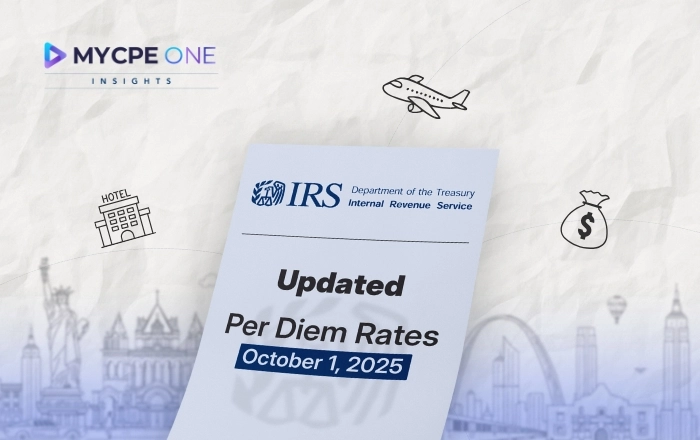
The IRS has confirmed that per diem rates for lodging, meals, and incidental expenses will remain unchanged from last year in 2025, and it also plans to eliminate paper checks from the government payment system by September 30, 2025. While consistency is beneficial for companies and accountants, rising travel costs mean employees may find daily allowances inadequate, which could lead to corporate policy tensions and potentially push the IRS to adjust rates in 2026.
Business travelers hoping for a little extra cushion in 2025 will have to wait. In Notice 2025-54, the IRS confirmed that per diem rates for lodging, meals, and incidental expenses will remain unchanged from last year. And that’s not the only freeze coming from the taxman; the agency also plans to eliminate paper checks from the government payment system by September 30, 2025. On the surface, these changes look like administrative housekeeping, but together they spark bigger questions: how do flat allowances stack up against rising travel costs, what does the shift away from paper mean for reimbursements, and where do businesses and employees go from here?
Starting October 1, 2025, the high-low substantiation rates will stay the same:
For companies and accountants, this consistency keeps systems and policies steady. For employees, however, it may feel like déjà vu as daily allowances lag behind real-world costs. The last adjustment came in 2024, when the IRS bumped per diem rates from $309 / $214 to $319 / $225, and raised transportation industry M&IE from $69 / $74 to $80 / $86. That increase reflected higher travel costs at the time. By contrast, the 2025 freeze suggests the IRS is prioritising stability, even as inflation continues to influence lodging and food prices.
Flat rates are good news for employers; they avoid policy changes and reduce audit risk. But for employees travelling to high-cost cities like New York, San Francisco, or Miami, $319 often won’t stretch far. The result is tension:
If inflation keeps pushing travel prices higher, the IRS may face pressure to adjust rates again in 2026. More cities could also be added to the “high-cost” list, raising caps in select markets. Until then, organizations should document their policies carefully and communicate openly with staff to manage expectations. The IRS’s decision to freeze per diem rates for 2025 simplifies compliance but complicates the reality of business travel. With costs rising, the unchanged numbers risk widening the gap between tax law and actual spending. For accountants, controllers, and CFOs, the challenge lies in balancing clean compliance with fair treatment of employees. The IRS may be holding rates steady, but the conversation around travel costs is anything but flat.
Until next time…
Don’t forget to share this story on LinkedIn, X and Facebook
Subscribe now for $199 and get unlimited access to MYCPE ONE, from CPE credits to insights Magazine
📢MYCPE ONE Insights has a newsletter on LinkedIn as well! If you want the sharpest analysis of all accounting and finance news without the jargon, Insights is the place to be! Click Here to Join
Earn CPE Credits by Simply Reading Articles – Starting at Just $199/Year!
50 of the Top 200 Accounting Firms trust MYCPE ONE for their team’s learning—why not you? With 15,000+ approved content hours, 500+ emerging subject areas, and automated compliance tracking, staying ahead has never been easier.
We don’t just create boring tax, accounting, and audit content—our platform offers engaging, insightful, and trending material that your team will actually enjoy while earning CPE credits.
Sign up today, go through the comprehensive list of features and unlock unlimited learning!
You’ve reached the 3 free-content piece limit. Unlock unlimited access to all News & CPE resources.
Subscribe Today.
Already have an account?
Sign In