

MYCPE ONE
MYCPE ONE LOGO

Join 250,000+
professionals today

Add Insights to your inbox - get the latest
professional news for free.

MYCPE ONE insights

New IRS Tracking System Could End a Major Tax Headache

Join our 250K+ subscribers

Join our 250K+ subscribers

Subscribe

29 MAY 2026 / IRS UPDATES

New IRS Tracking System Could End a Major Tax Headache

New IRS Tracking System Could End a Major Tax Headache

Imagine mailing a rent check, watching it clear your bank account, and then hearing your landlord say, "Sorry, we can't find it." That is essentially the headache some taxpayers face when the IRS receives a payment but cannot immediately connect it to the right account. It sounds like a problem from the filing cabinet era. In some ways, it is. A recent report from the Treasury Inspector General for Tax Administration (TIGTA) revealed that the IRS is still relying on spreadsheets, paper files, and manual processes to track billions of dollars in unidentified payments. Now the agency says it will build a new electronic case management system designed to bring order to the chaos. For tax professionals, the announcement is more than an internal technology upgrade. It could eventually mean fewer payment-tracing cases, fewer frustrated client calls, and a smoother path to resolving payment disputes.

Why Is the IRS Building This System Now?

Between fiscal years 2022 and 2024, the IRS received approximately $3.2 billion in unidentified payments. These are payments that cannot be immediately matched to a taxpayer's account because critical information is missing or incomplete. Think checks without taxpayer identification numbers. Money orders missing tax period information. Payments that arrive but lack enough details for the IRS to know exactly where they belong. The IRS successfully applied about $2.3 billion, or 70%, to taxpayer accounts. Yet $741 million was removed from inventory or transferred to excess collections after remaining unresolved for a year, while another $218 million remained unresolved.

TIGTA's findings paint a picture that would make any process improvement consultant wince. The IRS currently manages unidentified payments through three separate tax processing centers that use independent systems. Cases are assigned manually. Employees often rely on spreadsheets and paper files. Performance metrics are limited. Timeliness standards do not formally exist. In one example, the Ogden, Utah processing center handled roughly 40% of unidentified payment inventory, while the Kansas City center handled about 11%, despite having similar staffing levels.

What Exactly Will Be Built?

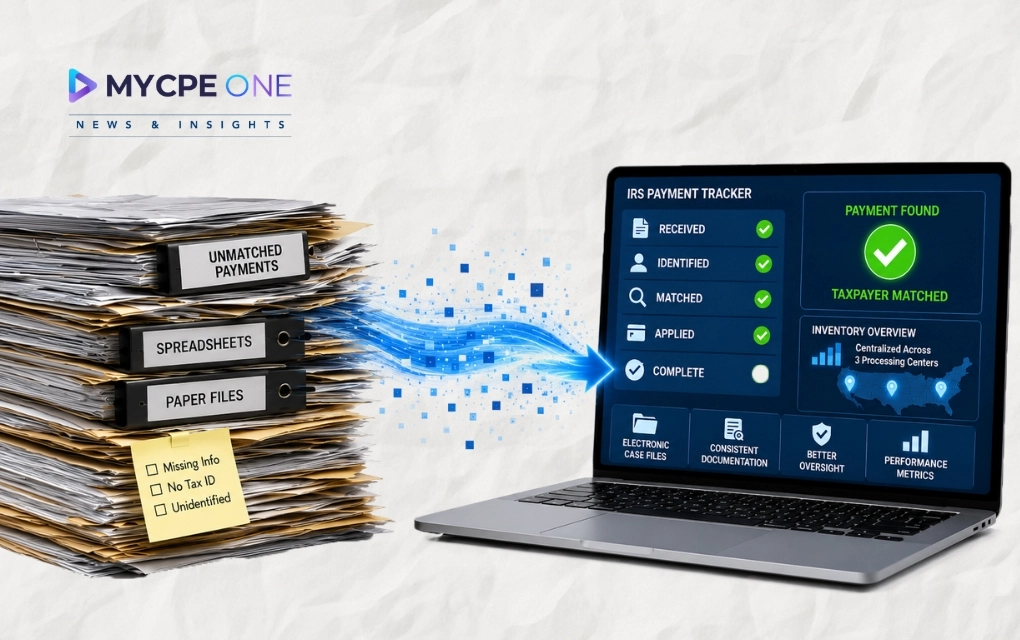
The IRS has agreed to develop an electronic case management system for unidentified payments and payment tracer cases. The planned system will centralize oversight across all processing centers and replace many of the manual tracking methods currently in use.

According to TIGTA, the system is expected to:

  • Provide centralized inventory management.
  • Allow employees to work electronic case files.
  • Improve documentation consistency.
  • Reduce employee errors.
  • Help balance workloads among processing centers.
  • Create better internal controls and oversight.
  • Support performance tracking and program metrics.

The agency has already implemented an interim process for tracking so-called "hardcore payment tracers," which are cases used to locate missing or misapplied taxpayer payments. The broader electronic system is intended to serve as a long-term solution rather than a temporary patch.

Interestingly, this effort also aligns with the federal government's wider push toward electronic payments and records management. Even with that push underway, the IRS reported receiving 41.4 million paper payments during calendar year 2025, alongside 261.2 million electronic payments. That is a lot of envelopes still moving through the system.

When Will It Be Up and Running?

That is the million-dollar question. Or perhaps the $3.2 billion question. At the moment, the IRS has not announced a public launch date.

Here's what we know:

  • May 21, 2026: TIGTA released its report.
  • May 2026: The IRS agreed with all recommendations.
  • Current status: An interim tracking process for hardcore payment tracers is already operating.
  • Future status: The full electronic case management system remains under development.

The agency is also working on metrics to measure program effectiveness and resolution timeliness, which have been largely absent from the current process. In other words, the IRS has committed to building the system, but taxpayers and practitioners should not expect a switch to flip overnight.

What's In It for Tax Professionals?

  • Faster case resolution: Reduced manual tracking means quicker identification of missing payments, allowing you to close client cases faster
  • Less follow-up burden: Fewer client calls, letters, and IRS visits mean less time spent fielding urgent client inquiries about missing payments
  • Better visibility: centralized inventory oversight across all 3 processing centers lets you track case status more reliably
  • Consistent documentation: Reduced employee error at the IRS means fewer mistakes in your clients' payment records and fewer corrections needed
  • Predictable timelines: Once timeliness criteria are established, you can give clients realistic expectations about resolution timeframes
  • Reduced workload imbalance: Balanced workloads across centers (currently 40% at Ogden vs. 11% at Kansas City) will reduce delays for your clients' cases
  • Streamlined "hardcore payment tracer" cases: The interim process already helps with the most complex missing payment cases your firm handles

The Bottom Line

The IRS is building this new electronic case management system because its current process relies heavily on manual tracking, fragmented oversight, and outdated workflows that have struggled to manage $3.2 billion in unidentified payments over the last three fiscal years. The agency has agreed with every recommendation made by TIGTA and has already started implementing interim fixes. While no official launch date exists yet, the broader system is expected to modernize how missing taxpayer payments are tracked, resolved, and monitored.

Until next time…

Don’t forget to share this story on LinkedIn, X and Facebook

Subscribe now for $199 and get unlimited access to MYCPE ONE, from CPE credits to insights Magazine

📢MYCPE ONE Insights has a newsletter on LinkedIn as well! If you want the sharpest analysis of all accounting and finance news without the jargon, Insights is the place to be! Click Here to Join

Unlock Annual Access to News & CPE Subscription

You’ve reached the 3 free-content piece limit. Unlock unlimited access to all News & CPE resources.
Subscribe Today.

News & Updates

  • Exclusive News & Insights
  • Latest Regulatory Updates
  • Accounting Industry Trends
  • Expert Insights
  • AI-Driven Audio & Summaries
  • Infographics & Videos
  • CPE-Approved Articles
  • Digital Magazine
  • Benchmarking Blogs

Unlimited CPE Access for 1 Year

  • 15,000+ Hours of Content
  • 500+ Subject Areas
  • Mandatory Ethics Courses
  • 250+ Compliance Packages
  • 50+ Virtual Conferences and Events Access
  • Format: Live, Audio, Video, E-Books
  • Audio Based Courses & Podcasts
  • Add External Certificates with AI
  • AI Compliance Tracking and Report
  • Instant Certification and Fast Reporting
  • Mobile App Access (iOS and Android)
  • Dedicated Support System
  • Practical Training Programs
  • AI Academy Access
  • Tax Academy Access
  • Audit Academy Access
  • Leadership Academy Access