MYCPE ONE
MYCPE ONE LOGO

Join 250,000+
professionals today

Add Insights to your inbox - get the latest
professional news for free.

MYCPE ONE insights

IRS FAQs Reveal the Fine Print on Crypto Reporting

Join our 250K+ subscribers

Join our 250K+ subscribers

Subscribe

07 NOV 2025 / IRS UPDATES

IRS FAQs Reveal the Fine Print on Crypto Reporting

IRS FAQs Reveal the Fine Print on Crypto Reporting

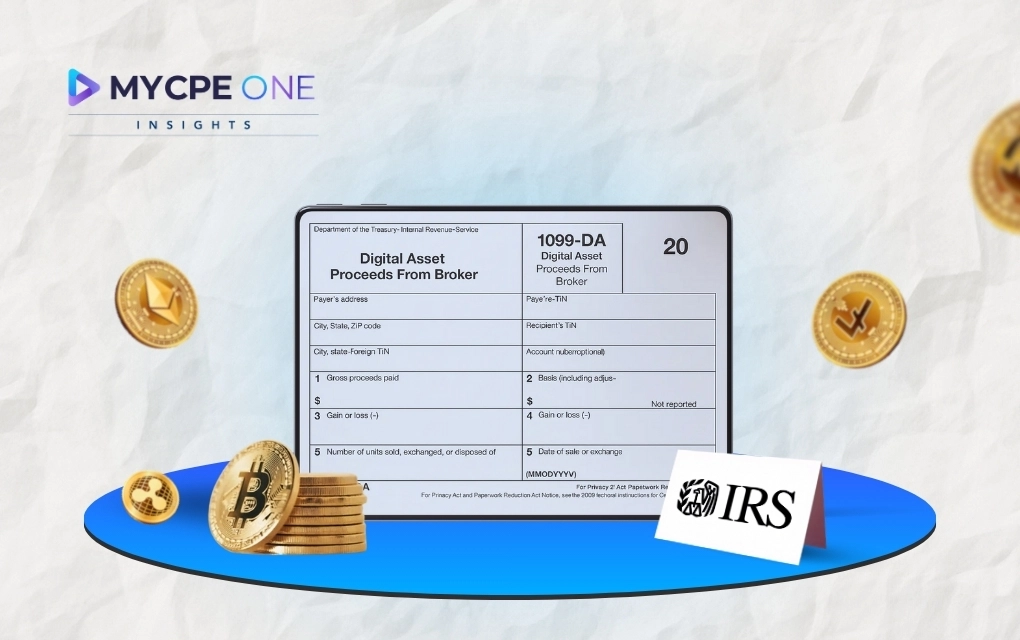
Ever had a party crash where someone shows up with a clipboard? That’s basically what just happened to the crypto world. Starting in 2026, the IRS is rolling in with Form 1099-DA, the agency’s shiny new way of saying, “We’re watching your wallet.” For accountants, tax pros, and financial advisors, this isn’t just another form; it’s a full-blown data marathon disguised as a compliance update.

The IRS Goes Blockchain-Sherlock

For years, crypto taxation has been a free-for-all. Investors traded tokens, minted NFTs, swapped coins across exchanges, and accountants were left chasing cost basis ghosts. Then came the Infrastructure Investment and Jobs Act of 2021, which amended Section 6045 of the Internal Revenue Code. Translation: crypto platforms are now “brokers,” and starting January 1, 2025, they must report all sales or exchanges on Form 1099-DA.


That means come the 2026 tax season, investors and Uncle Sam both get a form spelling out crypto gains, losses, and transactions. Think of it like Form 1099-B for stocks, except now it’s for Bitcoin, Dogecoin, and that NFT of a pixelated cat someone spent ten grand on. Fun fact: the IRS even had to clarify what to do when a stablecoin “de-pegs.” If your coin drifts more than 3 percent from the dollar for 10 days straight, it flunks the “stable” test. Yep, there’s a rule for that now.

Broker or Just Messenger?

Here’s where things get spicy. The IRS’s “broker” net is wide enough to catch just about anyone in the crypto chain who can identify a user. So, if your platform moves coins for customers, runs a kiosk that trades tokens for cash, or facilitates exchanges. Congrats, you might be a broker. But if you’re just holding assets (like a digital vault) without executing sales, you’re off the hook. The new FAQs even spell it out: a business that only transfers crypto to an exchange doesn’t have to file a 1099-DA. A kiosk that actually sells coins? You’re in the hot seat.

Tax pro Tomer Siegal at Ledgible put it bluntly on LinkedIn: kiosks that sell crypto are “digital asset middlemen” under the law. And custodial brokers can rely on “reasonably reliable” customer data for figuring out which coins were sold, but not for reporting cost basis. In other words, you can use a PDF from another broker to estimate your order of sale, but not to calculate gains. Talk about splitting hairs.

Cost Basis Chaos and the Zero Dilemma

Here’s the real headache: cost basis. In traditional finance, if you move stocks between brokers, they share your purchase data. Easy. In crypto? Not so much. Wallets and exchanges often don’t talk to each other. So, if you bought Ethereum in 2019 on Kraken, moved it to Coinbase, and sold it in 2025, Coinbase might report your cost basis as zero. Zero basis equals massive taxable gains, even if you actually lost money. That’s the kind of math that sends accountants reaching for aspirin. Tax pros already warn clients to use crypto tax software or risk audit nightmares. As one advisor joked, “It’s like doing your taxes with 12 different puzzle boxes and no picture on the lid.”

NFTs, FEEs, and all that Jazz

The IRS even had to issue a correction for NFT sales. On the 2025 Form 1099-DA, there’s a typo saying creators must fill in both Box 1f and Box 11c for their first NFT sales. Nope. The IRS confirmed only Box 11c counts. One box, not two. Small win, but hey, we’ll take it. Transaction fees? Also regulated. If your client sells 100 units of a token and pays 1 unit as a fee, you’ll use FIFO, first-in, first-out, to decide which coin paid that fee. That’s right, even your gas fees now come with a tax-logic algorithm.

Accountants in the Crossfire

So, is Form 1099-DA a blessing or a burden? It depends on your caffeine tolerance. On one hand, it’s a step toward treating crypto like any other security: transparency, standardized reporting, and less guesswork. On the other hand, it’s a jungle of conflicting data, mis-tagged self-transfers, and overlapping broker reports. Imagine reconciling ten 1099-DAs from six exchanges, all reporting slightly different numbers. Sounds fun, right? IRS penalties under Sections 6721 and 6722 still apply for incorrect filings. Brokers get no free passes. Investors? They’ll get matching notices faster than you can say “Schedule D.”

If you’re advising clients, here’s the playbook:

  • Start now. Track every wallet, every transfer, every token.
  • Educate your clients. Many don’t realize that crypto moved between wallets can still trigger reporting mismatches.
  • Test your tools. Choose crypto tax software that can import multiple exchanges and flag discrepancies.
  • Brace for the first wave. Form 1099-DA hits inboxes in early 2026, but cost-basis reporting fully ramps up by 2027.

As Benjamin Franklin (a guy who knew a thing or two about taxes) might say if he were alive today: In this world, nothing can be said to be certain, except death, taxes, and now, crypto forms.

Takeaway

Form 1099-DA isn’t the end of crypto freedom; it’s the start of crypto adulthood. Accountants will grumble, investors will scramble, and the IRS will smile knowing the blockchain just got a little less anonymous. So, buckle up, sharpen those spreadsheets, and remember in the crypto tax world, every Satoshi counts.

Until next time…

Don’t forget to share this story on LinkedIn, X and Facebook

Subscribe now for $199 and get unlimited access to MYCPE ONE, from CPE credits to insights Magazine

📢MYCPE ONE Insights has a newsletter on LinkedIn as well! If you want the sharpest analysis of all accounting and finance news without the jargon, Insights is the place to be! Click Here to Join

Scale Your Accounting Firm the Smart Way with MYCPE ONE!

Your Trusted Offshore Partner for CPAs and Accounting Firms.

Struggling to scale? Let MYCPE ONE’s offshore accounting team help you grow faster and more efficiently.

With 500,000+ vetted professionals across 40 offices in 2 countries, we provide you access to top talent and advanced technology, all while handling the hiring process for you.

Trusted by 3,000+ firms, including 45+ BDO Alliance Firms and 40+ of the Top 200 Accounting Firms!

Start building your offshore dream team today with MYCPE ONE!

Scale smarter. Save bigger. Stay ahead.

Schedule a call!

Unlock Annual Access to News & CPE Subscription

You’ve reached the 3 free-content piece limit. Unlock unlimited access to all News & CPE resources.
Subscribe Today.

News & Updates

  • Exclusive News & Insights
  • Latest Regulatory Updates
  • Accounting Industry Trends
  • Expert Insights
  • AI-Driven Audio & Summaries
  • Infographics & Videos
  • CPE-Approved Articles
  • Digital Magazine
  • Benchmarking Blogs

Unlimited CPE Access for 1 Year

  • 15,000+ Hours of Content
  • 500+ Subject Areas
  • Mandatory Ethics Courses
  • 250+ Compliance Packages
  • 50+ Virtual Conferences and Events Access
  • Format: Live, Audio, Video, E-Books
  • Audio Based Courses & Podcasts
  • Add External Certificates with AI
  • AI Compliance Tracking and Report
  • Instant Certification and Fast Reporting
  • Mobile App Access (iOS and Android)
  • Dedicated Support System
  • Practical Training Programs
  • AI Academy Access
  • Tax Academy Access
  • Audit Academy Access
  • Leadership Academy Access