MYCPE ONE
MYCPE ONE LOGO

Join 250,000+
professionals today

Add Insights to your inbox - get the latest
professional news for free.

MYCPE ONE insights

IRS Forms 1099-NEC and 1099-MISC Can Produce Different Tax Bills

Join our 250K+ subscribers

Join our 250K+ subscribers

Subscribe

23 FEB 2026 / IRS UPDATES

CPE Approved

IRS Forms 1099-NEC and 1099-MISC Can Produce Different Tax Bills

IRS Forms 1099-NEC and 1099-MISC Can Produce Different Tax Bills

A single IRS form can quietly move income from ordinary taxation into payroll-level taxes. And most clients have no idea it is happening. Every January, Forms 1099 start landing in mailboxes and inboxes. To many, they feel like routine compliance noise. To the IRS matching system, though, they are data triggers. A Form 1099-NEC often points straight to Schedule C and self-employment tax. A Form 1099-MISC might not. For accountants and finance leaders, that distinction is not paperwork. It is tax exposure. Let’s break down why this tiny form packs a punch.

The IRS Is Basically Saying, “Show Me Schedule C.”

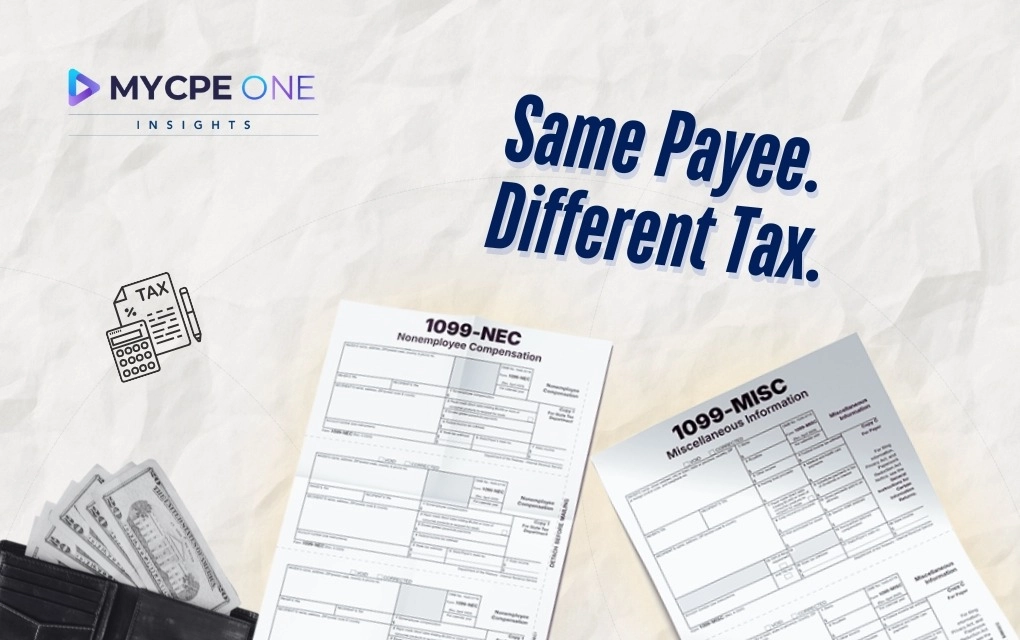
Form 1099-NEC reports nonemployee compensation. If a business pays $600 or more in 2024 or 2025 to an independent contractor, consultant, director, or outside professional for services, it generally issues a 1099-NEC. That threshold jumps to $2,000 for payments made in 2026 and will be indexed for inflation thereafter. Box 1 is where the action is. When the IRS sees income in Box 1 of Form 1099-NEC, it usually expects to see that amount reported on Schedule C. And that expectation matters. Self-employment tax currently runs at 15.3% up to the Social Security wage base, with 2.9% Medicare tax continuing above that threshold. In other words, this is not chump change. A six-figure 1099-NEC can trigger five figures of additional tax before income tax is even calculated.

Technically, the form does not automatically create self-employment tax. Facts and circumstances still control. But in practice, a 1099-NEC sends a loud signal to the IRS matching system. If the income shows up somewhere other than Schedule C, the odds of a CP2000 notice increase. That is where things can get messy fast.

1099-MISC

After the IRS split nonemployee compensation into its own form in 2020, Form 1099-MISC became more of a specialized reporting tool. It now covers:

  • Rents in Box 1
  • Royalties in Box 2
  • Other income in Box 3
  • Medical and health care payments in Box 6
  • Gross proceeds paid to attorneys in Box 10

Many of these payments are taxable, but they do not automatically trigger self-employment tax. Box 3 “other income” is where confusion often starts. Certain settlements, awards, termination payments, or punitive damages may land here. They are still taxable, but they may not be tied to a trade or business. That means no Schedule C and no self-employment tax in some cases.

Here is where professionals need to stay sharp. The box number matters. A lot. Take attorney payments. Attorneys’ fees for services go on Form 1099-NEC, Box 1. But gross proceeds paid to an attorney in connection with a settlement go on Form 1099-MISC, Box 10. Same payee. Same case. Different form. Different tax implications. Reverse those forms, and you are basically inviting the IRS to misread the income. That is not a great look when automated notices start rolling out.

The 1099-K Plot Twist

Now layer in Form 1099-K, and things get even more interesting. Form 1099-K reports payments processed through third-party networks like PayPal or Venmo. Congress lowered the threshold to $600 back in 2021. The IRS delayed implementation used a $5,000 threshold for 2024, and then the One Big Beautiful Bill Actin July 2025 pushed the reporting threshold back to more than $20,000 in payments and more than 200 transactions beginning with the 2025 tax year, retroactive to 2022. So, we have shifting thresholds, retroactive legislation, and overlapping reporting forms. If that sounds like a compliance headache, that is because it is. And here is the kicker. Even if a client does not receive a Form 1099-NEC or 1099-K, they are still required to report all income. The form is evidence. It is not the rule.

The Tax Still Has to be Right

Payers make mistakes. They use the wrong form. They check the wrong box. They misclassify attorney fees as gross proceeds or vice versa. The first step is always to request a corrected form. That keeps IRS transcripts clean and reduces matching problems. But if a correction never comes, the taxpayer still has to report the income properly. Income is taxable whether the form is accurate, inaccurate, or never received at all. Clear disclosure, consistent treatment, and documentation of the reporting position are essential. Practitioners should align reporting with the actual nature of the payment, not blindly follow the form.

Self-Employment Tax

At the end of the day, most of this debate boils down to one question. Does this income trigger self-employment tax? That answer affects estimated tax payments using Form 1040-ES, retirement contribution limits, entity structuring decisions, and cash flow planning. If net self-employment income hits $400 or more, Schedule SE likely comes into play. As one tax advisor put it, “If you’re self-employed, you’re responsible for paying Social Security and Medicare taxes in addition to income taxes. This extra tax is known as the self-employment tax. However, you can deduct 50 percent of the self-employment tax you pay.” That deduction helps, but it does not erase the impact. For finance leaders advising contractors, founders, or professional service providers, reviewing 1099 classification is not clerical work. It is risk management. It shapes how the IRS reads the return before a human ever touches it.

Bottom Line

Forms 1099-NEC and 1099-MISC may look similar, but they send very different signals to the IRS. One frequently points to Schedule C and the self-employment tax. The other may not. Throw Form 1099-K into the mix, and reporting becomes even more nuanced. For accounting and finance professionals, the real job is not just entering the numbers. It is understanding what that number tells the IRS and making sure the tax treatment matches the facts. Because in a world of automated matching and AI-driven notices, the wrong box can snowball into a bigger problem than anyone expected. If you want more breakdowns on how reporting mechanics quietly shape tax outcomes, subscribe and stay tuned. The details are where the real strategy lives.

Click here to get your CPE Credit.

Until next time…

Don’t forget to share this story on LinkedIn, X and Facebook

Subscribe now for $199 and get unlimited access to MYCPE ONE, from CPE credits to insights Magazine

📢MYCPE ONE Insights has a newsletter on LinkedIn as well! If you want the sharpest analysis of all accounting and finance news without the jargon, Insights is the place to be! Click Here to Join

Unlock Annual Access to News & CPE Subscription

You’ve reached the 3 free-content piece limit. Unlock unlimited access to all News & CPE resources.
Subscribe Today.

News & Updates

  • Exclusive News & Insights
  • Latest Regulatory Updates
  • Accounting Industry Trends
  • Expert Insights
  • AI-Driven Audio & Summaries
  • Infographics & Videos
  • CPE-Approved Articles
  • Digital Magazine
  • Benchmarking Blogs

Unlimited CPE Access for 1 Year

  • 15,000+ Hours of Content
  • 500+ Subject Areas
  • Mandatory Ethics Courses
  • 250+ Compliance Packages
  • 50+ Virtual Conferences and Events Access
  • Format: Live, Audio, Video, E-Books
  • Audio Based Courses & Podcasts
  • Add External Certificates with AI
  • AI Compliance Tracking and Report
  • Instant Certification and Fast Reporting
  • Mobile App Access (iOS and Android)
  • Dedicated Support System
  • Practical Training Programs
  • AI Academy Access
  • Tax Academy Access
  • Audit Academy Access
  • Leadership Academy Access