


Join 250,000+
professionals today
Add Insights to your inbox - get the latest
professional news for free.
Join our 250K+ subscribers
Subscribe24 APR 2026 / IRS UPDATES
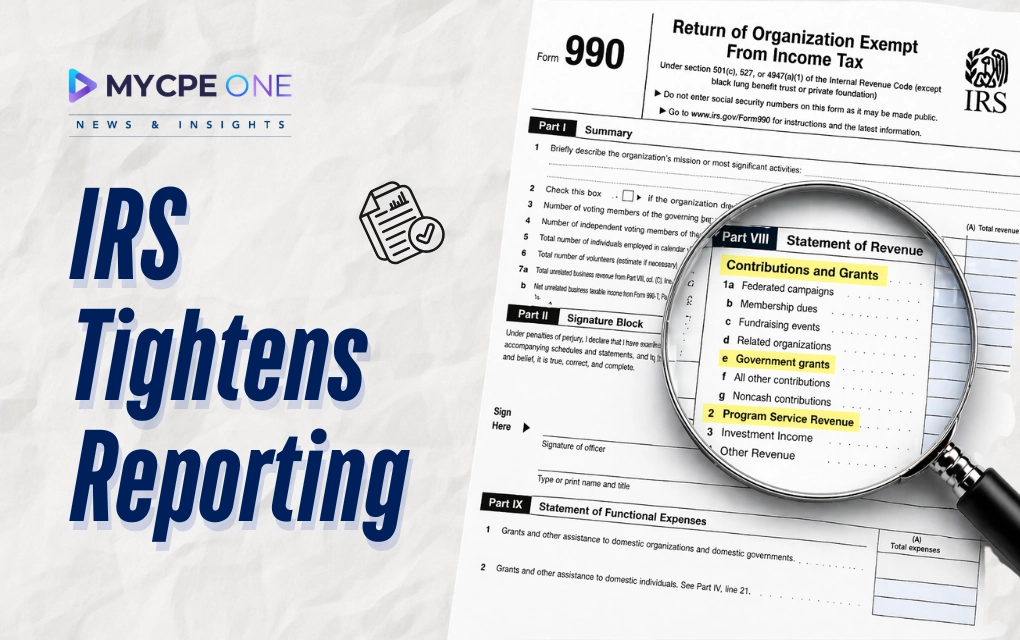
The IRS has planned a revamp of Form 990, the annual return filed by tax-exempt organizations, in a move signaling more comprehensive disclosures around government contracts, grants, and fiscal sponsorship arrangements, along with increased transparency surrounding executive compensation. This new push is accompanied by a call for whistleblowers to report any misuse of federal funds within these organizations, who could receive up to 30% of the proceeds collected by the IRS.
It used to be that Form 990 was a quiet compliance exercise. File it, archive it, move on. Now it is starting to look less like paperwork and more like a spotlight. And not the soft kind. The IRS just turned the dial up. Between a planned overhaul of Form 990 and a fresh push for whistleblowers, tax-exempt organizations are stepping into a new era where “show me the money” is not just a movie line, it is policy. So, what is really going on here, and why should accountants, auditors, and advisors care?
At the center of this shift is a revamp of Form 990, the annual return filed by tax-exempt organizations under Section 501(c)(3). Treasury and the IRS want more detail. Not a little more. A lot more. We are talking about deeper disclosures around government contracts, grants, and how funds move through fiscal sponsorship arrangements. If money flows from a federal grant to a sponsored project, the IRS now wants to know who controls it, who spends it, and where it lands. That last part is key.
Fiscal sponsorship has long been a gray area for some organizations. It is legitimate, widely used, and often essential for smaller initiatives. But it can also get messy. Think layered entities, pass-through funding, and unclear accountability. The IRS is basically saying, “No more guessing.” And if you are thinking this sounds like audit prep baked into a tax form, you are not wrong.
The IRS is pushing toward mandatory e-filing for Forms 990 and 990-EZ. The paper is out. Digital is in. That alone changes how organizations track, store, and review data. But the bigger shift is in disclosure.
Organizations will need to break down:
And yes, executive pay is getting extra attention. If compensation crosses certain thresholds, Schedule J kicks in with detailed breakdowns. Base pay. Incentives. Retirement benefits. The whole package. Recent rules expanding the 21% excise tax on compensation above $1 million mean nonprofits cannot just track the “top five” anymore. High earners across the organization, and even across related entities, are now part of the picture. That is not just compliance. That is forensic accounting territory.
Right as organizations are digesting these changes, the IRS dropped something else. A whistleblower alert. For the first time, the agency is actively calling on insiders to report misuse of federal funds tied to tax-exempt entities. And they are not being subtle about it. They listed examples like false grant applications, self-dealing, improper payments to insiders, and even failure to deliver promised outcomes. And here is the kicker, whistleblowers can receive up to 30% of the proceeds collected by the IRS based on their information. That is not pocket change. It changes behavior. Inside finance teams, governance committees, and even among external advisors, the calculus shifts. People notice things. People ask questions. And sometimes, people pick up the phone. If you have ever heard the phrase “loose lips sink ships,” this is the compliance version.
Treasury officials have been clear that the goal is to reduce fraud, abuse, and misuse of taxpayer dollars. Fair enough. Public funds come with public accountability. But there is another layer. Recent political and regulatory signals suggest a broader focus on how tax-exempt organizations use funds, especially when it intersects with policy, advocacy, or controversial activities. There have already been high-profile cases and investigations involving nonprofit funding flows. Some are still unfolding, and details are not always clear. So yes, this is about fraud detection. But it is also about visibility. The IRS wants a cleaner, more traceable map of where nonprofit money comes from and where it goes. And once that map exists, it can be used for a lot of different purposes.
If you work with nonprofits, this is not a “wait and see” moment. This is a “get your house in order” moment.
And finally, risk assessment needs a refresh. Ask yourself, if someone inside the organization filed a whistleblower claim tomorrow, what would they point to?
There is an old saying in accounting: “Trust, but verify.” The IRS seems to be dropping the first part. Tax-exempt status still carries benefits. No question. But it also comes with growing expectations around transparency, accountability, and traceability. Form 990 is no longer just a filing requirement. It is becoming a public report card, an audit trail, and in some cases, a starting point for investigations. So, the next time someone says, “It’s just the 990,” you might want to smile and say, “Not anymore.” Because in this new setup, the numbers do not just tell a story. They invite questions.
Until next time…
Don’t forget to share this story on LinkedIn, X and Facebook
Subscribe now for $199 and get unlimited access to MYCPE ONE, from CPE credits to insights Magazine
📢MYCPE ONE Insights has a newsletter on LinkedIn as well! If you want the sharpest analysis of all accounting and finance news without the jargon, Insights is the place to be! Click Here to Join
You’ve reached the 3 free-content piece limit. Unlock unlimited access to all News & CPE resources.
Subscribe Today.
Already have an account?
Sign In