MYCPE ONE
MYCPE ONE LOGO

Join 250,000+
professionals today

Add Insights to your inbox - get the latest
professional news for free.

MYCPE ONE insights

Why 1.4M Taxpayers Are Facing IRS Tax Refund Delays

Join our 250K+ subscribers

Join our 250K+ subscribers

Subscribe

26 MAR 2026 / IRS UPDATES

Why 1.4M Taxpayers Are Facing IRS Tax Refund Delays

Why 1.4M Taxpayers Are Facing IRS Tax Refund Delays

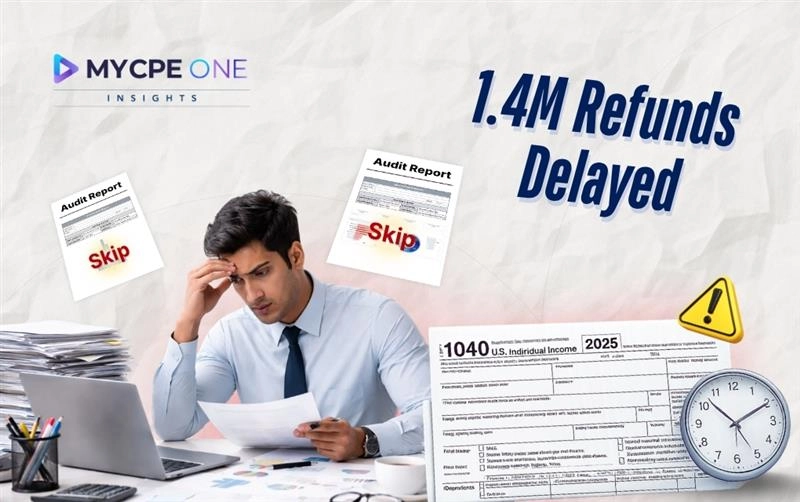
Most taxpayers expect one thing during filing season: speed. File the return, wait a few weeks, and the refund lands. It’s predictable, almost routine. But this year, that expectation is breaking. Across the country, more than 1.4 million taxpayers are now facing delays in receiving their refunds, and the number isn’t static. It’s growing by roughly 300,000 each week. What’s different this time isn’t a simple backlog. It reflects a broader shift in how IRS systems are operating, how resources are being allocated, and how enforcement priorities are evolving.

The Shift That Started It All

The starting point of this issue lies in a structural change. In March 2025, Executive Order 14247 directed federal agencies, including the IRS, to phase out paper checks and move toward fully electronic payments by the end of September 2025. The objective was clear: improve efficiency, reduce fraud, and lower administrative costs. On paper, the shift looks seamless. During the 2025 filing season, about 94% of taxpayers already used direct deposit. But that still leaves millions who don’t. And that gap is where the system begins to strain.

At the same time, questions around execution were already emerging. A Treasury Inspector General review found that the IRS had overestimated costs for its Direct File program by nearly $45 million, projecting $61.2 million while actual costs came closer to $16.2 million. The issue wasn’t just budgeting, it was planning based on assumptions that didn’t fully reflect taxpayer behavior. Now, that same mismatch is showing up in refund processing.

Where the Process Slows Down

The delay is not caused by a technical failure. It is caused by how the system now handles missing information. Under the new framework, taxpayers who do not provide direct deposit details are required to go through additional steps before refunds are released.

  • Receiving an IRS notice
  • Logging into or creating an IRS account
  • Submitting banking details
  • Waiting for verification

If no action is taken, the IRS does not immediately issue a paper check. Instead, refunds can be held for several weeks before any fallback process begins. This is where delays multiply. And while most taxpayers can adapt, not everyone can do so easily. Roughly 10 million taxpayers still rely on paper checks, often due to structural or personal constraints, not preference.

  • Unbanked or underbanked households
  • Individuals living abroad
  • Elderly taxpayers
  • People with disabilities
  • Victims of domestic violence
  • Taxpayers with religious restrictions

For these groups, paper checks are not optional. They are the only viable method.

How the Delay Timeline Extends

In effect, what used to be a 4–6 week process can now stretch to 10–16+ weeks, depending on how quickly the taxpayer reacts. If you're trying to estimate realistic timelines under these new rules, the breakdown in When Will I Get My Tax Refund in 2026 explains how refund cycles are evolving

A Parallel Issue in IRS Oversight

While individual taxpayers are navigating stricter processes, a parallel shift is happening on the enforcement side. The IRS defines large partnerships as entities with $10 million or more in assets. Over the past decade, these entities have grown significantly in number, from around 140,500 filings in 2011 to nearly 335,000 in 2023. However, audit coverage has moved in the opposite direction. Examination rates have dropped sharply from 2.7% in 2011 to below 0.1% in 2023. That means the IRS is reviewing only a tiny fraction of large, complex partnership filings today.

The decline has accelerated since 2024–2025, when staffing reductions and funding cuts significantly reduced enforcement capacity. The IRS workforce in the pass-through entities division dropped by more than 20% in 2025 alone, limiting the ability to audit complex returns.

Is IRS Pulling Back on Partnership Audits

This shift is not a policy decision to ignore large partnerships. It is a resource constraint. Auditing partnerships is inherently complex. Even after reforms under the Bipartisan Budget Act of 2015, which allowed entity-level audits, challenges remain:

  • Tiered partnership structures make it difficult to trace income flows
  • Adjustments may impact multiple layers of ownership
  • Identifying noncompliance often requires deep transaction-level analysis

Historically, audits were even more intensive. Before 2015, the IRS had to examine each individual partner’s return, making partnership audits one of the most time-consuming processes in tax enforcement. Even today, despite centralized audit frameworks, complexity remains high. Because of this, the IRS has had to prioritize. And with limited staff, it cannot examine every return.

Declining Scrutiny of Large Partnerships

The short answer is yes, but not by design. The IRS is still conducting audits on large partnerships, including a focused review of around 82 of the largest entities, but many of these cases were initiated before recent staffing reductions. More importantly, some enforcement actions are not being fully followed through.

For example:

  • The IRS issued 483 soft letters flagging discrepancies in partnership returns
  • 163 received no response
  • 182 responses were rejected as insufficient
  • Yet, due to time and resource constraints, many of these cases were not escalated into full audits

This suggests that while risks are being identified, they are not always being pursued. It does not mean the IRS is “trusting CPAs” blindly. It means the IRS is operating under constraints that limit how much follow-up it can realistically perform.

A Growing Imbalance in Enforcement

This creates a notable contrast.

On one side:

  • Individual taxpayers face more procedural friction
  • Refunds are delayed due to stricter process requirements

On the other:

  • Large partnerships face lower audit coverage
  • Identified discrepancies are not always pursued

This is not a contradiction in policy. It is a reflection of operational limits. The IRS is tightening processes where automation is possible, while pulling back in areas that require intensive human review. This also explains why some refunds are not just delayed but temporarily held, especially when system validations are incomplete, a scenario explored further in Why Your IRS Tax Refund Could Freeze in Tax Season 2026.

What Professionals Need to Do Now

For tax professionals, this is no longer just a processing issue. It is a client management issue.

Key actions include:

  • Ensure completeness at filing stage
  • Avoid triggering delays due to missing information
  • Educate clients on digital requirements
  • Reduce dependency on paper-based processes
  • Maintain strong documentation for partnerships
  • Even if audits are less frequent, exposure remains
  • Monitor IRS enforcement trends
  • Shifts in focus can change quickly based on funding and policy

Professionals are now navigating both system friction and enforcement gaps at the same time.

What Comes Next

Looking ahead, the IRS is entering a transitional phase where two trends are likely to continue. The agency will keep pushing toward fully digital workflows, reducing reliance on paper-based systems and increasing automation, while audit coverage may remain uneven unless staffing and funding stabilize, with the IRS already indicating it may need to reassess its audit goals due to limited resources. This means systems are becoming more efficient, but also more dependent on user readiness, resource availability, and system accuracy. At a broader level, this situation is not just about delayed refunds or reduced audits, it reflects how a system behaves under pressure. On one side, stricter processes are slowing down individual taxpayers, while on the other, limited resources are reducing oversight of complex entities. For professionals, the shift is clear but uneven, requiring more than compliance, it demands awareness, adaptability, and proactive guidance. Because whether it is a delayed refund or an unreviewed return, the impact ultimately shows up in the same place: trust in the system.

Until next time…

Don’t forget to share this story on LinkedIn, X and Facebook

Subscribe now for $199 and get unlimited access to MYCPE ONE, from CPE credits to insights Magazine

📢MYCPE ONE Insights has a newsletter on LinkedIn as well! If you want the sharpest analysis of all accounting and finance news without the jargon, Insights is the place to be! Click Here to Join

Unlock Annual Access to News & CPE Subscription

You’ve reached the 3 free-content piece limit. Unlock unlimited access to all News & CPE resources.
Subscribe Today.

News & Updates

  • Exclusive News & Insights
  • Latest Regulatory Updates
  • Accounting Industry Trends
  • Expert Insights
  • AI-Driven Audio & Summaries
  • Infographics & Videos
  • CPE-Approved Articles
  • Digital Magazine
  • Benchmarking Blogs

Unlimited CPE Access for 1 Year

  • 15,000+ Hours of Content
  • 500+ Subject Areas
  • Mandatory Ethics Courses
  • 250+ Compliance Packages
  • 50+ Virtual Conferences and Events Access
  • Format: Live, Audio, Video, E-Books
  • Audio Based Courses & Podcasts
  • Add External Certificates with AI
  • AI Compliance Tracking and Report
  • Instant Certification and Fast Reporting
  • Mobile App Access (iOS and Android)
  • Dedicated Support System
  • Practical Training Programs
  • AI Academy Access
  • Tax Academy Access
  • Audit Academy Access
  • Leadership Academy Access