
Join 250,000+
professionals today
Add Insights to your inbox - get the latest
professional news for free.
Join our 250K+ subscribers
Subscribe12 JAN 2026 / IRS UPDATES
The U.S. Internal Revenue Service (IRS) is proposing changes to taxation rules for digital income under the One Big Beautiful Bill Act. These changes aim to improve the accuracy of taxation and better regulate third-party settlement organizations like PayPal and Airbnb, ensuring consistently applied thresholds and backup withholdings.
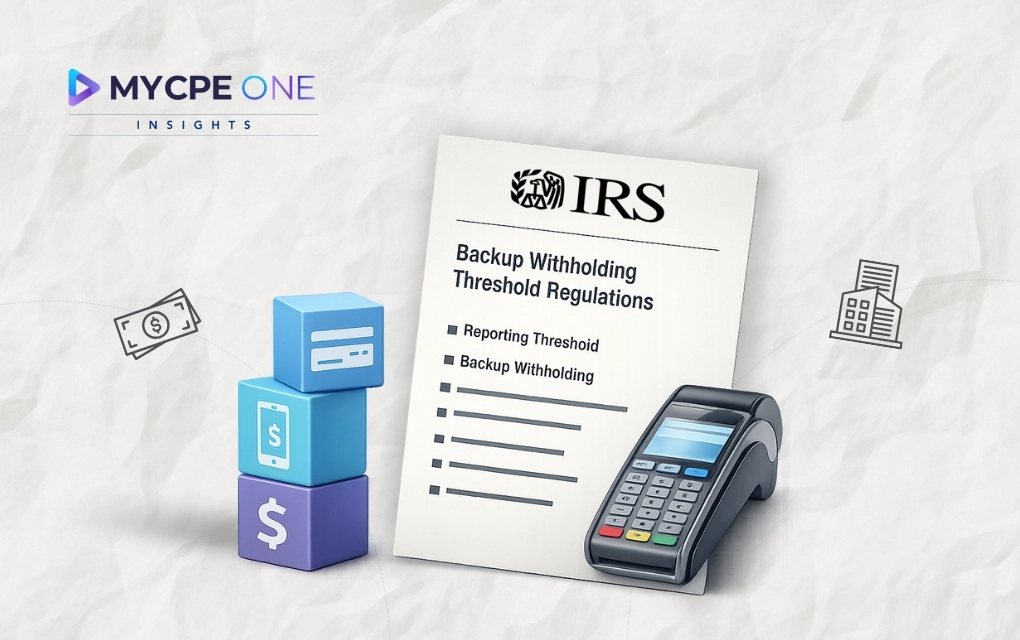
The 2026 tax filing season officially kicks off on January 26, and for many taxpayers, that early start means faster refunds and updated forms. Not surprisingly, refund timing is already top of mind for filers and their advisors, especially as the IRS phases out paper checks and rolls out new tax law changes. If clients are asking when money might hit their bank accounts, When Will I Get My Tax Refund in 2026 offers a timely breakdown worth bookmarking. But behind the scenes, something bigger is brewing. As millions of returns begin flowing into IRS systems, the agency is also tightening how digital income is tracked and collected. Thanks to changes under the One Big Beautiful Bill Act, payment companies are about to feel the IRS standing a lot closer to the checkout counter. The Treasury Department and the Internal Revenue Service have rolled out proposed regulations that reshape backup withholding rules for third-party settlement organizations, or TPSOs. Think PayPal, Venmo, Etsy, Airbnb, StubHub, and similar platforms. While the headlines focus on reporting thresholds, the real action is happening in how and when withholding kicks in.
Backup withholding is the IRS’s built-in safety net. When a payee fails to provide a valid taxpayer identification number or when IRS records flag a mismatch, payers must withhold tax at a fixed rate and send it straight to the government. Historically, digital platforms did not deal with this often. The rules existed, but enforcement lagged behind the rapid growth of online payments. That gap is exactly what Congress targeted with the One Big Beautiful Bill Act, signed into law by President Donald Trump on July 4, 2025. One major change was restoring the Form 1099-K reporting threshold to its pre-2021 level. Reporting is now required only when a payee’s gross transactions exceed $20,000 and more than 200 transactions in a year.
However, the law did not clearly align backup withholding rules with the restored threshold. The proposed regulations are the Treasury’s attempt to clean up that mismatch and bring consistency back into the system.
Under the proposed rules, third-party settlement organizations generally would not be required to apply backup withholding unless two conditions are met.
This is a meaningful shift from the uncertainty created after the American Rescue Plan Act of 2021, which lowered the reporting threshold to $600 with no transaction minimum. That change triggered widespread concern over compliance burdens and taxpayer confusion, leading the IRS to repeatedly delay implementation. Now, the IRS is drawing a clearer line. Informational reporting and backup withholding thresholds are being brought back into sync. As tax commentator Ed Zollars put it, the proposal addresses “the core conflict” between reporting rules and withholding obligations by incorporating the same de minimis thresholds into both frameworks.
For payment companies, this is not a minor regulatory tweak. Backup withholding affects real dollars moving through platforms. It impacts cash flow for sellers, user experience for customers, and system design for compliance teams. If finalized, the rules will require platforms to strengthen onboarding processes, tighten taxpayer identification verification, and track aggregate transactions in real time. Companies will also need systems that can trigger withholding promptly when thresholds are crossed or when required information is missing. In short, treating backup withholding as a back-office afterthought is a risky move. The IRS is clearly positioning platforms as active participants in tax enforcement, not just passive reporters at year's end.
The IRS has been explicit on one point that often gets lost in the noise. Reporting thresholds and withholding rules do not determine whether income is taxable. Even if a taxpayer does not receive a Form 1099-K, the income is still taxable and must be reported. With the 2026 filing season opening in late January, accountants and advisors should expect early questions from clients who see withholding for the first time and assume something went wrong. Education will be key, especially for gig workers and small sellers who rely on payment apps for income. Professionals advising payment platforms should also be reviewing backup withholding systems now. As Zollars noted, firms need the ability to track both current-year thresholds and prior-year reporting status, starting with payments made in 2025.
The IRS is not inventing a new tax. It is tightening the plumbing. By aligning backup withholding with restored reporting thresholds, the agency is reinforcing compliance at the point where money actually changes hands. Payment companies are being pulled deeper into the tax infrastructure, and backup withholding is moving from a last-resort tool to a routine enforcement mechanism. For tax professionals, platforms, and high-volume payees, the message is simple. Get systems, messaging, and expectations in order now. Once these rules are finalized, there will be very little room to play catch-up.
Until next time…
Don’t forget to share this story on LinkedIn, X and Facebook
Subscribe now for $199 and get unlimited access to MYCPE ONE, from CPE credits to insights Magazine
📢MYCPE ONE Insights has a newsletter on LinkedIn as well! If you want the sharpest analysis of all accounting and finance news without the jargon, Insights is the place to be! Click Here to Join
You’ve reached the 3 free-content piece limit. Unlock unlimited access to all News & CPE resources.
Subscribe Today.
Already have an account?
Sign In