
Join 250,000+
professionals today
Add Insights to your inbox - get the latest
professional news for free.
Join our 250K+ subscribers
Subscribe16 OCT 2025 / PCAOB UPDATES
CPE Approved
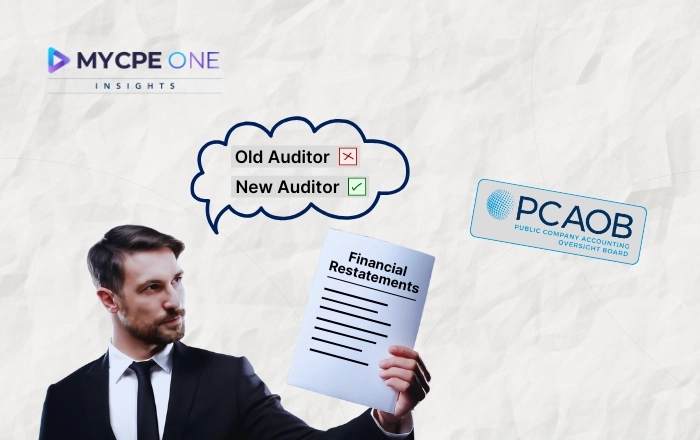
A recent data report by the Public Company Accounting Oversight Board (PCAOB) has shown a suspicious correlation between companies changing their auditors and issuing serious financial restatements. With the rate of major restatements doubling in the last three years, the PCAOB's findings suggest new auditors often discover overlooked mistakes or manipulations, thus striving to introduce reforms to raise audit quality and reduce financial discrepancies.
Have you ever noticed how some companies swap out auditors right before “discovering” a few oops moments in their books? It’s like repainting the house right before selling it; you can’t help but wonder what’s under the new coat. The PCAOB just dropped a data-heavy nugget that has accountants, investors, and audit committees doing a double-take. It’s not exactly scandalous, but it’s suspicious enough to raise eyebrows over at the audit committee happy hour. The Board’s latest Data Points report on Financial Restatements and Auditor Turnover shows a link that feels less like a coincidence and more like cause and effect.
From 2005 to 2024, about 29% of companies that issued “Big R” restatements, the serious ones that make prior financials unreliable, had changed auditors within the previous year. For everyone else, that number averaged just 11%. Translation: if you’ve recently kicked your auditor to the curb, your odds of a restatement just tripled. And just when restatements seemed to be fading into history, the trend reversed. After nearly fifteen years of decline, major restatements have more than doubled in the last three years. Something’s up.
Source: PCAOB
As PCAOB Chair Erica Williams put it, fresh auditors often spot things the old crew didn’t, or didn’t want to. Call it the “fresh-eyes effect.” Sometimes the new firm uncovers mistakes, and sometimes the company swapped firms because the last one refused to play along. Either way, when an audit breakup happens, the numbers often get messy.
Think of an auditor change as a mix of spring cleaning and damage control. Sometimes, management fires the auditor after “creative differences” over how bold they can be with revenue recognition or goodwill valuation. Other times, the auditor quits first, perhaps after losing faith in management’s spreadsheets or internal controls. Let’s put it in perspective: restatements happen about three times more often within a year of an auditor’s change than they do at companies that stick with their auditors. That’s not just bad luck; that’s a pattern worth watching.
The PCAOB’s analysis points to a handful of familiar red flags:
To reduce these post-audit headaches, the PCAOB is rolling out a batch of reforms designed to raise audit quality and keep the financials straight. At the top of the list: AS 1000, a modernized auditing standard consolidating old 2003-era rules. It spells out what auditors are actually accountable for, like professional skepticism, due care, and judgment, and even tightens deadlines for audit documentation from 45 days to 14 days after the report date. Translation: less time to “forget” what went wrong.
Then there’s QC 1000, a new quality control standard that forces audit firms to treat risk management and internal oversight as more than just compliance checkboxes. The PCAOB also proposed stronger analytical procedure standards, ensuring auditors use better data and logic before giving companies a clean bill of financial health. And in true bureaucratic fashion, the Board even cleaned up its registration reporting rules, so it can spot problematic firms faster. Fewer bad apples means fewer rotten audits.
If there’s one lesson here, it’s simple: when the auditor leaves, pay attention. The PCAOB’s data shows roughly one in three Big R restatements comes with an auditor change in the rearview mirror. That’s not noise, that’s a signal. Investors, boards, and finance pros would do well to watch those 8-K filings like hawks. Because sometimes, the real story in a restatement isn’t just about the numbers, it’s about who signed off on them last year. And if you’re a CFO reading this with a new auditor at the table, maybe check those spreadsheets again, just to make sure the only thing that’s about to restate is your commitment to transparency.
Get your CPE Credit from here
Until next time…
Don’t forget to share this story on LinkedIn, X and Facebook
Subscribe now for $199 and get unlimited access to MYCPE ONE, from CPE credits to insights Magazine
📢MYCPE ONE Insights has a newsletter on LinkedIn as well! If you want the sharpest analysis of all accounting and finance news without the jargon, Insights is the place to be! Click Here to Join
Earn CPE Credits by Simply Reading Articles – Starting at Just $199/Year!
50 of the Top 200 Accounting Firms trust MYCPE ONE for their team’s learning—why not you? With 15,000+ approved content hours, 500+ emerging subject areas, and automated compliance tracking, staying ahead has never been easier.
We don’t just create boring tax, accounting, and audit content—our platform offers engaging, insightful, and trending material that your team will actually enjoy while earning CPE credits.
Sign up today, go through the comprehensive list of features and unlock unlimited learning!
You’ve reached the 3 free-content piece limit. Unlock unlimited access to all News & CPE resources.
Subscribe Today.
Already have an account?
Sign In