


MYCPE ONE
MYCPE ONE LOGO

Join 250,000+
professionals today

Add Insights to your inbox - get the latest
professional news for free.

MYCPE ONE insights

Why the SEC Dropped a $3.7 Billion Accounting Case

Join our 250K+ subscribers

Join our 250K+ subscribers

Subscribe

13 JAN 2026 / SEC UPDATES

Why the SEC Dropped a $3.7 Billion Accounting Case

Why the SEC Dropped a $3.7 Billion Accounting Case

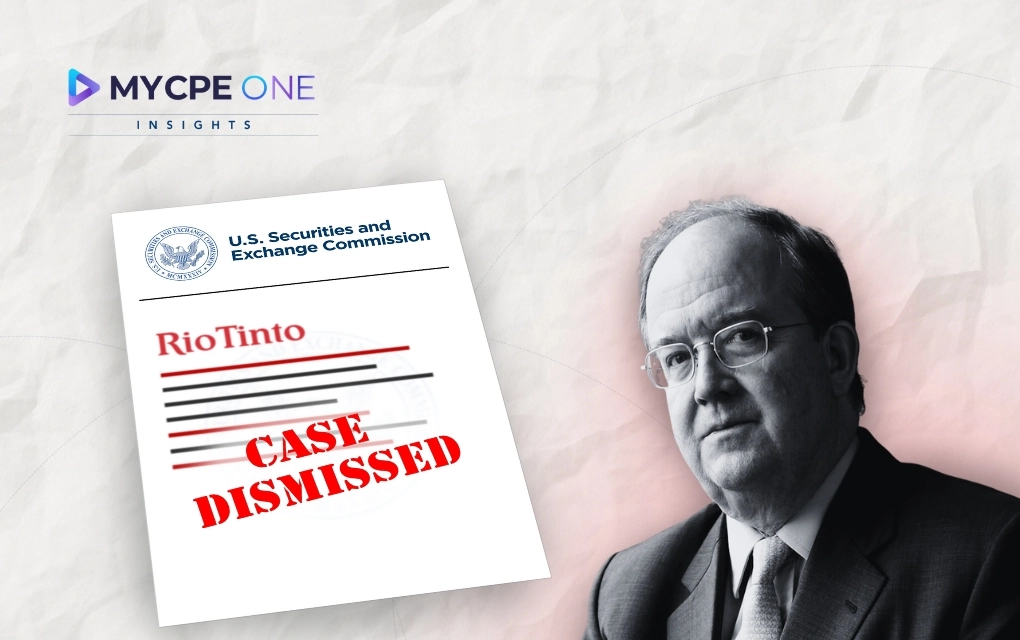
There is a line from The Big Short that fits this story a little too well: “Truth is like poetry. And most people hate poetry.” For nearly a decade, the SEC argued it had the truth about how a $3.7 billion mining deal went sideways inside one of the world’s largest resource companies. This week, that long running saga took an unexpected turn when the agency quietly walked away from its fraud case against former Rio Tinto CFO Guy Elliott. No settlement. No admission. Just a joint filing in Manhattan federal court ending the case in what the SEC called an exercise of discretion. For finance leaders and auditors, the ending raises more questions than answers. 

How the Mozambique deal went off the rails 

The story starts in 2011, when Rio Tinto acquired Riversdale Mining for $3.7 billion to gain access to coal assets in Mozambique, a deal positioned as a long term strategic bet on premium coking coal. On paper, the reserves looked attractive. In practice, the economics depended heavily on infrastructure assumptions that quickly fell apart. Mozambique’s government rejected Rio’s plan to transport coal by barge down the Zambezi River, forcing the company to rely on rail solutions that proved far more expensive and operationally constrained than expected. At the same time, estimates of recoverable coal were downgraded, cutting directly into projected cash flows.

By mid 2012, internal assessments painted a stark picture. Executives concluded the Mozambique assets could be worth negative $680 million, meaning the liabilities and costs outweighed the expected benefits. That conclusion went to the heart of accounting judgment. Asset valuations, impairment testing, and disclosure timing suddenly became critical decisions, not technical footnotes. Despite those internal signals, public disclosures continued to reflect optimism about the project’s long term value, even as the underlying assumptions no longer held.

The gap between internal analysis and external messaging widened until it finally snapped. In 2013, Rio recorded more than $3 billion in writedowns tied to the Mozambique business. A year later, the assets were sold for just $50 million. What had been framed as a growth platform collapsed into a near total loss, turning the acquisition into a case study in how infrastructure risk, valuation assumptions, and delayed impairments can combine to destroy value and attract regulatory scrutiny.

How the SEC said it was done 

According to the SEC’s 2017 complaint, the alleged misconduct was not tied to a single bad judgment call, but to how the Mozambique coal assets were carried on the books long after internal assessments showed the deal had effectively failed. The regulator argued that accounting and disclosure decisions, not just business strategy, sat at the center of the case. 

  • Asset values were allegedly maintained at inflated levels despite internal analyses showing the assets could be worth negative $680 million. 
  • Impairments were delayed even as operational setbacks, including rejected transportation plans and rising costs, became unavoidable. 
  • The SEC claimed proper accounting rules were not followed when valuing the assets, leading to disclosures that overstated recoverability. 
  • Elliott, as CFO, was accused of misleading Rio Tinto’s auditors and contributing to books and records violations through how information was presented. 
  • The case relied heavily on internal valuations, impairment models, auditor communications, and disclosure decisions, rather than hidden emails or side deals. 

Taken together, the SEC framed the matter as an accounting driven failure that crossed into fraud territory, a distinction that helps explain both the length of the case and the difficulty in ultimately proving it. 

How it was caught and why it dragged on 

The cracks surfaced internally before regulators got involved. In early 2013, concerns about the carrying value of the coal assets triggered internal reviews, followed by leadership changes and massive impairments. Once those disclosures reached the market, regulators followed the trail. Rio Tinto settled with the SEC in 2023, agreeing to pay a $28 million fine, while former CEO Tom Albanese paid a $50,000 penalty, both without admitting wrongdoing. Elliott chose to fight, and despite a federal judge ruling as recently as last year that factual disputes should go to a jury, the SEC ultimately moved to dismiss the case. As A Few Good Men put it, “You want answers?” In this case, none came. 

What this means for executives and finance leaders 

For CFOs, controllers, and audit committee members, the case is a reminder that disclosure decisions can follow you far longer than deal memos. Impairment timing, valuation assumptions, and how bad news is escalated internally all matter, especially when markets are still being tapped for capital. Even when a company settles, individuals may remain exposed for years. Elliott’s dismissal may read as vindication, but eight years of litigation is a steep price, regardless of outcome. 

What the SEC should rethink going forward 

The dismissal raises uncomfortable questions for regulators as well. Eight years is a long runway for a case that ultimately ends without resolution. Accounting driven enforcement cases require sharp lines between aggressive judgment and fraud, especially in asset heavy industries where regulatory and infrastructure risks can flip valuations overnight. Clearer standards, faster timelines, and tighter evidentiary thresholds would help restore confidence that enforcement actions land where they should, and end when they must. As Moneyball reminded everyone, “Adapt or die.” 

The road ahead 

The Mozambique coal deal will remain a cautionary tale in failed M&A, disclosure pressure, and accounting judgment under stress. The SEC’s decision to drop its case against Guy Elliott closes one chapter, but it does not rewrite the history of the deal itself. For professionals watching closely, the lesson is not about courtroom wins or losses. It is about how optimism can outpace reality, how accounting choices made under pressure can echo for years, and how quickly a bad deal can become a career defining moment once the numbers stop cooperating.

Until next time…

Don’t forget to share this story on LinkedIn, X and Facebook

Subscribe now for $199 and get unlimited access to MYCPE ONE, from CPE credits to insights Magazine

📢MYCPE ONE Insights has a newsletter on LinkedIn as well! If you want the sharpest analysis of all accounting and finance news without the jargon, Insights is the place to be! Click Here to Join

Unlock Annual Access to News & CPE Subscription

You’ve reached the 3 free-content piece limit. Unlock unlimited access to all News & CPE resources.
Subscribe Today.

News & Updates

  • Exclusive News & Insights
  • Latest Regulatory Updates
  • Accounting Industry Trends
  • Expert Insights
  • AI-Driven Audio & Summaries
  • Infographics & Videos
  • CPE-Approved Articles
  • Digital Magazine
  • Benchmarking Blogs

Unlimited CPE Access for 1 Year

  • 15,000+ Hours of Content
  • 500+ Subject Areas
  • Mandatory Ethics Courses
  • 250+ Compliance Packages
  • 50+ Virtual Conferences and Events Access
  • Format: Live, Audio, Video, E-Books
  • Audio Based Courses & Podcasts
  • Add External Certificates with AI
  • AI Compliance Tracking and Report
  • Instant Certification and Fast Reporting
  • Mobile App Access (iOS and Android)
  • Dedicated Support System
  • Practical Training Programs
  • AI Academy Access
  • Tax Academy Access
  • Audit Academy Access
  • Leadership Academy Access