Join 250,000+
professionals today
Add Insights to your inbox - get the latest
professional news for free.
Join our 250K+ subscribers
Subscribe05 JUN 2026 / EXPERT INSIGHTS
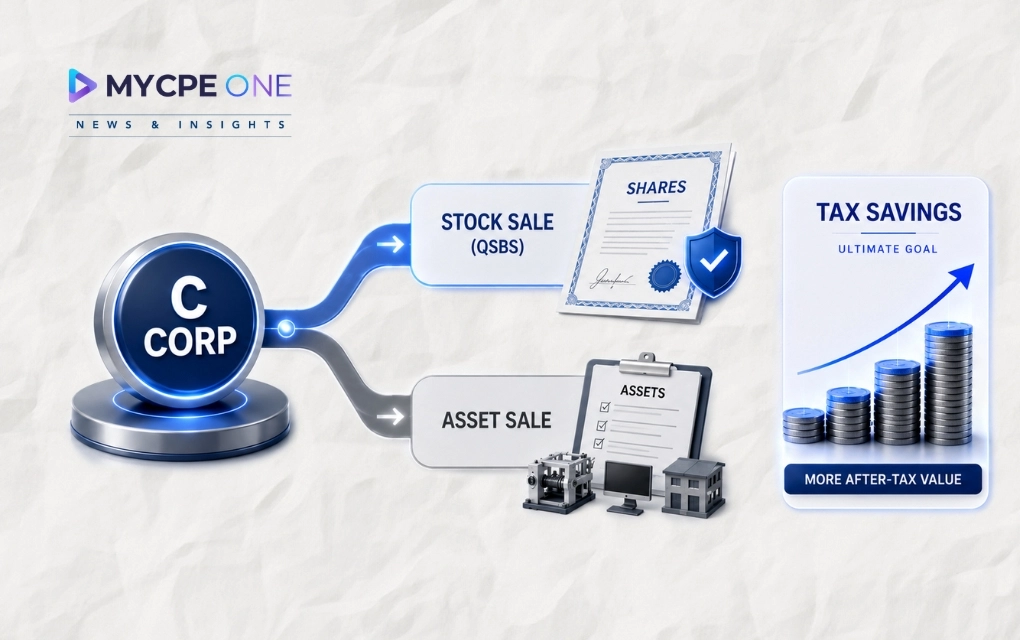
C corporation sales' tax outcomes can swing by more than 50% based on deal structure, arguing, in particular, for the advantages of the Qualified Small Business Stock (QSBS) status. The tax outcome of a C corporation sale is a significant economic issue for sellers and buyers alike, turning deal structure from merely being a legal detail into a non-negotiable part of transaction planning.
Buyers and sellers have always negotiated deal structure, but in C corporation sales, that conversation is no longer just legal cleanup before closing. It can decide whether the seller walks away with the economics they expected or watches a very large chunk of the purchase price to take a one-way trip to the IRS.
For C corporations, tax outcomes can swing by more than 50% depending on whether the transaction is structured as a stock sale or an asset sale, and whether Qualified Small Business Stock (QSBS) status under Internal Revenue Code Section 1202 applies. Most important of all, a sale or exchange of QSBS can produce $0 federal income tax on eligible gain. That is not a footnote. That is the kind of result that makes deal structure suddenly feel much less boring.
This article provides an overview of the tax issues involved in structuring the sale of C corporations, the only entity type that can issue QSBS and potentially qualify for the exemption. As private equity groups and other investors look for ways to access QSBS benefits, C corporations are becoming more common in transaction planning. Apparently, when the tax code offers a potential zero federal income tax outcome, people start paying attention.
The difference in after-tax seller proceeds can be dramatic. A sale may be structured as a stock sale, similar to how individuals sell shares in the stock market. Or it may be structured as an asset sale, where the corporation sells its assets, then usually liquidates and distributes the proceeds to shareholders.
Sellers usually prefer stock deals because they often reduce or eliminate tax at the seller level. Buyers, meanwhile, generally prefer asset deals because those structures can provide tax deductions, basis step-ups, and more control over which liabilities they assume. So while both sides may be talking about the same business, they are often staring at two very different tax scoreboards. The following example shows why the structure conversation deserves a front row seat.
Amounts in $000s | Stock Sale | Asset Sale |
Recap: Seller proceeds after tax |
|
|
QSBS | 50,000 | 41,600 |
Conventional (Non-QSBS) | 39,290 | 32,889 |
|
|
|
Tax - Corporate Level |
|
|
Gross proceeds | 50,000 | 50,000 |
Asset basis | NA | 10,000 |
Gain | NA | 40,000 |
Corporate tax (21%) | NA | 8,400 |
Asset deal premium |
| 10,633 |
|
|
|
Tax - Shareholder Level |
|
|
Shareholder proceeds | 50,000 | 41,600 |
Stock basis | 5,000 | 5,000 |
Taxable gain | 45,000 | 36,600 |
Shareholder tax (23.8%) | 10,710 | 8,711 |
The table does not exactly whisper the point. A QSBS stock sale allows the seller to keep the full $50 million, while a conventional asset sale leaves approximately $32.9 million after federal taxes. That creates a $17.1 million difference between the best and worst outcomes, meaning an optimal QSBS structure can increase seller proceeds by more than 50% compared with a conventional asset sale.
The ranking is clear: QSBS stock sale first, QSBS asset sale second, conventional stock sale third, and conventional asset sale last. That order is why deal structure is not just a technical preference buried in the transaction memo. It is a major economic issue for C corporation sellers.
The disadvantage of asset sales in C corporations comes down to double taxation. It is the classic C corporation problem, and unfortunately for sellers, it has aged quite well.
First, the corporation pays tax on the gain from selling its assets. Second, shareholders pay tax again when the after-tax proceeds are distributed to them. The government gets two bites at the apple, and sellers are left wondering why they brought the apple in the first place.
In the example above, the corporation sells assets for $50 million with a $10 million basis, creating a $40 million gain. At a 21% corporate tax rate, the corporate-level tax is $8.4 million. That leaves $41.6 million available for distribution.
Then comes the stockholder-level tax, because apparently one layer was not enough. After deducting the shareholder’s $5 million stock basis, $36.6 million is taxable to the shareholders. At a 23.8% tax rate, that produces another $8.711 million of tax, leaving final after-tax proceeds of $32.889 million.
That is how a $50 million gross sale turns into less than $33 million in seller proceeds. Same deal, same buyer, same business, very different ending.
Fortunately, if a C corporation meeting QSBS criteria sells its assets, owners may still be able to obtain the stockholder-level tax exemption. Upon a complete liquidation, the distribution of proceeds can be treated as an exchange of stock, potentially allowing the QSBS exclusion to apply at the shareholder level. In that case, the seller may bear only the corporate-level tax. Only, of course, is doing some heavy lifting here, but it is still a far better answer than double taxation.
QSBS can meaningfully change the economics of a C corporation sale. Under the expanded rules, QSBS issued after July 4, 2025, may exempt gain on sale up to the greater of $15 million or 10 times adjusted stock basis from federal income tax, assuming all requirements are satisfied. In addition to the 100% exemption available after a five-year holding period, partial benefits are now available earlier: 50% after three years and 75% after four years.
Stock issued before July 4, 2025, but after September 27, 2010, remains subject to the prior rules. Those rules generally require a five-year holding period and provide a $10 million exclusion limit.
Of course, QSBS is not available to every business. Certain industries are excluded, including service businesses, hospitality, farming, insurance, finance, and mining. Businesses that rely heavily on individual expertise, reputation, or skill may also be excluded. Over the holding period, at least 80% of assets must be used in a qualified trade or business.
So QSBS is powerful, but it is not a magic wand. It must be planned for, documented, and tested against the rules. The tax code is generous here, but it is not handing out blank checks at the door.
To sellers’ chagrin, asset deals are often far more beneficial to buyers. An asset deal allows the buyer to acquire assets through a new C corporation and potentially claim QSBS treatment at the buyer’s own future exit. Buyers also receive a step-up in the tax basis of acquired assets, reflecting the seller’s gain on sale. That step-up can allow the buyer to write off much of the purchase price over the period the company is owned.
For example, purchase price allocated to equipment may be immediately deductible under bonus depreciation rules. Buyers may also limit the assumption of seller liabilities to those specified in the agreement, although there are important exceptions, including product liability, environmental obligations, ERISA funding, and certain state taxes.
That is the buyer’s side of the story. The seller’s side is less cheerful. Because asset sales can impose additional tax on sellers, QSBS sellers often want a higher price to compensate for the loss of stock deal tax benefits. This is where tax math stops being theoretical and starts elbowing its way into the purchase agreement.
The implied premium is typically calculated as:
Corporate Tax ÷ (1 − Tax Rate)
In the above example, the $40 million gain creates $8.4 million of corporate-level federal income tax. Using the formula, the asset deal premium is $10.633 million. That means the buyer would need to increase the sale price to approximately $60.633 million to make the seller economically whole.
That is not a minor negotiating point. That is a major pricing issue, and no one should pretend otherwise just because the spreadsheet has small font.
Other mitigating strategies may exist for asset deals, particularly for individual owners in conventional sales.
One strategy is establishing personal goodwill. This involves making a separate payment at closing directly to the owner for personal goodwill. When properly supported, the gain may be taxed at the 20% capital gains rate. But this is not something to casually sprinkle into the agreement at the eleventh hour. Personal goodwill must be supported by a valuation showing that the owner has relationships of value that are independent of the company.
As seen in the example above, if 50% of the gain were allocated to personal goodwill, seller proceeds would increase by $3.96 million. In practice, personal goodwill is less relevant when QSBS already eliminates stockholder-level tax.
Other strategies may also be available, including compensation arrangements and non-compete agreements. Net operating loss carryforwards can also reduce the gain on sale. Another non-QSBS strategy may involve continuing the corporation to avoid the second-level stockholder tax, to the extent permitted by tax law.
Stock purchases are often the buyer’s second choice because they generally provide fewer tax benefits. In a stock deal, the buyer assumes all liabilities, known and unknown. That includes tax issues that may arise from prior business practices, even owner personal items deducted by the business. Buyers do not get to cherry-pick assets and liabilities in the same way they may try to in an asset deal. Still, stock purchases can be structured in different ways.
If the buyer keeps the entity as a C corporation, the buyer steps into the double-tax environment. If the buyer later sells assets, the same double-tax issue may arise at exit. Different owner, same tax trap.
There is also a QSBS wrinkle. QSBS benefits are generally available only to holders of original issue stock. A buyer purchasing existing stock must proceed carefully if trying to create its own QSBS opportunity. Unless the buyer uses complex and sometimes risky planning involving holding companies or redemptions, QSBS benefits may be unavailable. In other words, the buyer cannot simply buy someone else’s stock and expect QSBS treatment to show up like a welcome basket.
An S election converts the corporation into a pass-through entity, which generally avoids double taxation going forward.
But there is a catch, because tax law rarely lets anyone leave the room that easily. The corporation remains subject to the C corporation built-in gains tax on asset dispositions within five years. The buyer also receives no step-up in asset basis and must comply with several restrictions, including limits on the number and types of shareholders. So yes, S status may solve one problem, but it brings its own rulebook.
Another route is converting to an LLC structure. This often begins with an IRC Section 338(g) election to achieve a buyer step-up in the tax basis of assets. The election is unilateral by the buyer, meaning it does not require the seller’s consent because it does not affect the seller. In doing so, the buyer incurs the corporate-level tax.
If properly structured, the next step is liquidation under IRC Sections 331 and 336. Generally, no or minimal additional tax is due.
Deal structure is critical for sellers exiting C corporations. The purchase price may get the headline, but the structure often determines the amount the seller actually keeps. A stock sale, an asset sale, QSBS qualification, corporate-level tax, stockholder-level tax, basis, buyer deductions, and liability exposure can all influence the final economic result.
Sellers who plan early, evaluate QSBS eligibility, and understand how buyers price tax benefits are better positioned to preserve after-tax proceeds. Waiting until closing to think about structure is a little like reviewing the tax bill after the check has cleared. Educational, maybe. Pleasant, probably not.
In practice, the optimal structure is negotiated by balancing buyer economics, seller tax outcomes, pricing adjustments, elections, and legal structuring. It behooves sellers to address structure at the outset of the transaction, because as the deal progresses, it may be too late to fix the tax consequences without paying for them.
By then, the deal may still close. But the seller may discover that the real negotiation was never just about price. It was about what was left after tax. And in a C corporation exit, that difference can be millions of dollars, which is a rather expensive way to learn that structure was not just a legal detail.
Until next time…
Don’t forget to share this story on LinkedIn, X and Facebook
Subscribe now for $199 and get unlimited access to MYCPE ONE, from CPE credits to insights Magazine
📢MYCPE ONE Insights has a newsletter on LinkedIn as well! If you want the sharpest analysis of all accounting and finance news without the jargon, Insights is the place to be! Click Here to Join
You’ve reached the 3 free-content piece limit. Unlock unlimited access to all News & CPE resources.
Subscribe Today.
Already have an account?
Sign In