Join 250,000+
professionals today
Add Insights to your inbox - get the latest
professional news for free.
Join our 250K+ subscribers
Subscribe12 JAN 2026 / ACCOUNTING & TAXES
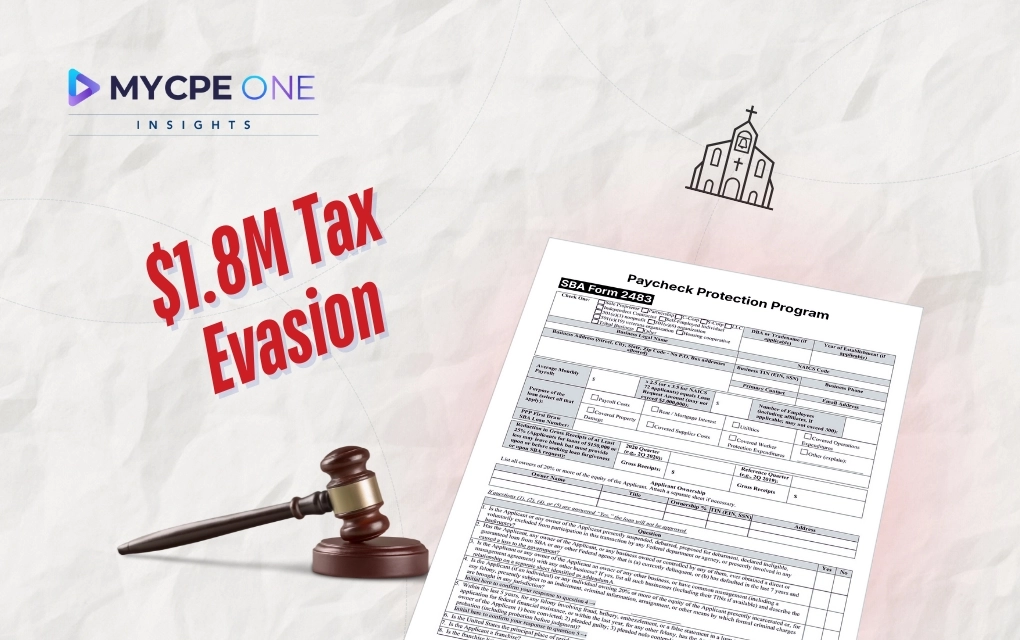
Ricky Lee Taylor Jr., an entrepreneur and former college basketball player, was sentenced to 30 months in federal prison for creating fraudulent Paycheck Protection Program (PPP) loan applications. Investigated by IRS-CI and the U.S. Secret Service, Taylor filed eight PPP loan applications for five of his businesses, falsifying tax documents, payroll records, and employee counts and receiving about $1.8 million, prompting audits and highlighting the need for thorough oversight of federal relief programs.
At the height of the pandemic, Washington opened the money spigot fast. Billions flowed out the door with barely a pulse check. For most businesses, the Paycheck Protection Program was a lifeline. For a few, it became a cash grab. Ricky Lee Taylor Jr.’s story sits squarely in that second camp. A former college basketball player turned pastor and entrepreneur, Taylor rode the chaos of COVID relief straight into federal prison. What looked like hustle on paper unraveled into one of Tennessee’s most telling PPP fraud cases. This is how it started, how it collapsed, and why professionals should be paying close attention.
Taylor’s early narrative played well. University of Tennessee at Chattanooga basketball alum. Local preacher. Business owner. By 2020, he controlled multiple entities, including Potter’s Wheel Trucking, Ricky Taylor Basketball, Arena of Praise church, Spirit Logistics, and Reap Real Estate. Then COVID hit. Congress rolled out more than $200 billion through PPP loans, designed to keep workers on payroll. Speed mattered more than scrutiny. Banks pushed approvals through fast, relying heavily on borrower-provided payroll data. Taylor saw the opening. Between 2020 and 2021, he filed eight PPP loan applications across five entities. According to the DOJ, those applications included inflated employee counts, fabricated payroll records, and falsified tax documents. The result: roughly $1.8 million in federally backed funds, far exceeding what his businesses were legally entitled to receive. At the time, it probably felt like easy money. No audits. No immediate questions. Just wires hitting accounts.
Taylor’s fraud was not sophisticated, just aggressive. And that is what ultimately made it easy to detect.
Federal investigators later laid out the mechanics clearly:
The tax angle sealed his fate. While PPP forgiveness is excluded from gross income under certain conditions, fraudulent proceeds are not. Taylor filed personal returns that ignored the income entirely. That crossed the line from civil exposure into criminal territory. As IRS Criminal Investigation likes to say, math does not lie. Paper trails do.
By 2023, the net tightened. IRS-CI and the U.S. Secret Service flagged inconsistencies through nationwide PPP audit sweeps. Inflated payrolls. Shell entities. Missing tax reporting. The dots connected fast. Taylor pleaded guilty in 2024 to one count of wire fraud and one count of filing a false tax return. On January 8, 2026, U.S. District Judge Charles E. Atchley Jr. sentenced him to 30 months in federal prison, followed by three years of supervised release. The financial damage did not stop there. The court ordered:
In a letter to the court, Taylor admitted, “I was wrong requesting so much,” citing the collapse of his trucking business and the loss of his congregation. Prosecutors were blunt in response. Abuse of emergency relief undermines trust and harms families who actually needed help. As U.S. Attorney Francis Hamilton put it, relief fraud does real damage, not victimless math.
Taylor’s case fits a broader pattern. In another Tennessee prosecution, Edward Zanes pleaded guilty to filing false COVID employment tax credit claims using fake businesses, pulling in more than $1.8 million in bogus refunds. Same tools. Same credits. Same ending. The message from DOJ and IRS-CI is loud and clear: pandemic fraud cases are not fading. They are accelerating. Investigators are still working through data, and sentencing is catching up years later. If anything, enforcement is just getting warmed up.
For CPAs, CFOs, advisors, and business owners, Taylor’s downfall delivers hard truths:
One upfront conversation with a competent CPA costs far less than explaining yourself to federal prosecutors later. No shortcuts. No funny business.
Taylor now faces prison time, supervised release, and crushing restitution obligations. His businesses are shuttered. His church attendance evaporated. Rebuilding credibility will take years, if it happens at all. For the rest of the professional world, this case is a reminder that COVID era relief is still under the microscope. Audits are ongoing. Charges are still coming. And the statute of limitations clock has not run out. The money may have felt free back then. The consequences never are. If you want more breakdowns on fraud cases, tax enforcement trends, and what regulators are actually watching, follow along and stay sharp. The feds definitely are.
Until next time…
Don’t forget to share this story on LinkedIn, X and Facebook
Subscribe now for $199 and get unlimited access to MYCPE ONE, from CPE credits to insights Magazine
📢MYCPE ONE Insights has a newsletter on LinkedIn as well! If you want the sharpest analysis of all accounting and finance news without the jargon, Insights is the place to be! Click Here to Join
You’ve reached the 3 free-content piece limit. Unlock unlimited access to all News & CPE resources.
Subscribe Today.
Already have an account?
Sign In