MYCPE ONE
MYCPE ONE LOGO

Join 250,000+
professionals today

Add Insights to your inbox - get the latest
professional news for free.

MYCPE ONE insights

BDO’s £2M Fine Is About More Than One Audit Failure

Join our 250K+ subscribers

Join our 250K+ subscribers

Subscribe

28 MAY 2026 / ACCOUNTING & TAXES

BDO’s £2M Fine Is About More Than One Audit Failure

BDO’s £2M Fine Is About More Than One Audit Failure

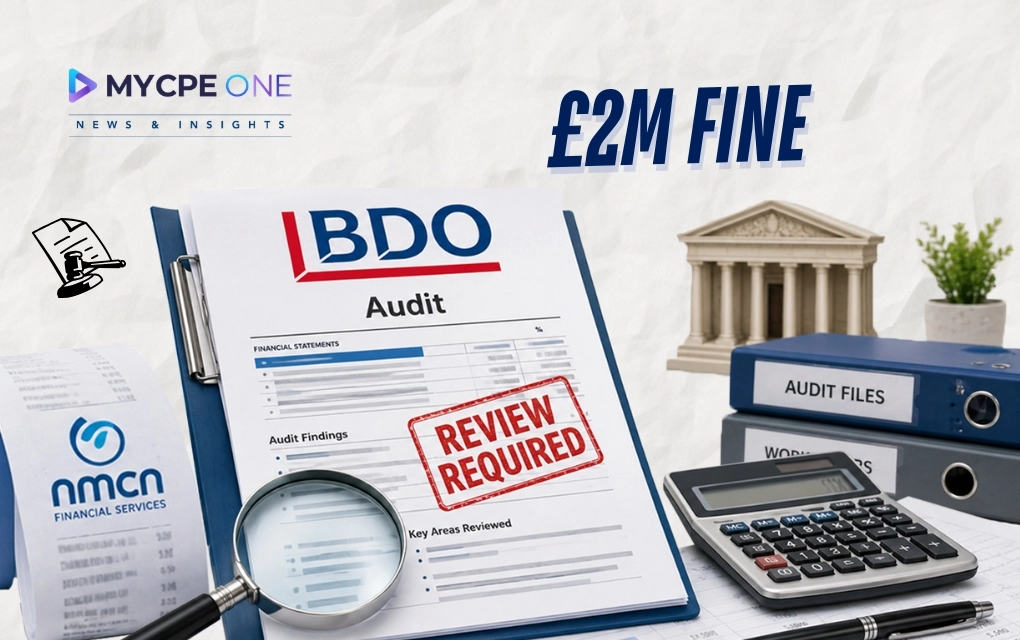
Auditors love to say their job is about “reasonable assurance,” not guarantees. Fair enough. Nobody expects an audit team to walk into a client office wearing Sherlock Holmes hats and flipping over every invoice like a Netflix crime doc. Still, when a construction company collapses shortly after receiving clean audit opinions, regulators, creditors, and administrators start asking the same uncomfortable question: what exactly was everyone looking at? That question now sits at the center of BDO’s growing troubles tied to the collapse of UK construction group NMCN. Between a £1.3 million regulatory fine, an £80 million negligence lawsuit, and ongoing Financial Reporting Council scrutiny, this story has become bigger than one failed construction company. And honestly, the whole thing feels a bit like watching Margin Call in reverse. Everyone knew the room smelled funny. Nobody wanted to be the first person to pull the fire alarm.

Did NMCN’s numbers look too good to be true?

NMCN, formerly North Midland Construction, entered administration in October 2021 after a rapid financial collapse. The timing mattered because only months earlier the company had reported roughly £406 million in revenue and £7.7 million in pre-tax profit for 2019, backed by clean audit opinions from BDO. Financial reporting delays piled up. Trading in NMCN shares was suspended. Senior executives exited unexpectedly. Estimated 2020 losses ballooned to around £43 million. Administrators later identified more than £21 million in material misstatements across the company’s 2018 and 2019 financial statements.

For anyone who remembers Carillion, Wirecard, or even parts of the Evergrande saga, the sequence feels painfully familiar. Strong revenue growth. Aggressive contract accounting. Optimistic forecasts. Then suddenly, everybody acts shocked when the cash disappears. The core allegations now haunting BDO revolve around basic but dangerous audit pressure points: revenue recognition, going concern assessments, management estimates, and weak internal controls. According to court filings, NMCN allegedly recorded profits on projects that were actually losing money. In one example, the company reportedly booked additional fees before customers had even agreed to pay them. Administrators argue those judgments should have triggered much tougher audit scrutiny.

So, how does audit negligence actually get caught?

Once insolvency hits, the entire process changes. Administrators gain access to records, draft opinions, internal emails, review notes, and audit workpapers. Suddenly, decisions that once sounded commercially reasonable get replayed with the benefit of hindsight and forensic scrutiny. That is exactly what happened here. NMCN’s administrators, Grant Thornton, reportedly compelled the production of BDO’s audit files under the Insolvency Act. The resulting litigation now centers less on whether mistakes happened and more on whether BDO challenged management hard enough in the first place.

One allegation attracting particular attention involves claims that BDO prepared two versions of its 2019 audit opinion. One version allegedly flagged material uncertainty around NMCN’s ability to continue as a going concern. Another reportedly gave the company a clean opinion after management submitted more optimistic cash flow forecasts. Now picture that scenario inside a courtroom years later. A regulator or plaintiff lawyer does not ask, “Did management sound convincing at the time?” They ask, “What contradictory evidence existed, and why was it not escalated?” That distinction changes everything. Audit negligence cases are often won or lost through documentation trails. Internal emails. Draft memos. Review comments. Evidence of challenge. Or evidence that challenge never really happened.

Why are regulators suddenly all over BDO?

The Financial Reporting Council has criticized BDO’s audit quality for five consecutive years. In its latest inspection cycle, only about half of BDO audits reviewed required no more than limited improvement, placing the firm at the bottom of its peer group. That stings because BDO has simultaneously become one of the most successful challengers to the Big Four in winning public interest entity audits. That combination creates pressure from every direction. Clients want competitive fees and tight timelines. Regulators want deeper skepticism and stronger documentation. Audit teams face staffing shortages, technical complexity, and increasingly aggressive litigation risk. Somewhere in the middle, judgment calls get made under intense commercial pressure.

Nobody says, “Let’s ignore red flags today.” Real audit failures usually happen through incremental normalization. Teams grow comfortable with management explanations. Last year’s assumptions become this year’s assumptions. Forecasts get refreshed. Deadlines creep closer. Then one day the company collapses and every unresolved concern suddenly looks neon bright. The FRC’s criticism of BDO focused heavily on professional skepticism, which may be the most overused phrase in auditing and still one of the hardest things to operationalize consistently. Skepticism is easy during training sessions. It gets harder during a Friday night sign-off meeting in busy season when everyone just wants the file closed and the pizza boxes are piling up in the conference room.

Are mid-tier audit firms getting squeezed from both sides?

Governments and regulators want more competition against the Big Four. Mid-tier firms like BDO are encouraged to take on larger listed-company audits to reduce concentration risk in the market. Sounds good on paper. The problem is that listed-company audits carry enormous litigation exposure, especially in sectors loaded with estimates and long-term contracts like construction, real estate, and infrastructure. Construction audits are particularly brutal because revenue recognition depends heavily on management forecasting future project outcomes. Small changes in assumptions can radically alter reported profits.

That creates a dangerous cocktail:

  • Aggressive client forecasts.
  • Heavy reliance on judgment.
  • Compressed audit timelines.
  • Fee pressure.
  • Regulatory scrutiny.
  • Litigation exposure years later.

It is basically accounting’s version of “this could get ugly fast.” The NMCN case may eventually become a broader test of whether mid-tier firms can realistically compete for complex public-company audits while maintaining inspection quality levels regulators expect.

What should professionals and audit firms actually take from this?

  • Technical compliance alone is not enough if regulators or courts later question whether auditors genuinely challenged management assumptions.
  • Revenue recognition, going concern forecasts, and unresolved internal control weaknesses remain the biggest audit risk areas.
  • Quality management systems must influence real engagement behavior, especially under deadline pressure and client demands.
  • Audit documentation, draft opinions, emails, and review notes can become critical evidence in litigation, making clear documentation of professional skepticism essential.

What happens next?

BDO has not yet filed its defense in the NMCN litigation, while the FRC investigation remains ongoing. The outcome could influence how audit risk gets priced across the UK market, especially for construction and other estimate-heavy industries. More broadly, this case reinforces something uncomfortable about the audit profession. Most major audit failures are not caused by missing information. They happen because warning signs get rationalized, softened, or explained away over time. The numbers rarely collapse overnight. Confidence does. And once administrators, regulators, and litigators start replaying the story backward, yesterday’s “reasonable judgment” can suddenly look like tomorrow’s negligence claim. That is the £80 million question hanging over BDO right now.

Until next time…

Don’t forget to share this story on LinkedIn, X and Facebook

Subscribe now for $199 and get unlimited access to MYCPE ONE, from CPE credits to insights Magazine

📢MYCPE ONE Insights has a newsletter on LinkedIn as well! If you want the sharpest analysis of all accounting and finance news without the jargon, Insights is the place to be! Click Here to Join

Unlock Annual Access to News & CPE Subscription

You’ve reached the 3 free-content piece limit. Unlock unlimited access to all News & CPE resources.
Subscribe Today.

News & Updates

  • Exclusive News & Insights
  • Latest Regulatory Updates
  • Accounting Industry Trends
  • Expert Insights
  • AI-Driven Audio & Summaries
  • Infographics & Videos
  • CPE-Approved Articles
  • Digital Magazine
  • Benchmarking Blogs

Unlimited CPE Access for 1 Year

  • 15,000+ Hours of Content
  • 500+ Subject Areas
  • Mandatory Ethics Courses
  • 250+ Compliance Packages
  • 50+ Virtual Conferences and Events Access
  • Format: Live, Audio, Video, E-Books
  • Audio Based Courses & Podcasts
  • Add External Certificates with AI
  • AI Compliance Tracking and Report
  • Instant Certification and Fast Reporting
  • Mobile App Access (iOS and Android)
  • Dedicated Support System
  • Practical Training Programs
  • AI Academy Access
  • Tax Academy Access
  • Audit Academy Access
  • Leadership Academy Access