MYCPE ONE
MYCPE ONE LOGO

Join 250,000+
professionals today

Add Insights to your inbox - get the latest
professional news for free.

MYCPE ONE insights

A Tax Change That Could Cost Charities $5.7 Billion

Join our 250K+ subscribers

Join our 250K+ subscribers

Subscribe

18 MAR 2026 / ACCOUNTING & TAXES

A Tax Change That Could Cost Charities $5.7 Billion

A Tax Change That Could Cost Charities $5.7 Billion

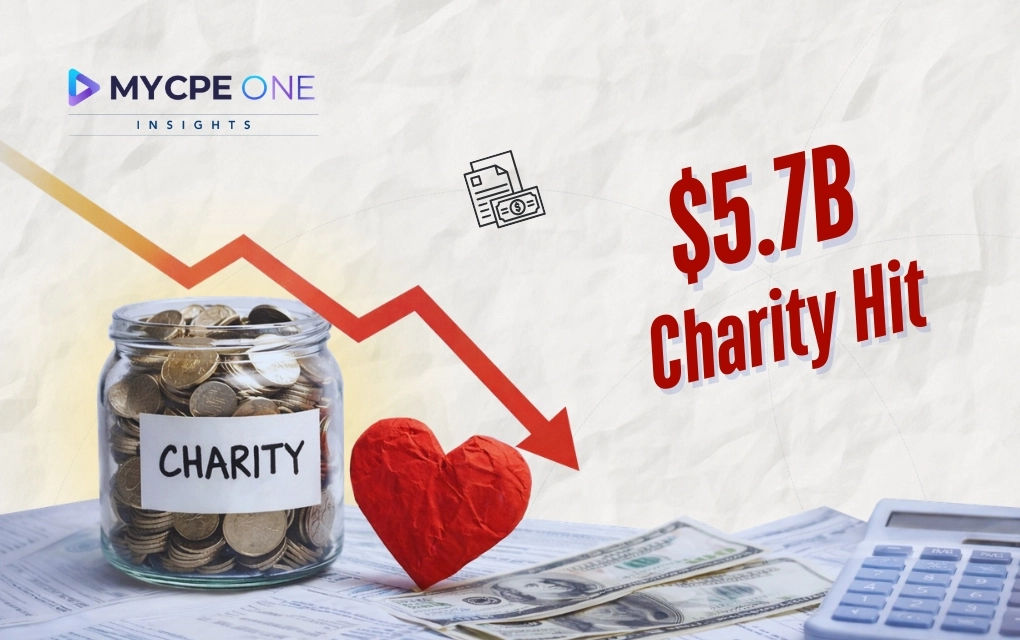
Most accountants have seen this pattern before. It’s late December, inboxes are flooding, and suddenly clients remember they meant to donate earlier in the year. A quick calculation, a rushed transfer, and just like that, generosity meets tax planning. But what happens when the math itself changes? When the rules behind giving start shifting mid-play? That’s exactly where things stand now. A new federal tax law is expected to cut charitable giving by $5.7 billion annually, not because people suddenly care less, but because the incentives behind giving are being quietly rewritten. For professionals, this isn’t just another regulatory update. It’s a structural shift in how philanthropy behaves, who drives it, and how it needs to be planned.

What Actually Changed

The latest overhaul under the One Big Beautiful Bill Act (OBBBA) didn’t eliminate charitable incentives. Instead, it redistributed them across income groups, introducing friction at the top while creating access at the bottom. At a high level, the law introduces deduction limits, thresholds, and a new universal deduction. On paper, it looks like a balanced approach, but in practice, it reshapes the economics of giving.

  • A 0.5% AGI floor means a portion of donations is no longer deductible
  • A reduction in deduction value for top earners lowers tax efficiency
  • A corporate giving threshold limits deductions for smaller contributions
  • A universal deduction allows non-itemizers to claim up to $1,000 or $2,000

The system now creates two parallel tracks. High-income donors face tighter rules and reduced incentives, while smaller donors are encouraged to participate for the first time. That shift sounds inclusive, but it changes the financial backbone of charitable giving.

Breaking Down the $5.7 Billion Impact

The projected decline isn’t a collapse, it’s a redistribution of incentives playing out in real numbers.

  • $10 billion decline from reduced incentives for wealthy individuals and corporations
  • $4.39 billion increase from the universal deduction expanding participation

On the surface, a 1% drop in total giving may not seem alarming. But context tells a different story. This decline is layered on top of an earlier $20 billion drop linked to the 2017 Tax Cuts and Jobs Act, which already reduced donor participation by making itemization less attractive. In other words, this isn’t a one-time dip. It’s part of a longer downward adjustment in how tax policy interacts with philanthropy.

Why the Real Pressure Falls on Big Donors

Charitable giving in the U.S. has always been concentrated, and that concentration now becomes a risk factor. A relatively small group of high-income taxpayers contributes to a disproportionately large share of donations. When policy reduces their tax benefits, the impact is immediate and amplified. The research confirms that a small group of donors accounts for a large share of total giving

This concentration explains why:

  • Small policy changes at the top can result in multi-billion-dollar shifts
  • Nonprofits dependent on large donors face higher volatility
  • Strategic giving decisions by wealthy individuals carry outsized influence

Even if high-net-worth individuals continue to give, the structure and timing of their contributions are likely to change, affecting how and when nonprofits receive funding.

The Universal Deduction

The introduction of a universal charitable deduction is one of the most talked-about elements of the new law. It is expected to bring 6 to 8.7 million new donors into the system, expanding participation across households that previously had no tax incentive to give. But participation and contribution are not the same thing. Most of these new donors are expected to give smaller amounts. While this increases engagement and broadens the donor base, it does not fully compensate for the reduction in large contributions. The result is a structural shift toward a more distributed, but less concentrated, funding model. This creates a new dynamic where nonprofits may gain more supporters, but face greater uncertainty in total funding levels.

From TCJA to OBBBA

To fully understand the current moment, it helps to look at how charitable giving has evolved over time. The 2017 TCJA doubled the standard deduction, significantly reducing the number of taxpayers who itemize. As a result, fewer people received direct tax benefits from charitable contributions. Giving didn’t disappear, but it became more concentrated among those who still itemized, primarily high-income individuals. Recent years showed signs of recovery, with total giving rebounding and larger donations increasing. But that recovery was uneven. Smaller donors continued to drop off, and participation rates declined. Now, OBBBA builds on that foundation by introducing new limits and incentives that further reshape behavior. If you want to see how this transition is already influencing real-world decisions, the earlier piece Charitable Giving in 2025 Gets a Lift Before OBBBA Takes Hold breaks down how professionals and donors are adjusting strategies ahead of these rules.

What This Means for Professionals

For accountants and advisors, this shift is not theoretical. It directly affects planning conversations, client decisions, and year-end strategies.

  • Timing becomes more critical, with clients deciding whether to accelerate or defer contributions
  • Bunching strategies and donor-advised funds gain importance, especially for high-income taxpayers
  • Compliance and documentation become tighter, increasing the need for precise execution

At the same time, nonprofits will need to rethink their approach to donor engagement. Reliance on a small group of major donors becomes riskier, while building a broader base of contributors requires new strategies and resources.

Final Takeaway

Charitable giving in the U.S. is entering a new phase, one shaped less by pure generosity and more by the structure of tax incentives. The shift is clear. High-value donors face tighter rules. Smaller donors gain entry. Total participation may rise, but total dollars may not keep pace. For professionals, the role is evolving. It’s no longer just about maximizing deductions. It’s about planning smarter, timing contributions strategically, and helping clients navigate a system that is becoming more fragmented and nuanced. Because this isn’t just a tax change, it’s a reset in how giving works.

Until next time…

Don’t forget to share this story on LinkedIn, X and Facebook

Subscribe now for $199 and get unlimited access to MYCPE ONE, from CPE credits to insights Magazine

📢MYCPE ONE Insights has a newsletter on LinkedIn as well! If you want the sharpest analysis of all accounting and finance news without the jargon, Insights is the place to be! Click Here to Join

Unlock Annual Access to News & CPE Subscription

You’ve reached the 3 free-content piece limit. Unlock unlimited access to all News & CPE resources.
Subscribe Today.

News & Updates

  • Exclusive News & Insights
  • Latest Regulatory Updates
  • Accounting Industry Trends
  • Expert Insights
  • AI-Driven Audio & Summaries
  • Infographics & Videos
  • CPE-Approved Articles
  • Digital Magazine
  • Benchmarking Blogs

Unlimited CPE Access for 1 Year

  • 15,000+ Hours of Content
  • 500+ Subject Areas
  • Mandatory Ethics Courses
  • 250+ Compliance Packages
  • 50+ Virtual Conferences and Events Access
  • Format: Live, Audio, Video, E-Books
  • Audio Based Courses & Podcasts
  • Add External Certificates with AI
  • AI Compliance Tracking and Report
  • Instant Certification and Fast Reporting
  • Mobile App Access (iOS and Android)
  • Dedicated Support System
  • Practical Training Programs
  • AI Academy Access
  • Tax Academy Access
  • Audit Academy Access
  • Leadership Academy Access