Join 250,000+
professionals today
Add Insights to your inbox - get the latest
professional news for free.
Join our 250K+ subscribers
Subscribe06 OCT 2025 / ACCOUNTING & TAXES
CPE Approved
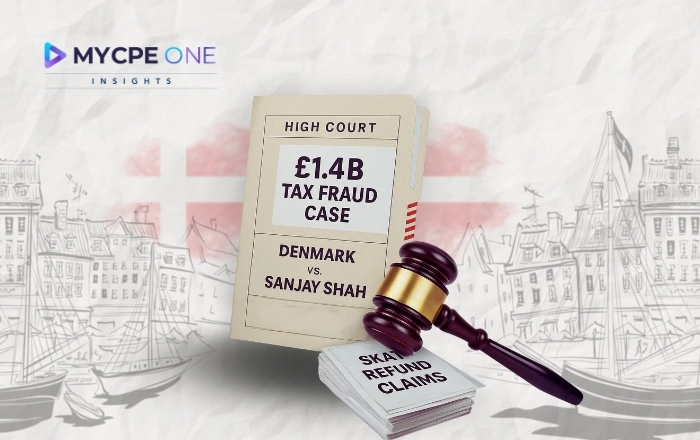
The Danish tax authority, Skat, lost a £1.4 billion fraud case against Solo Capital Partners along with several hedge funds and traders in London's High Court. The case was investigating a major tax scandal arising from the abuse of dividend tax loopholes, which has cost European treasuries more than €55 billion, and this latest ruling could inspire further defense arguments in ongoing cases across the continent.
If there’s one thing the financial world never runs out of, it’s loopholes, and Denmark just tripped over a £1.4 billion hole. After nearly a decade of courtroom drama, 108 hearing days, and legal fees that could bankroll a startup boom, London’s High Court dropped a bombshell: Denmark’s tax authority, Skat, lost its massive fraud case against Solo Capital Partners and a global web of hedge funds and traders. What was meant to be a slam-dunk victory against one of Europe’s biggest tax scandals ended up as a brutal reminder that in finance, being right doesn’t always mean winning.
To understand how Denmark’s case unraveled, you’ve got to start with the villain of the story, the cum-ex trade. “Cum-ex” sounds like some Wall Street latte, but it’s really the kind of financial sleight of hand that makes auditors break into a cold sweat. The scheme exploited dividend tax loopholes by rapidly buying and selling shares around dividend dates, muddying who actually owned the shares when the dividend was paid. That chaos led multiple parties to claim tax refunds on the same withholding tax, even though it had only been paid once. Think of it as a “one meal, many receipts” scam; everyone at the table paid once, but everyone walked away with a refund.
Between 2012 and 2015, Skat processed more than 4,000 refund claims, coughing up around 12.7 billion kroner (£1.4bn). At the centre was Sanjay Shah, a London-based trader who founded Solo Capital Partners in 2009 and allegedly turned these trades into a billion-pound business model. Denmark eventually caught up with him. Extradited from Dubai in 2023, Shah was sentenced to 12 years in prison last December, the harshest fraud sentence in Danish history, and ordered to forfeit 7.2 billion kroner. But across the North Sea, his London battle told a very different story.
On October 2, 2025, Justice Andrew Baker of the London High Court delivered a ruling that stunned both tax lawyers and finance pros alike. His verdict? Denmark wasn’t tricked; it was sloppy. While he called Shah “not a trustworthy individual” whose testimony contained “implausible claims and obvious lies,” Baker ruled that Skat’s controls were “so flimsy as to be almost non-existent.” Without strong systems, the court said, it couldn’t conclude Denmark had been legally deceived. Translation: it’s not fraud if you didn’t do your homework.
This nuance, the difference between moral wrong and legal proof, turned Denmark’s billion-pound case into dust. After nearly eight years, the country walked away empty-handed, with the bill for one of the longest civil trials in UK history likely running into hundreds of millions of pounds. The original case targeted over 100 defendants, from traders to corporate entities. By the time the trial wrapped, the list was cut down to about 50, and every single one walked free.
Behind the spreadsheets and subpoenas was Jas Bains, a lawyer who worked at Solo Capital from 2010 to 2013. When he realized the magnitude of the cum-ex trades, he blew the whistle, tipping off Danish authorities in 2015 and helping their investigation. His reward? Getting sued by the same government he helped. After years of legal limbo, the High Court cleared his name. Speaking to the BBC, Bains said, “This unnecessary trial cost me eight years of my life, and I’m grateful to the justice system for exonerating me.” His story captures the emotional toll behind high-stakes financial litigation, where even the good guys get dragged into the mud.
For Denmark, the ruling wasn’t just a courtroom defeat; it was a credibility hit. Kim Tolstrup, head of Skat, called the verdict “a surprising ruling we strongly disagree with” and vowed to appeal. But that appeal won’t be easy or cheap. The political fallout is already brewing as taxpayers question how such weak controls ever let billions slip through. Across Europe, governments are sweating. The cum-ex scandal has cost European treasuries more than €55 billion, and similar cases are ongoing in Germany, France, and the Netherlands. Denmark alone has filed lawsuits in seven countries, including the US, Canada, and Malaysia, trying to recover its losses.
This London ruling could embolden defendants across the continent. If Denmark, armed with a convicted fraudster, mountains of documents, and political backing, couldn’t prove deceit, what chance do other nations have? The message to tax agencies is clear: tighten your systems before you tighten your lawsuits. In this game, weak compliance is a defense lawyer’s dream.
There’s a painful irony here. Denmark chased down one of Europe’s slickest financial schemes only to be told it was too unorganised to prove it was scammed. It’s like realising your credit card got hacked, but being denied a refund because your password was “password123.” Still, not all is lost. Denmark’s global legal offensive has paid off in parts; authorities seized €232 million from Shah, and a New York court recently awarded Skat 1 billion kroner. But the London judgment is a loud wake-up call: even the strongest moral case can crumble without procedural muscle.
Denmark’s £1.4 billion defeat isn’t just about tax refunds; it’s a warning about how fast global finance moves compared to old-school bureaucracy. In a world where trades happen in microseconds and refunds in milliseconds, regulators are still running on human speed. The result? Systems that can’t keep up, fraudsters who can, and governments footing billion-pound tuition fees to learn the lesson. So, while Skat gears up for its appeal, the rest of Europe should be watching and learning. Because in this high-stakes game of taxes and tricks, Denmark just paid for everyone else’s masterclass.
Get Your CPE Credit From Here
Until next time…
Don’t forget to share this story on LinkedIn, X and Facebook
Subscribe now for $199 and get unlimited access to MYCPE ONE, from CPE credits to insights Magazine
📢MYCPE ONE Insights has a newsletter on LinkedIn as well! If you want the sharpest analysis of all accounting and finance news without the jargon, Insights is the place to be! Click Here to Join
Unlimited CPE for Just $199/Year!
Get CPE credits by reading or listening to approved content. Enjoy unlimited CPE for CPA (US), EA, CMA, CIA, CFE, SHRM, HRCI, and 100+ other designations—all for just $199 per year! (Learn More)
Team Subscriptions Available – Starting at Just $199/Year!
Schedule a no-obligation callYou’ve reached the 3 free-content piece limit. Unlock unlimited access to all News & CPE resources.
Subscribe Today.
Already have an account?
Sign In