MYCPE ONE
MYCPE ONE LOGO

Join 250,000+
professionals today

Add Insights to your inbox - get the latest
professional news for free.

MYCPE ONE insights

Doorstep Taxes put Amazon and DoorDash on the State Revenue Menu

Join our 250K+ subscribers

Join our 250K+ subscribers

Subscribe

13 OCT 2025 / ACCOUNTING & TAXES

Doorstep Taxes put Amazon and DoorDash on the State Revenue Menu

Doorstep Taxes put Amazon and DoorDash on the State Revenue Menu

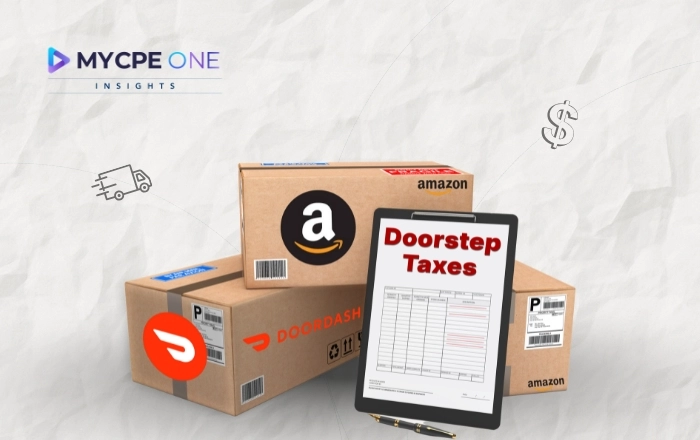
Imagine ordering your usual Friday night pizza, kicking back, and hearing that subtle “cha-ching” sound, not from DoorDash, but from your state government. Yep, in 2025, the delivery driver isn’t the only one stopping by. Say hello to “doorstep taxes,” the latest way states are cashing in on our stay-at-home habits. Gone are the days when hidden fees came only from corporations. Now, it’s statehouses quietly sliding their own surcharges into your digital cart, one delivery at a time.

From Free Shipping to “Fee Shipping”

Remember when “free delivery” was the golden promise of the internet? Amazon practically built its empire on it. But as our shopping carts moved online and gas tax revenues started to run dry, governments spotted a shiny new target: our doorsteps. Colorado kicked things off in 2022 with a 28-cent-per-delivery charge. Minnesota followed with a 50-cent fee on orders over $100. And more states, New York, Hawaii, Ohio, Maryland, and even Mississippi, are circling the idea like hawks over a rotisserie chicken. Each sees billions in potential revenue. Colorado alone expects around $5 billion over the next decade.

The logic? Simple math. As more drivers switch to electric vehicles, gas taxes, the old workhorse of infrastructure funding, are sputtering. So, lawmakers figured: if trucks are still rolling, why not tax the wheels that bring us our toilet paper, tacos, and toothpaste?

When Every Click is a Quarter More

Fast forward to today. Those extra pennies might not sound like much, but they’re multiplying faster than Amazon Prime memberships. In 2019, there were roughly 400 local and state delivery or service fees nationwide. Now? Over 1,400. And counting. Governments are calling them “fees.” Economists like to call them “rent extraction.” Consumers? We just call them annoying. Mike Bernard, Vertex’s chief tax officer, put it bluntly: “If people aren’t driving to stores and paying gas tax, but UPS trucks are still hitting the roads, states want their cut.” Fair enough. But for families living paycheck to paycheck, that “cut” adds up faster than a Starbucks order at the airport, especially since some airports are now adding “neighborhood fees” and 3% surcharges on food.

And then there’s Amazon, whose own fees just joined the party. As of this year, Prime members pay up to $9.95 for grocery deliveries under $50. The company says it’s about “keeping prices low,” which is corporate-speak for “our costs are high.” DoorDash, Instacart, and Grubhub are quietly adjusting their own pricing models too, because every new regulation or tax ends up somewhere, and spoiler alert: it’s not in the boardroom.

More Traffic, Less Trust

Here’s where things get messy. Doorstep taxes are supposed to fund roads and infrastructure. But ironically, they might be putting more cars on the road. Think about it: one Amazon van can deliver to 20 homes in a single trip. If those same people decide to avoid the new fees and drive to the store themselves, that’s 20 separate cars hitting the same road. More traffic. More emissions. More stress. And more honking, because that’s just how we roll in America. Families, too, are getting squeezed. A delivery tax turns a time-saving grocery drop-off into a minor financial dilemma. Do you pay the 50 cents, or do you load the kids into the minivan for a “quick” trip that somehow eats two hours of your Saturday? For people juggling multiple jobs or elder care, that’s not a choice, it’s a burden.

Then there’s an accessibility problem. Many elderly, disabled, or rural residents need delivery to get medicine and groceries. They can’t just “drive to the store.” For them, doorstep taxes are more than inconvenient; they’re punitive. As one analyst said, it’s like charging a toll to the very people at least able to find another route. Local restaurants also take a hit. If a $0.50 tax or an extra delivery fee makes diners think twice about ordering takeout, that means fewer orders, fewer tips, and smaller paychecks for gig workers. DoorDash drivers and Instacart shoppers are already feeling it. Less demand equals fewer gigs. And while state coffers may fill up, the delivery economy, the side-hustle lifeline for millions, feels the squeeze.

Taxing Tomorrow’s Convenience

So, what’s next? More of it, probably. Legislators see doorstep taxes as “low-hanging fruit.” After all, it’s politically easier to tack a few cents onto your Amazon order than to raise property or income taxes. But there’s a catch. Economists like Arjun Mahadevan warn that these “stealth taxes” are short-term fixes. They might plug a budget gap, sure, but at the cost of long-term trust and consumer confidence. Small businesses selling through Etsy or eBay face even steeper competition if customers balk at delivery costs. Fewer deliveries mean less digital commerce, which ironically hurts the very innovation these taxes were supposed to fund.

Meanwhile, big players like Amazon and DoorDash aren’t taking it lying down. They’ve teamed up under the Chamber of Progress, arguing these taxes are regressive and inefficient. Their spin is that doorstep delivery isn’t a luxury anymore, it’s essential. And for many households, that’s true. New York assemblyman Robert Carroll, though, isn’t backing off. He’s pushing a $3 delivery fee in New York City, exempting food, medicine, and baby formula. His goal? To nudge people toward fewer, bundled deliveries and fund free public transit. A noble idea, but in a city where over 2 million packages arrive daily, even a small tax becomes a big number.

Final Delivery

At its core, this isn’t just about pennies on pizza. It’s a bigger debate about what kind of economy we want. Do we tax convenience to fund sustainability, or risk sustainability by keeping convenience cheap? For now, families pay a little more; gig workers earn a little less, and Amazon passes along the difference with a polite smile. The “doorstep tax” might sound small, but it’s a sign of the times: as our habits evolve, so do the ways governments and corporations find to monetize them. So next time you tap “Order Now,” don’t be surprised if your fries come with a side of fiscal policy. After all, the taxman delivers too.

Until next time…

Don’t forget to share this story on LinkedIn, X and Facebook

Subscribe now for $199 and get unlimited access to MYCPE ONE, from CPE credits to insights Magazine

📢MYCPE ONE Insights has a newsletter on LinkedIn as well! If you want the sharpest analysis of all accounting and finance news without the jargon, Insights is the place to be! Click Here to Join

The Only All-in-One CPE & Learning Platform for CPA & Accounting Firms

Get everything you need for team learning and CPE compliance—starting at just $199 per user/year!

  • 15,000+ hours of CPE-approved content
  • Learning Management Software to track & manage learning
  • CPE compliance tracking for all 50 states & 100+ designations
  • Mobile app access with audio-based courses
  • CPE-approved articles (like the one you're reading!)
  • Practical staff training & assessments
  • Learning & Development services

Learn more or schedule a no-obligation call!

Unlock Annual Access to News & CPE Subscription

You’ve reached the 3 free-content piece limit. Unlock unlimited access to all News & CPE resources.
Subscribe Today.

News & Updates

  • Exclusive News & Insights
  • Latest Regulatory Updates
  • Accounting Industry Trends
  • Expert Insights
  • AI-Driven Audio & Summaries
  • Infographics & Videos
  • CPE-Approved Articles
  • Digital Magazine
  • Benchmarking Blogs

Unlimited CPE Access for 1 Year

  • 15,000+ Hours of Content
  • 500+ Subject Areas
  • Mandatory Ethics Courses
  • 250+ Compliance Packages
  • 50+ Virtual Conferences and Events Access
  • Format: Live, Audio, Video, E-Books
  • Audio Based Courses & Podcasts
  • Add External Certificates with AI
  • AI Compliance Tracking and Report
  • Instant Certification and Fast Reporting
  • Mobile App Access (iOS and Android)
  • Dedicated Support System
  • Practical Training Programs
  • AI Academy Access
  • Tax Academy Access
  • Audit Academy Access
  • Leadership Academy Access