Join 250,000+
professionals today
Add Insights to your inbox - get the latest
professional news for free.
Join our 250K+ subscribers
Subscribe02 MAR 2026 / ACCOUNTING & TAXES
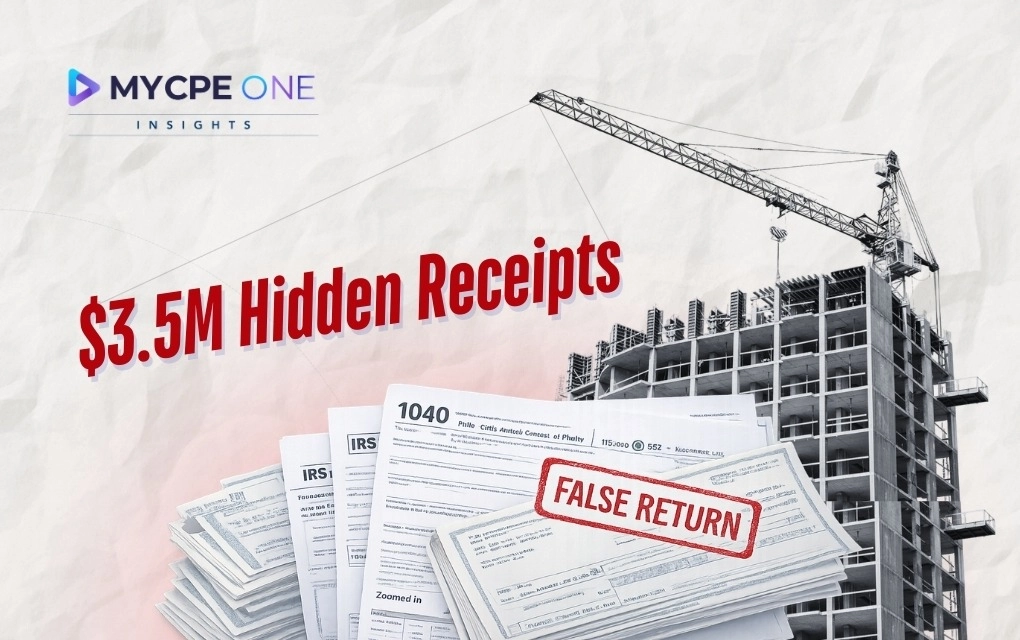
Philip Castracucco, a 63-year-old contractor in Westchester County, New York, has pleaded guilty to filing false individual income tax returns, a felony carrying a maximum of three years in jail. Over the years, Castracucco managed to hide over $3.5 million from his masonry business and more than $1 million in salaries by cashing business receipt checks at a check-cashing service instead of a bank, omitting this income from his corporation and personal tax returns.
Every CPA has had this moment. A contractor walks in with a box of 1099s, a shoebox of receipts, and a casual line that makes your internal alarm bell ring. “Some of the jobs were cash. We’ll square it up later.” Most of the time, it is sloppy recordkeeping. Sometimes, it is something else. Last week, Philip Castracucco, a 63-year-old construction contractor from Westchester County, New York, pled guilty in federal court to filing false individual income tax returns. According to the U.S. Attorney for the Southern District of New York and IRS Criminal Investigation, this was not an oversight. It was a multi-year system designed to keep money off the books. Let’s unpack what actually happened, why it worked for a while, and what professionals should take from it.
The mechanics were simple. That is what makes it uncomfortable.
From 2017 through 2022, Castracucco owned a masonry contracting business operating around Westchester County. During that period, he caused more than $3.5 million in business receipt checks to be cashed at a check-cashing service instead of deposited into the company’s bank account. No deposit, no bank trail. No bank trail, no easy reconciliation.
He converted those checks to cash. He then used that cash to pay:
From 2018 through 2023, he filed S corporation returns on Form 1120-S that omitted those gross receipts and more than $1 million in salaries and wages. He also filed Forms 941 that failed to report those wages. Between 2020 and 2023, he filed individual Forms 1040 that omitted more than $900,000 in business income he received from the S corporation. This was not one bad year. This was a pattern. He ultimately pled guilty to one count of making and subscribing to a false individual income tax return, a felony that carries a statutory maximum of three years in prison.
If you have worked with closely held construction or trades businesses, you already know the pressure points. Construction is cash-flow driven. Subcontractors get paid via check. Materials get paid fast. Payroll hits every week. Margins can be tight, and recordkeeping discipline varies widely. Check-cashing businesses exist precisely because some owners prefer liquidity over traceability. That alone is not illegal. But when checks never hit the business bank account, you have a built-in blind spot. Think about how many CPA firms rely on bank statements as the starting point for revenue testing in small S corporations. If $3.5 million never touches the operating account, it never appears in the standard reconciliation. Unless you independently reconcile customer invoices to total project billings, you may not see the gap.
Castracucco has pleaded guilty. The government publicly tied his conduct to the broader “tax gap,” which the IRS estimates at hundreds of billions of dollars annually. Enforcement messaging matters here. U.S. Attorney Jay Clayton framed it bluntly: cheating on taxes is stealing from fellow New Yorkers. IRS-CI emphasized accountability and deterrence. That language is not accidental. The IRS is under ongoing pressure from Congress to demonstrate measurable enforcement outcomes, particularly against business owners who underreport income. This case fits that narrative cleanly:
For practitioners, the timing also matters. The IRS continues to deploy funding authorized in recent years toward enforcement in areas involving pass-through entities and higher-income individuals. S corporations sit squarely in that crosshairs. You do not need to be a conspiracy theorist to see the direction of travel. Increased third-party data matching. Better analytics. Focus on industries with historical cash leakage. The era of “we’ll fix it next year” is fading fast.
Will this scare every contractor straight? No. Some will still roll the dice. That is human nature. But the direction is clear. Data matching improves. Investigative tools expand. Check-cashing services leave trails. Forms 941 and 1120-S filings cross-reference in ways they did not twenty years ago. If you serve closely held businesses, now is the time to review revenue recognition processes, payroll reporting, and internal controls. Not in theory. In actual files. Because here is the bottom line. The mechanics of this case were not sophisticated. They were old-school. Cash the check. Do not deposit it. Do not report it. And that is exactly why professionals should pay attention. The simplest schemes often unravel the hardest.
Until next time…
Don’t forget to share this story on LinkedIn, X and Facebook
Subscribe now for $199 and get unlimited access to MYCPE ONE, from CPE credits to insights Magazine
📢MYCPE ONE Insights has a newsletter on LinkedIn as well! If you want the sharpest analysis of all accounting and finance news without the jargon, Insights is the place to be! Click Here to Join
You’ve reached the 3 free-content piece limit. Unlock unlimited access to all News & CPE resources.
Subscribe Today.
Already have an account?
Sign In