
MYCPE ONE
MYCPE ONE LOGO

Join 250,000+
professionals today

Add Insights to your inbox - get the latest
professional news for free.

MYCPE ONE insights

How a Big Four Audit Fee Cut Raises a Bigger AI Question

Join our 250K+ subscribers

Join our 250K+ subscribers

Subscribe

09 FEB 2026 / ACCOUNTING & TAXES

How a Big Four Audit Fee Cut Raises a Bigger AI Question

How a Big Four Audit Fee Cut Raises a Bigger AI Question

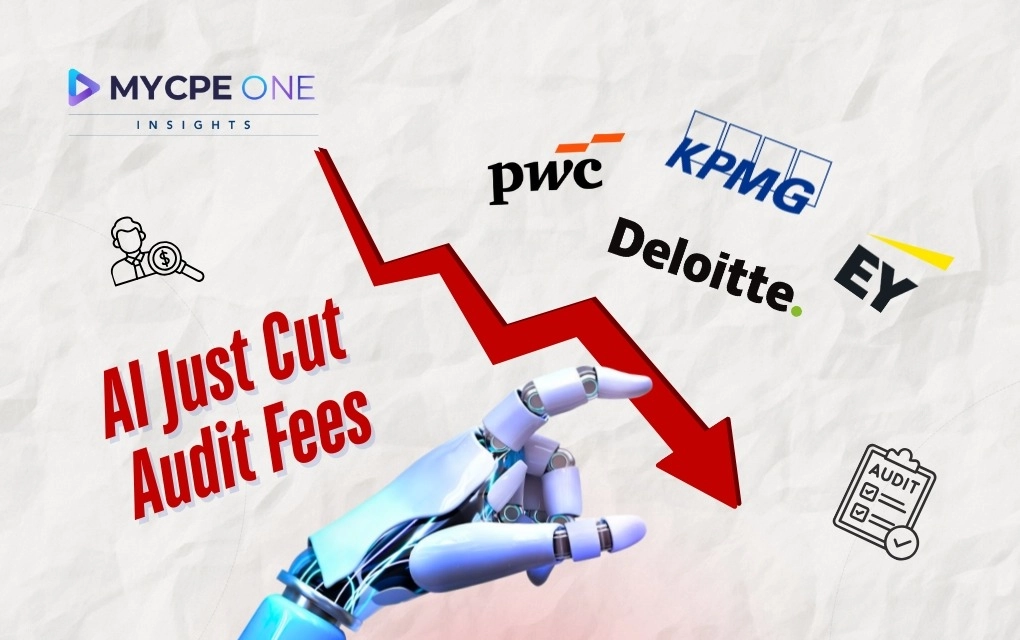
A funny thing happens when the world’s biggest audit firms stop talking about AI in conference keynotes and start talking about it in the invoice review. Suddenly, the hype gets very practical. Last year, KPMG quietly did something that should make every CPA partner and audit committee chair sit up a little straighter. It pressed its own auditor, Grant Thornton UK, for a fee cut. Not because of a restatement, not because of a scope reduction, but because AI was supposed to make the work cheaper. Grant Thornton agreed. The audit fee for KPMG International’s 2025 audit fell from $416,000 to $357,000, about a 14% drop. On paper, it looks modest. In practice, it hits right where the profession lives: pricing, value, and who actually benefits from automation. This was not a press release moment. It was a behind-closed-doors negotiation that leaked because it says something uncomfortable about where audit economics may be headed.

Is AI finally showing up in audit pricing?

For years, firms have pitched AI as a quality upgrade. Better risk assessment. Smarter planning. More consistent documentation. All true, at least in part. What they have been careful not to promise is lower fees. KPMG flipped that script, at least for its own audit. The argument was simple. Grant Thornton had audited KPMG International for years. The books were not unusually complex. AI tools should accelerate planning, automate routine testing, and reduce manual effort. If the work gets faster, the bill should shrink. That logic landed. UK filings show the fee cut clearly.

This matters because audit pricing has historically moved in one direction, up. According to Ideagen Audit Analytics, average audit fees rose across nearly every European country last year, even as firms poured money into AI. The reason is familiar to anyone who has run an engagement. New tools do not eliminate people. They add layers of review, controls, validation, and training. Efficiency gains exist, but they rarely show up cleanly in year-one budgets. KPMG’s move signals a shift. At least some clients now believe AI savings are no longer theoretical. They expect to see them reflected in the fee letter.

Who really captures the value of automation?

Audit firms have spent billions building AI platforms. Deloitte’s Omnia supports documentation review, data extraction, memo drafting, and risk monitoring across roughly 85,000 auditors. PwC is pushing toward near-end-to-end audit automation by 2026, backed by a $1.5 billion investment and Microsoft Azure OpenAI. EY is deploying AI to analyze financial reporting code and external risk signals, with autonomous agents planned next. KPMG’s Clara platform, using MindBridge AI, runs full population transaction testing and anomaly detection. None of this is cheap. Models need training. Systems need governance. Regulators expect explainability, not black boxes. Partners know this. So do CFOs.

That creates tension. If AI speeds up testing but requires higher-skilled reviewers, more oversight, and heavier compliance infrastructure, where does the margin go? Firms argue it supports quality and risk reduction. Clients increasingly ask why that does not translate into pricing relief. This is where the rubber meets the road. In most firms, audit pricing still leans heavily on hours, even if nobody admits it out loud. AI challenges that model without fully replacing it. The work changes shape, not volume. Junior hours compressed. Senior review time expands. The cost base shifts, but it does not disappear. KPMG essentially said, some of that shift is on the table now. Grant Thornton accepted that, at least for this engagement.

Does this change the balance of power?

It might, especially for large, repeat clients with leverage. KPMG did not make a philosophical argument. It made a commercial one and backed it with the ultimate pressure point, the threat to switch auditors. Not every company can do that. Many cannot, due to independence rules, market concentration, or limited alternatives. But large multinationals with clean histories and predictable operations absolutely can push back. That sets a precedent. Audit committees will notice. CFOs will ask questions. Procurement teams will get involved earlier. AI will move from marketing decks into fee negotiations.

For mid-sized firms, this creates a squeeze. Clients hear that AI makes audits faster. They assume cheaper. Firms still carry rising partner compensation, regulatory scrutiny, PCAOB inspection pressure, and tech spend. Something has to give. As one partner put it recently, efficiency without margin relief is not nothing, but it is not the full story either.

What does this mean inside real CPA firms?

Picture a typical U.S. firm during busy season. Teams are already in the weeds. Staff turnover remains high. Seniors are stretched thin. Partners review more work, not less, because AI flags more anomalies, not fewer. Now add a client asking for a discount because the firm uses AI. That is not hypothetical anymore. Firms will have to get sharper about explaining where AI helps and where human judgment still dominates. Grant Thornton said it plainly. High-quality audits rely heavily on expert judgment. Fees reflect people and technology. Both cost money.

That explanation will hold in complex audits, high-risk industries, or first-year engagements. It gets harder to defend in stable, repeat audits where processes are mature and data flows cleanly. This also pushes firms toward outcome-based thinking. If AI improves quality, reduces risk, and avoids restatements, that value matters. But it is harder to price than hours. Until pricing models evolve, these conversations will feel awkward and personal. No one wants to admit that AI savings might first show up as margin protection rather than client discounts. Yet clients increasingly have skin in the game and want their share.

So, where does this actually land?

KPMG’s fee cut does not mean audit fees are about to fall across the board. The data says otherwise. Fees are still climbing in most markets. AI investment costs are real and ongoing. What this episode does signal is a mindset change. Large clients now see AI as part of the commercial discussion, not just the quality discussion. That changes how future engagements get negotiated. Expect more pointed questions. Where exactly did AI reduce effort? Which procedures still require senior review? How much of the workflow is automated versus augmented? Those questions will move from internal dashboards to client meetings. The profession has long sold trust, judgment, and independence. AI strengthens those pillars when used well. But once efficiency enters the picture, pricing conversations follow. KPMG asked the question out loud. Others will quietly ask it next.

Until next time…

Don’t forget to share this story on LinkedIn, X and Facebook

Subscribe now for $199 and get unlimited access to MYCPE ONE, from CPE credits to insights Magazine

📢MYCPE ONE Insights has a newsletter on LinkedIn as well! If you want the sharpest analysis of all accounting and finance news without the jargon, Insights is the place to be! Click Here to Join

Unlock Annual Access to News & CPE Subscription

You’ve reached the 3 free-content piece limit. Unlock unlimited access to all News & CPE resources.
Subscribe Today.

News & Updates

  • Exclusive News & Insights
  • Latest Regulatory Updates
  • Accounting Industry Trends
  • Expert Insights
  • AI-Driven Audio & Summaries
  • Infographics & Videos
  • CPE-Approved Articles
  • Digital Magazine
  • Benchmarking Blogs

Unlimited CPE Access for 1 Year

  • 15,000+ Hours of Content
  • 500+ Subject Areas
  • Mandatory Ethics Courses
  • 250+ Compliance Packages
  • 50+ Virtual Conferences and Events Access
  • Format: Live, Audio, Video, E-Books
  • Audio Based Courses & Podcasts
  • Add External Certificates with AI
  • AI Compliance Tracking and Report
  • Instant Certification and Fast Reporting
  • Mobile App Access (iOS and Android)
  • Dedicated Support System
  • Practical Training Programs
  • AI Academy Access
  • Tax Academy Access
  • Audit Academy Access
  • Leadership Academy Access