Join 250,000+
professionals today
Add Insights to your inbox - get the latest
professional news for free.
Join our 250K+ subscribers
Subscribe16 JAN 2026 / ACCOUNTING & TAXES
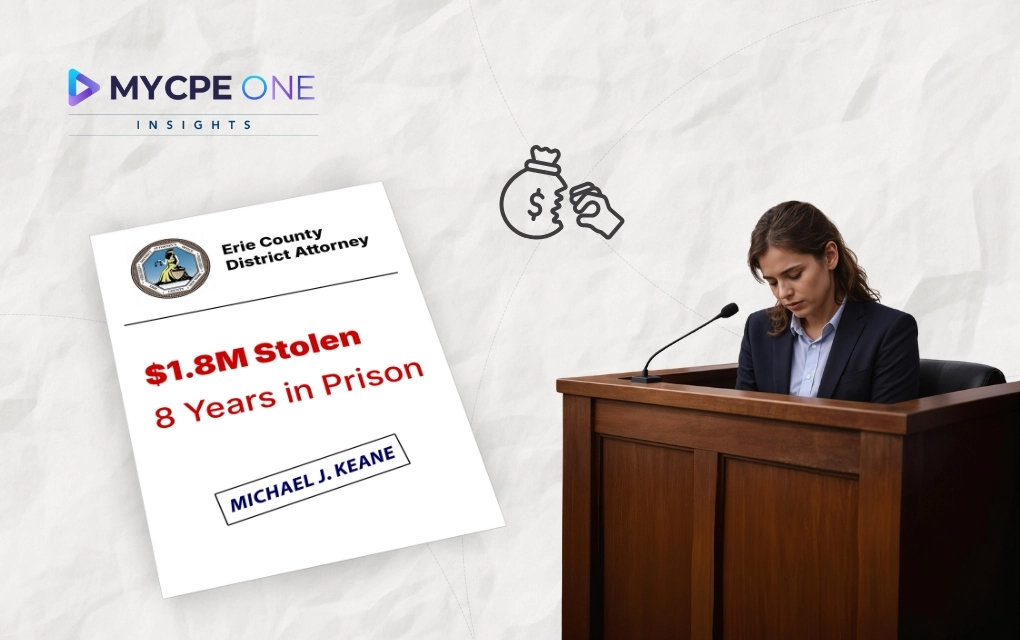
Former bookkeeper Bonnie Bova has received an eight year prison sentence after running a seven-year fraud totaling over $1.8 million. Bova, a bookkeeper for a medical practice in Erie County, New York, falsified checks to herself and manipulated financial records to hide her scheme, which was eventually unveiled by an internal audit instigated by a vigilant employee's suspicion over a check's legitimacy.
Some frauds unravel because of a whistleblower. Others crack when a system spits out an error. This one ended because someone paused, squinted at a check, and said, “That’s weird.” Seven years. More than $1.8 million. One sharp-eyed employee finally pulled the thread.
That moment now lands Bonnie Bova, a former bookkeeper in Erie County, New York, behind bars for up to eight years. For accounting and tax professionals, this case hits close to home. Not because the mechanics feel exotic, but because they feel painfully familiar.
Between September 2017 and October 2024, Bova issued checks from a medical practice in Amherst to herself, then altered computer records to make the payments look like routine vendor disbursements. No offshore accounts. No shell companies. Just a steady drip of checks masked by manipulated accounting records.
That should make every firm partner a little uncomfortable.
This was not a one-time override, or a frantic end-of-month move. Investigators say the scheme ran quietly for seven years, totaling $1,830,779.56. The money covered credit cards and personal expenses. Think lifestyle creep funded by weak internal controls.
Here’s the uncomfortable truth. Small and mid-sized medical practices often trust long-tenured bookkeepers like family. Duties blur. Reviews turn into check-the-box exercises. Segregation of duties sounds nice until payroll hits and someone needs to “just handle it.”
That trust gap is where fraud lives.
The fraud ended in October 2024 when another employee noticed a problem with a check and kicked off an internal audit. No hotline tip. No outside auditor. Just curiosity and follow-through.
That detail matters.
Many firms rely on annual financials or tax prep as a backstop. In reality, those processes rarely test vendor legitimacy or payment authorization deeply enough to catch this kind of scheme. If a vendor looks real and the amounts stay below pain thresholds, the paper trail passes.
This is where practitioners see the real-world tension. Clients want efficiency. They do not want controls that slow operations or feel accusatory. But efficiency without oversight turns messy fast.
As Warren Buffett once put it, “Only when the tide goes out do you discover who’s been swimming naked.” In this case, the tide never went out until someone finally asked a basic question.
Bova also failed to report the stolen funds as income on her personal tax returns from 2019 through 2023. That added a second felony charge for offering a false instrument for filing.
From a tax perspective, this part is a no-brainer. Embezzled funds count as taxable income. Courts have been crystal clear on that for decades. Still, fraud cases routinely pile on tax charges because offenders convince themselves that stolen money somehow sits outside the tax system.
It does not.
Bova agreed to pay $97,561 in restitution to the New York State Department of Taxation and Finance, on top of restitution to her former employer. Her defense attorney already submitted $600,000, with another $3,500 paid at sentencing. Full restitution remains outstanding.
For tax professionals, this reinforces a quiet risk. When fraud surfaces, tax compliance almost always sits in the blast radius. Returns get amended. Penalties follow. And advisors get dragged into uncomfortable conversations about what they did or did not know.
This was not a breakdown caused by complexity or volume. It was a breakdown caused by familiarity. When processes run quietly for years without friction, oversight fades, and professional skepticism softens. That is when risk compounds.
The court resolved this matter with a sentence. The profession should resolve it with discipline. Systems that feel stable can quietly accumulate risk when no one pauses to challenge them. That pause, uncomfortable as it may be, is often the most valuable control a firm has.
Until next time…
Don’t forget to share this story on LinkedIn, X and Facebook
Subscribe now for $199 and get unlimited access to MYCPE ONE, from CPE credits to insights Magazine
📢MYCPE ONE Insights has a newsletter on LinkedIn as well! If you want the sharpest analysis of all accounting and finance news without the jargon, Insights is the place to be! Click Here to Join
You’ve reached the 3 free-content piece limit. Unlock unlimited access to all News & CPE resources.
Subscribe Today.
Already have an account?
Sign In