Join 250,000+
professionals today
Add Insights to your inbox - get the latest
professional news for free.
Join our 250K+ subscribers
Subscribe30 MAR 2026 / ACCOUNTING & TAXES
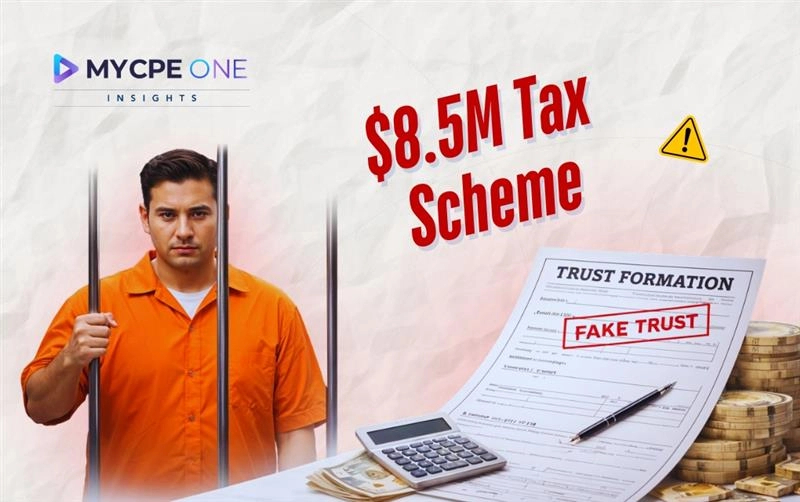
Multiple family members were sentenced after attempting to extract more than $8.5 million in tax refunds through the creation and misuse of fake trust entities. Despite receiving warnings from the IRS, the fraudsters continued to file false returns and submitted falsified financial documents, resulting in significant financial losses and several years in prison for the key culprits. This case raises awareness of tax fraud schemes, emphasizing the increasing focus of the IRS on substance over form, and underlining the increased risk as detection becomes more data-driven and targeted.
Most tax fraud cases don’t start with flashy schemes or complex loopholes. They start with something much simpler, a belief that the system can be bent just enough to go unnoticed. Sometimes it’s a small misreporting. Sometimes it’s aggressive structuring. And sometimes, like this case, it turns into a full-scale operation built on fabricated entities and repeated filings. That’s exactly what happened in a recent multimillion-dollar tax fraud case where a family attempted to turn fake trusts into real refunds. The result was predictable, but the scale and persistence behind the scheme reveal something deeper about how fraud evolves and how the IRS responds.
The foundation of the scheme dates back to around 2016, when multiple family members began creating and controlling purported trust entities. On paper, everything looked structured. The trusts had names, EINs, and formal filings. But the structure itself was the fraud.
The individuals filed Forms 1041 and 1041-NR, claiming large refunds based on fabricated income, withholding, and payment entries. These weren’t small claims. In total, they attempted to extract more than $8.5 million in tax refunds. To support these filings, they created multiple trust entities tied to different family members, opened bank accounts in those trust names, filed returns showing false financial activity, and submitted fake financial instruments and altered money orders to legitimize claims.
Despite receiving warning letters from the IRS to stop, they continued filing false returns and supporting documents. This wasn’t a one-time filing error. It was a repeated, structured attempt to extract funds using layers of documentation designed to appear legitimate.
The scheme eventually triggered enforcement action after years of filings, discrepancies, and escalating red flags.
Following a jury trial, three key individuals were sentenced:
A fourth individual is awaiting sentencing. The financial impact was significant:
The funds weren’t hidden in complex offshore structures. They were spent on:
That spending pattern is often what accelerates detection. Once funds move into visible assets, the paper trail becomes harder to ignore.
At a surface level, the scheme appeared organized. Trust entities were created, documentation existed, and filings were consistent. But it failed for a simple reason: substance did not match structure. The IRS does not evaluate entities based only on their existence; it looks at economic activity, ownership reality, the flow of income, and consistency across filings.
In this case, the trusts had no real economic purpose, the income and withholding claims were fabricated, and the supporting documents were falsified. More importantly, the defendants continued filing even after receiving IRS warnings, which significantly strengthened the criminal case. That persistence transformed what might have been viewed as aggressive or questionable filings into clear evidence of intentional fraud.
This was not an isolated incident. In a separate case, Michael J. Moore, a Nevada-based tax preparer, pleaded guilty to running a fraudulent tax scheme through his firm, X Tax Professionals. His approach was different, but the underlying principle was the same.
Instead of creating trusts, he:
Within just three months, this scheme caused more than $250,000 in tax losses. But that wasn’t the full story. Moore had already pleaded guilty in a prior case involving a similar scheme that caused over $3.5 million in losses. Even while awaiting sentencing, he:
The charges included:
This case highlights a different risk vector, not taxpayers creating schemes, but professionals enabling them.
These cases highlight patterns that go beyond individual misconduct. For professionals, the warning signs are clear:
The key shift is this: Fraud today often looks structured, documented, and technically framed. But the IRS is increasingly focused on substance over form.
Looking ahead, enforcement is becoming more targeted and data-driven, with the IRS using analytics to identify abnormal refund patterns, track repeated filings, and focus on preparers as much as taxpayers. At the same time, penalties are getting stricter, including prison time, restitution, and civil consequences. While detection in complex cases may take time, once patterns are identified, enforcement moves quickly. Both cases show the same pattern: schemes run for years but lead to swift consequences once uncovered. The broader takeaway is simple, delayed detection does not reduce risk, it increases it. These cases highlight how easily structure can be mistaken for legitimacy, but the IRS looks beyond paperwork to substance. For professionals, the risk lies not just in what is filed, but in why it exists, because when structure replaces substance, the consequences are real.
Until next time…
Don’t forget to share this story on LinkedIn, X and Facebook
Subscribe now for $199 and get unlimited access to MYCPE ONE, from CPE credits to insights Magazine
📢MYCPE ONE Insights has a newsletter on LinkedIn as well! If you want the sharpest analysis of all accounting and finance news without the jargon, Insights is the place to be! Click Here to Join
You’ve reached the 3 free-content piece limit. Unlock unlimited access to all News & CPE resources.
Subscribe Today.
Already have an account?
Sign In