MYCPE ONE
MYCPE ONE LOGO

Join 250,000+
professionals today

Add Insights to your inbox - get the latest
professional news for free.

MYCPE ONE insights

How Nidec’s $1.6 Billion Accounting Crisis Unfolded

Join our 250K+ subscribers

Join our 250K+ subscribers

Subscribe

04 MAR 2026 / ACCOUNTING & TAXES

How Nidec’s $1.6 Billion Accounting Crisis Unfolded

How Nidec’s $1.6 Billion Accounting Crisis Unfolded

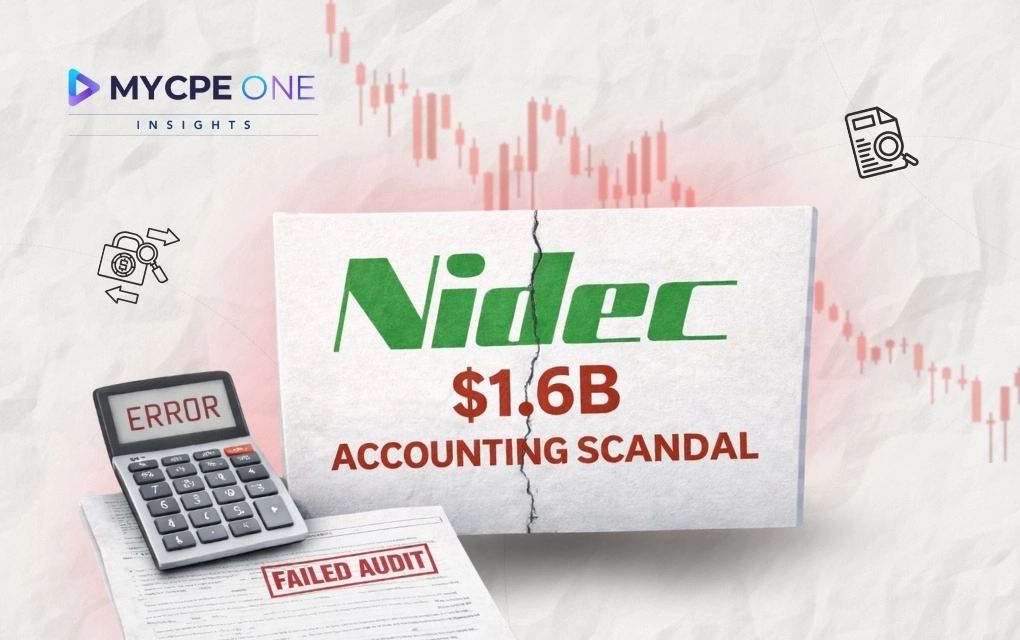
Every accounting professional has seen a version of this movie before. A company posts strong growth, leadership pushes ambitious targets, and the culture quietly shifts from “hit the number” to “hit the number at any cost.” At first it looks like discipline. Later, it starts looking like creative accounting. Nidec Corp., the Japanese manufacturer known globally for precision motors, is now learning how expensive that shift can become. What began as accounting irregularities in a subsidiary has evolved into a full corporate crisis. Investigators have identified more than 1,000 instances of improper accounting across multiple operations. The company may now record about ¥250 billion, roughly $1.6 billion, in impairment charges. For accountants, auditors, and finance leaders, the story goes far beyond a single company. It raises familiar questions about governance, corporate culture, internal controls, and the quiet pressure that builds inside high-performing organizations. And if you run or advise companies with aggressive growth goals, this one probably hits close to home.

How does Nidec end up with 1,000 accounting irregularities?

The scale of the problem surprised even seasoned observers.

A third-party investigative committee reviewed accounting practices across Nidec’s operations and documented more than 1,000 cases of improper accounting activity. The irregularities appeared across subsidiaries in Italy, Switzerland, and China, along with issues tied to its automotive inverter business. The examples read as a checklist that auditors know well. Investigators cited inflated inventory values, misreported customs values, government grants booked as revenue, and labor costs capitalized as fixed assets to defer expenses. In other words, the type of adjustments that can slowly distort financial statements occurs when oversight weakens.

One example that triggered deeper scrutiny involved a payment of about ¥200 million, roughly $1.35 million, by a Chinese subsidiary. That payment raised questions about underreported customs values and internal control failures. At first glance, none of this looked like a Hollywood fraud plot. No secret offshore accounts or fictional companies. Instead, it looks more like what Warren Buffett once described in a letter to shareholders: “Managers that always promise to make the numbers will usually find a way to make the numbers.” That line lands a little differently after reading the Nidec report.

When “10% margin or bust” becomes corporate policy

At Nidec, investigators pointed to a simple benchmark that quietly shaped behavior across the organization. The company treated a 10% operating margin as the minimum acceptable performance. Anything below that threshold effectively counted as a loss. Those expectations started at the top. Founder Shigenobu Nagamori, long admired for building Nidec into a global manufacturing force, personally set performance targets that flowed down to more than 350 subsidiaries and affiliated businesses. According to the investigative report, executives and managers understood the message clearly. Missing targets invited criticism and pressure. So, employees started smoothing results.

Some units recognized sales early. Others delayed inventory write-downs. Asset valuations shifted. Expenses moved around. None of this happened overnight. It accumulated over time, like accounting sand filling a jar. Investigators said Nagamori did not directly instruct anyone to manipulate financial results. But the environment created strong incentives to keep the numbers looking healthy. That dynamic will sound painfully familiar to many audit professionals. Every firm has seen versions of it during client engagements. Leadership sets aggressive expectations, middle management feels squeezed, and accounting judgments start drifting toward optimism. Then one day, the auditors start asking questions.

Can Nidec survive the regulatory?

Nidec expects potential impairment charges of around ¥250 billion, roughly $1.6 billion. The company has also delayed financial reporting while auditors review the scope of the accounting issues. Meanwhile, the Tokyo Stock Exchange has warned the company it could face delisting if governance problems are not resolved. Moody’s downgraded the company’s debt rating three levels into junk territory. Its stock has been removed from the Nikkei 225 index. Shares have also fallen sharply, dropping roughly 30% since late summer. For any public company, that combination is rough territory.

The leadership fallout has been equally dramatic. Chairman Hiroshi Kobe, Chief Financial Officer Akinobu Samura, and senior executive Yoshihisa Kitao have all resigned. Founder Nagamori stepped away from the board earlier, though he remains the largest individual shareholder. Chief Executive Mitsuya Kishida now faces the task of stabilizing the company and rebuilding trust with investors, regulators, and auditors. Nidec is preparing a recovery plan that will include revised financial statements, changes to internal controls, and new compliance education programs. That plan may be announced soon. But the third-party investigation is still ongoing, so additional findings remain possible.

Is this a governance failure or just a familiar corporate story?

The uncomfortable truth is that stories like this appear across markets every few years. Different companies. Different industries. Same pattern. Rapid expansion stretches internal controls. Leadership pushes ambitious targets. Oversight struggles to keep up with complexity. Nidec spent years pursuing aggressive acquisitions and expansion strategies, including attempts to acquire machine tool manufacturers and push deeper into automotive and industrial markets. Growth came quickly. Controls sometimes lagged behind. That gap matters.

When a company manages hundreds of subsidiaries across multiple jurisdictions, accounting oversight becomes a serious operational discipline. Customs values, inventory valuation, grant recognition, asset capitalization rules, and intercompany transactions can create thousands of opportunities for judgment calls. Without strong governance, those judgments slowly drift. Auditors know the feeling. One questionable entry appears during testing. Then another. Soon, the audit team starts expanding procedures and asking uncomfortable questions. By the time investigators are counting accounting irregularities in the hundreds, the internal culture already tells a story.

The Final Audit

It would be easy to treat the Nidec situation as just another international corporate drama. But there are real lessons here for finance teams and advisory firms.

  • First, internal controls rarely fail because of a single accounting error. They fail when culture signals that hitting targets matters more than transparency.
  • Second, aggressive growth strategies need equally aggressive governance structures. Expanding into multiple jurisdictions without strengthening oversight creates a slow-moving risk that eventually surfaces.
  • Third, accounting teams inside companies need the authority to push back when performance expectations cross into accounting pressure. Without that guardrail, small adjustments pile up.

And finally, auditors play a crucial role in breaking the cycle early. Independent oversight remains one of the few mechanisms that can interrupt unhealthy reporting incentives. Charlie Munger once joked that “show me the incentive and I will show you the outcome.” The Nidec story might become another example of that principle in action. Whether the company can rebuild trust now depends on something far less glamorous than expansion strategies or AI-driven products. It comes down to governance, transparency, and restoring the boring discipline of good accounting. In other words, the fundamentals.

Until next time…

Don’t forget to share this story on LinkedIn, X and Facebook

Subscribe now for $199 and get unlimited access to MYCPE ONE, from CPE credits to insights Magazine

📢MYCPE ONE Insights has a newsletter on LinkedIn as well! If you want the sharpest analysis of all accounting and finance news without the jargon, Insights is the place to be! Click Here to Join

Unlock Annual Access to News & CPE Subscription

You’ve reached the 3 free-content piece limit. Unlock unlimited access to all News & CPE resources.
Subscribe Today.

News & Updates

  • Exclusive News & Insights
  • Latest Regulatory Updates
  • Accounting Industry Trends
  • Expert Insights
  • AI-Driven Audio & Summaries
  • Infographics & Videos
  • CPE-Approved Articles
  • Digital Magazine
  • Benchmarking Blogs

Unlimited CPE Access for 1 Year

  • 15,000+ Hours of Content
  • 500+ Subject Areas
  • Mandatory Ethics Courses
  • 250+ Compliance Packages
  • 50+ Virtual Conferences and Events Access
  • Format: Live, Audio, Video, E-Books
  • Audio Based Courses & Podcasts
  • Add External Certificates with AI
  • AI Compliance Tracking and Report
  • Instant Certification and Fast Reporting
  • Mobile App Access (iOS and Android)
  • Dedicated Support System
  • Practical Training Programs
  • AI Academy Access
  • Tax Academy Access
  • Audit Academy Access
  • Leadership Academy Access