Join 250,000+
professionals today
Add Insights to your inbox - get the latest
professional news for free.
Join our 250K+ subscribers
Subscribe11 MAR 2026 / ACCOUNTING & TAXES
The rise of federally regulated prediction market platforms like Kalshi and Polymarket is causing a revenue gap for US states due to differing tax rates between these platforms and state-licensed sportsbooks such as FanDuel. The American Gaming Association estimates providing over $570 million loss in potential state tax revenue each year, as state gaming tax burden on sportsbooks is considerably higher than corporate income tax applied to federal prediction market platforms.
Picture two friends placing the same Super Bowl wager. One taps the app on FanDuel in New York. The other places a near-identical contract on Kalshi from the same couch. Same bet, same risk, same outcome. Yet the tax trail behind those two taps looks completely different. A wager placed through a state-licensed sportsbook like FanDuel can trigger one of the highest gaming tax rates in the country, with New York collecting 51 percent of sportsbook revenue. The contract placed through Kalshi runs through a federally regulated prediction market, where the state may collect little or no tax at all. Prediction platforms such as Kalshi and Polymarket have grown rapidly, generating roughly $44 billion in trading volume in 2025. The twist is that these platforms operate under a federal regulatory framework, not the state systems built for sports wagering. For states that spent years designing sports betting tax structures, that difference is starting to look like a serious revenue gap.
Since the Supreme Court’s Murphy v. NCAA ruling opened the door to legalized sports wagering, 32 states and Washington D.C. have adopted some form of regulated sports betting. For many of them, the activity quickly became a reliable revenue stream. Most states use a two-layer tax structure. Operators first pay licensing fees to enter the market. In North Carolina, sportsbooks must pay $1 million for a five-year license just to operate. Then comes the real revenue driver: a tax on gross gaming revenue, defined as wagers minus payouts.
Rates vary widely. Nevada collects about 6.75 percent, while New York and Rhode Island push the rate to 51 percent. Even moderate markets generate meaningful revenue. North Carolina alone collected more than $132 million in sports betting taxes in 2025, funding programs ranging from youth sports initiatives to university athletics and general state budgets. That model works well as long as wagers stay inside state-regulated sportsbooks. Prediction markets challenge that assumption.
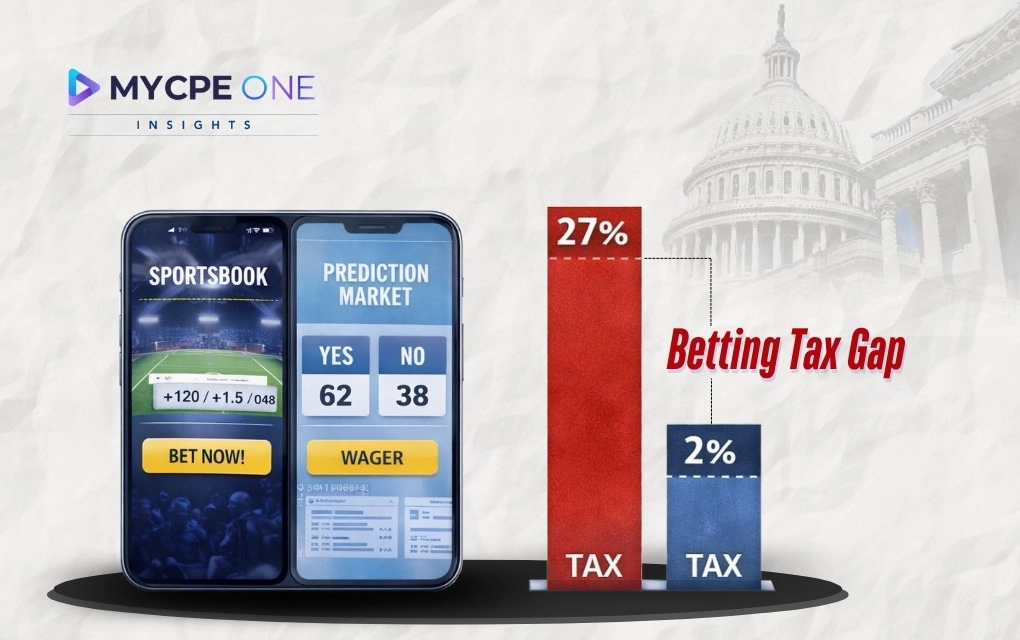
Prediction markets operate under the oversight of the Commodity Futures Trading Commission. The agency treats these wagers as event-based derivatives contracts, not traditional gambling activity. That distinction matters for taxes. Sportsbooks must pay state gaming taxes on their wagering revenue. Prediction market companies typically pay only standard corporate income taxes. The difference can be dramatic. In North Carolina, sportsbooks pay 18 percent gaming tax, while the corporate income tax rate sits around 2 percent. In states such as Texas, Ohio, and Wyoming, where corporate income taxes are zero, prediction platforms may effectively generate no state tax revenue at all. From a state budget perspective, it is the same economic activity producing vastly different tax outcomes.
The contrast becomes clearer when comparing state gaming tax rates with corporate income tax rates. Sportsbooks often face tax burdens several times higher than those imposed on prediction market operators.
The table below highlights the tax wedge between these systems across states that allow online sports betting.Source: Forbes
The takeaway is straightforward. In some states, the gaming tax burden on sportsbooks is seven to nine times higher than corporate taxes. In North Carolina, the ratio reaches 900 percent.
The American Gaming Association estimates that prediction markets could be diverting more than $570 million in potential state tax revenue each year. The estimate reflects how betting activity may shift from licensed sportsbooks to federally regulated event contract platforms that fall outside state gaming tax systems.
Key points include:
Estimated $570 million in annual lost tax revenue
Migration from state sportsbooks to prediction platforms
Reduced state gaming tax collections
Prediction markets themselves have expanded rapidly. Industry estimates suggest $44 billion in trading volume in 2025, with sports outcomes representing a large share of activity. If even 10 percent of sportsbook wagering volume moved to prediction platforms in a state like North Carolina, the state could lose tens of millions in annual tax collections. States without a corporate income tax, such as Nevada and Wyoming, face the biggest exposure because prediction market operators may owe no state tax at all.
The tax differences also affect individual bettors. Winnings from traditional sportsbooks are treated as ordinary income for federal tax purposes. Losses can offset winnings only if the taxpayer itemizes deductions, and they cannot exceed the amount of winnings. Prediction market contracts may fall under Section 1256 of the Internal Revenue Code, which governs certain regulated futures contracts. Under this framework, gains receive 60/40 capital gains treatment, with 60 percent taxed at long-term rates and 40 percent at short-term rates. Losses may offset gains and up to $3,000 of ordinary income annually, with additional losses carried forward. For active traders, that structure can produce more favorable tax outcomes than traditional gambling winnings.
States are now pushing for several possible policy fixes. One option is to classify sports-related prediction contracts as gambling activity, which would require platforms to obtain state licenses and pay gaming taxes. Another approach would divide authority between federal and state regulators. The Commodity Futures Trading Commission could oversee political and economic event contracts, while sports-based markets fall under state gaming regulators. For now, the legal environment remains uncertain. Several states have issued cease-and-desist orders, and court challenges are still unfolding. One thing is clear though. As prediction markets grow, the tax gap between federal platforms and state sportsbooks will keep drawing attention from regulators, lawmakers, and tax professionals alike.
Until next time…
Don’t forget to share this story on LinkedIn, X and Facebook
Subscribe now for $199 and get unlimited access to MYCPE ONE, from CPE credits to insights Magazine
📢MYCPE ONE Insights has a newsletter on LinkedIn as well! If you want the sharpest analysis of all accounting and finance news without the jargon, Insights is the place to be! Click Here to Join
You’ve reached the 3 free-content piece limit. Unlock unlimited access to all News & CPE resources.
Subscribe Today.
Already have an account?
Sign In