Join 250,000+
professionals today
Add Insights to your inbox - get the latest
professional news for free.
Join our 250K+ subscribers
Subscribe19 FEB 2026 / ACCOUNTING & TAXES
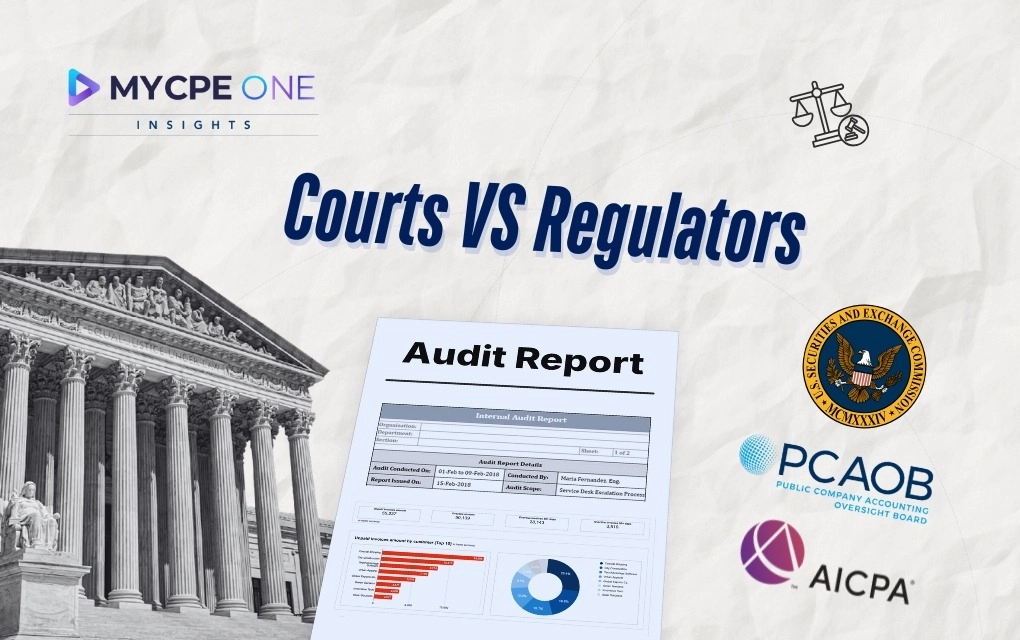
The Trump administration has reduced the Public Company Accounting Oversight Board (PCAOB)'s budget by 9% and installed Jim Logothetis, a 40-year EY veteran, as chair, signaling a desire for a leaner PCAOB that focuses on key missions such as consequential misconduct rather than process policing. The cutbacks are stoking concerns about whether this decrease in regulatory scrutiny may result in a spike in litigation against accounting firms.
I still remember sitting in a partner meeting years ago when someone said, “The regulator will catch it before we do.” Half the room nodded. The other half stared at the floor. That line feels different in 2026. With the Trump administration cutting the Public Company Accounting Oversight Board’s budget by 9% to $362 million for 2026, slashing board member pay by roughly 40%, and installing a 40-year EY veteran, Jim Logothetis, as chair, the message is clear. The SEC wants a leaner PCAOB that focuses on what it calls “core statutory mission” work. Less process policing. Fewer headline fines. More emphasis on what they view as consequential misconduct. Investor advocates are uneasy. Audit firms are quietly relieved. And everyone is looking at the courts. So, here is the real question for practitioners: If regulatory pressure cools, does litigation heat up?
The PCAOB was born out of Enron in 2002. It exists because self-regulation did not end well. For years, especially under the prior leadership, the board increased inspections, issued new standards, and imposed record penalties. Some firms felt like the microscope got a little too close to the glass. Now the board’s 2026 levy on public companies and broker-dealers will drop from $375 million to $306 million. Staff headcount has already fallen 5 percent this year. Pay is coming down. The SEC chair has openly criticized the cost structure and signaled a pivot toward “sensible, efficient oversight.” Translated into shop talk: expect fewer inspections and fewer enforcement actions.
For large firms, that means less regulatory friction. For mid-sized firms that audit public companies, it might mean fewer remediation cycles and fewer tense conversations with inspection teams. But here is the thing. Regulation does not exist in a vacuum. When one pressure valve tightens, another often loosens.
Three recent court cases have reshaped the conversation around auditor liability, and they are not academic footnotes. First, a New York state court decision involving BDO and the collapsed hedge fund Platinum Partners broadened the concept of “near privity.” Traditionally, investors have struggled to sue auditors because the audit engagement is with the company, not the shareholders. You need something close to a contractual relationship. In the BDO case, the court held that audit reports addressed to investors could create near privity, even if the auditor did not directly transmit them. That is not trivial. If upheld on appeal, it softens one of the biggest shields auditors have relied on, especially in New York, which has historically favored the defense.
On the flip side, PwC scored a win in a federal appeals court in litigation tied to Bloom Energy’s revenue restatement. The key issue was whether the revenue figure in the audit report represented fact or opinion. The court leaned toward opinion, noting the heavy use of assumptions and judgments in contract accounting. That distinction matters because certifying a false fact carries more liability risk than being wrong on an opinion grounded in professional judgment. Then there is the AmTrust saga. At one point, a federal court dismissed investor claims partly on the theory that audit reports are formulaic and do not meaningfully influence investor decisions. The SEC, under prior leadership, filed a submission arguing that audit reports are indeed material. The court reversed itself. The Supreme Court declined to step in, effectively leaving that pro-investor interpretation in place. So, while the PCAOB trims its sails, courts are actively shaping the liability perimeter. For CPA firms, that is not just legal theory. That is engagement risk.
Every audit report states that the auditor provides reasonable assurance, not a guarantee. That phrase has always carried weight in court. The current environment tests how much weight it carries. Consider a mid-sized firm auditing a regional public company with complex revenue streams and evolving contracts. The engagement team documents judgments around ASC 606. The work is solid, but a year later the company restates revenue, wiping out hundreds of millions in market value. Under a lighter inspection regime, that file may never face the same level of regulatory scrutiny. In litigation, it becomes Exhibit A.
Documentation quality, professional skepticism, and fraud procedures become more than compliance exercises. They become the backbone of defense strategy. A missing memo or thin analysis does not look like a minor oversight once discovery begins. As Benjamin Graham wrote in The Intelligent Investor, “The investor’s chief problem, and even his worst enemy, is likely to be himself.” Courts increasingly treat the audit report as a stabilizing force against that problem. If that stabilizing force falters, judges and juries notice.
Courts and regulators influence each other more than most practitioners realize. In AmTrust, the SEC’s position helped persuade the court that audit reports matter in investment decisions. A different administration might emphasize different priorities in similar cases. That interplay matters. If the SEC consistently frames audit opinions as judgment calls deserving deference, courts may hesitate to expand liability. If it stresses investor reliance and materiality, the tone shifts. Meanwhile, the new PCAOB leadership signals a focus on efficiency and core mission. That could mean fewer sweeping rulemakings and fewer headline-grabbing fines. It does not erase the fact that capital markets still depend on credible audit opinions.
For audit committees and CFOs, the takeaway is straightforward. Reduced regulatory friction does not reduce responsibility. If anything, it increases the importance of internal governance. Counting on regulators to catch aggressive accounting is not a strategy. It never was. For firms considering public company audits, the equation becomes more nuanced. Lower levies and a calmer regulatory climate may look attractive. Litigation exposure, insurance costs, and reputational risk remain very real. That is not alarmist. It is practical.
Right now, accountability rests on three pillars: regulatory oversight, judicial enforcement, and firm culture. One pillar appears lighter than it was two years ago. The other two adjust in response. Regulators may focus on systemic fraud rather than technical errors. Courts may revisit what counts as near-privity or how to classify an audit opinion. Firms must assume that if something goes wrong, the courtroom will dissect every decision, every judgment, and every paragraph in the report. In day-to-day practice, this means resisting complacency. It means tightening engagement reviews, asking harder questions in fraud brainstorming sessions, and not brushing off documentation gaps because “no one will look that closely.” Someone will.
Until next time…
Don’t forget to share this story on LinkedIn, X and Facebook
Subscribe now for $199 and get unlimited access to MYCPE ONE, from CPE credits to insights Magazine
📢MYCPE ONE Insights has a newsletter on LinkedIn as well! If you want the sharpest analysis of all accounting and finance news without the jargon, Insights is the place to be! Click Here to Join
You’ve reached the 3 free-content piece limit. Unlock unlimited access to all News & CPE resources.
Subscribe Today.
Already have an account?
Sign In