MYCPE ONE
MYCPE ONE LOGO

Join 250,000+
professionals today

Add Insights to your inbox - get the latest
professional news for free.

MYCPE ONE insights

Minnesota Man Caught in $2 Million SNAP Tax Fraud

Join our 250K+ subscribers

Join our 250K+ subscribers

Subscribe

24 MAR 2026 / ACCOUNTING & TAXES

Minnesota Man Caught in $2 Million SNAP Tax Fraud

Minnesota Man Caught in $2 Million SNAP Tax Fraud

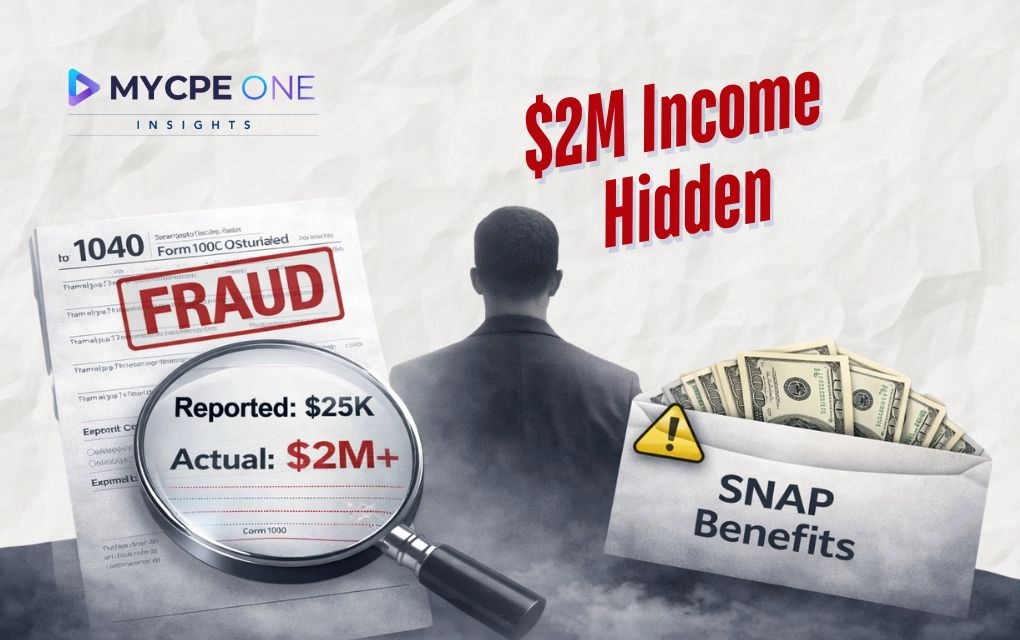
Every tax season has that one story professionals quietly talk about, the client who thought they could stay one step ahead of the system. It usually starts small. A number adjusted here, an expense stretched there. Then it compounds. One year becomes four, and what once felt manageable turns into something much harder to explain. That’s exactly how this case unfolded. A Minnesota man is accused of underreporting nearly $2 million in income, avoiding over $186,000 in taxes, and at the same time collecting around $40,000 in government benefits meant for low-income households. On the surface, it may have looked controlled. But the numbers were telling a very different story. This isn’t just about one individual. It’s a clear example of how tax fraud builds, how it gets flagged, and why enforcement today is far more connected than most people assume.

Building the Scheme

What stands out in this case is not just the scale, but the layering. Between 2020 and 2024, authorities allege a pattern of underreporting both personal and business income. The gap between actual earnings and reported figures wasn’t a one-time issue, it stretched across multiple years. That alone increases exposure significantly. The structure of the business added another layer. Investigators claim the business was registered under a relative’s name, creating distance between ownership and income. That kind of setup is often used to reduce visibility, but it also creates inconsistencies that are easier to trace over time. Then came spending behavior. Business funds were allegedly used for personal expenses, travel, lifestyle costs, and other non-business items. That blurring of lines is one of the fastest ways to trigger scrutiny, especially when documentation doesn’t support the classification. The most critical piece, however, was the contradiction. While reporting lower income, the individual allegedly qualified for and received SNAP and medical assistance benefits. That’s where systems start to connect the dots. High actual income combined with low reported income is one of the clearest signals modern enforcement tools are designed to detect.

Why This Case Got Flagged

Tax fraud cases rarely begin with dramatic investigations. They begin with mismatches. In this case, several red flags likely converged. Reported income didn’t align with spending patterns. Business activity didn’t match filing behavior. And benefit claims conflicted with earning capacity.

What’s different today is how quickly these inconsistencies surface. State tax agencies, federal systems, and public benefit programs are increasingly integrated. Data doesn’t sit in silos anymore. A mismatch in one system can trigger a review in another. Minnesota has also stepped up enforcement efforts. Recent initiatives targeting fraud across both tax filings and government programs have increased scrutiny. This case falls directly into that broader push, where agencies are not just reacting, but actively looking for patterns. And once a case is flagged, it rarely stays limited. It expands, pulling in multiple years of data, filings, and transactions.

How Common Is This?

Despite the headlines, cases like this are relatively rare. In 2026, the IRS identified around $4.5 billion in tax fraud, but much of that involved scams, not individuals deliberately underreporting income. When it comes to actual tax evasion cases, the numbers are much smaller. In 2024, the Department of Justice convicted about 360 individuals nationwide, with roughly 66% receiving prison sentences. Most cases involved amounts between $100,000 and $1.5 million, placing this case well within the range that typically attracts enforcement attention. That’s the key point. These cases are not common, but when they do surface, they are usually backed by strong evidence built over time.

Technology and Enforcement

One of the biggest shifts in tax enforcement is happening quietly, through data and technology. The IRS and state agencies now rely heavily on analytics and AI-driven systems to identify patterns across filings. These systems compare returns against historical data, industry benchmarks, third-party reports, and even behavioral patterns.

For example:

  • Reported income versus expected income based on business activity
  • Expense levels that don’t match revenue trends
  • Repeated inconsistencies across multiple years
  • Conflicts between tax filings and government benefit applications

This isn’t about catching a typo or a missed form. It’s about identifying patterns that don’t make sense over time. In cases like this, where activity spans several years, the system doesn’t just flag a single return. It builds a narrative.

After Detection

Once authorities step in, the process shifts quickly from review to enforcement. The first layer is financial. Unpaid taxes must be repaid, often with penalties and interest. In this case, authorities estimate more than $186,000 in unpaid taxes, which could increase depending on further findings. Next comes restitution. Any fraudulently obtained benefits, including the $40,000 in SNAP and medical assistance, are typically required to be paid back.

Then comes the most serious risk, criminal charges. Tax evasion and fraud can lead to significant penalties, including prison time, especially when the activity shows intent and repetition. Prior history also matters. In this case, the individual had already pleaded guilty to tax fraud in 2024. Repeat behavior significantly raises the stakes and reduces leniency.

What This Means for Professionals

For accountants, tax preparers, and advisors, this case reinforces a few critical realities.

  • Income must align with activity: Reported numbers should reflect actual business performance
  • Entity structures must be logical: Using proxies or relatives raises immediate concerns
  • Personal and business expenses must stay separate: Blurring them creates audit risk
  • Benefit claims are not isolated: They are cross-checked against tax filings
  • Patterns matter more than isolated errors: Repetition is what triggers deeper scrutiny

Professionals are not investigators, but they are the first line of defense. If something doesn’t add up, it usually doesn’t.

Final Takeaway

The Minnesota case is not just about underreported income. It’s about how modern enforcement connects the dots. Tax filings, business structures, and government benefit systems are no longer separate. They feed into each other. That means inconsistencies don’t stay hidden for long. For a while, it may feel like the system isn’t watching closely. That adjustments can be managed and gaps can go unnoticed. But eventually, the numbers tell their own story. And when they do, it’s not just about fixing a return. It’s about answering for the pattern behind it.

Until next time…

Don’t forget to share this story on LinkedIn, X and Facebook

Subscribe now for $199 and get unlimited access to MYCPE ONE, from CPE credits to insights Magazine

📢MYCPE ONE Insights has a newsletter on LinkedIn as well! If you want the sharpest analysis of all accounting and finance news without the jargon, Insights is the place to be! Click Here to Join

Unlock Annual Access to News & CPE Subscription

You’ve reached the 3 free-content piece limit. Unlock unlimited access to all News & CPE resources.
Subscribe Today.

News & Updates

  • Exclusive News & Insights
  • Latest Regulatory Updates
  • Accounting Industry Trends
  • Expert Insights
  • AI-Driven Audio & Summaries
  • Infographics & Videos
  • CPE-Approved Articles
  • Digital Magazine
  • Benchmarking Blogs

Unlimited CPE Access for 1 Year

  • 15,000+ Hours of Content
  • 500+ Subject Areas
  • Mandatory Ethics Courses
  • 250+ Compliance Packages
  • 50+ Virtual Conferences and Events Access
  • Format: Live, Audio, Video, E-Books
  • Audio Based Courses & Podcasts
  • Add External Certificates with AI
  • AI Compliance Tracking and Report
  • Instant Certification and Fast Reporting
  • Mobile App Access (iOS and Android)
  • Dedicated Support System
  • Practical Training Programs
  • AI Academy Access
  • Tax Academy Access
  • Audit Academy Access
  • Leadership Academy Access