Join 250,000+
professionals today
Add Insights to your inbox - get the latest
professional news for free.
Join our 250K+ subscribers
Subscribe19 MAR 2026 / ACCOUNTING & TAXES
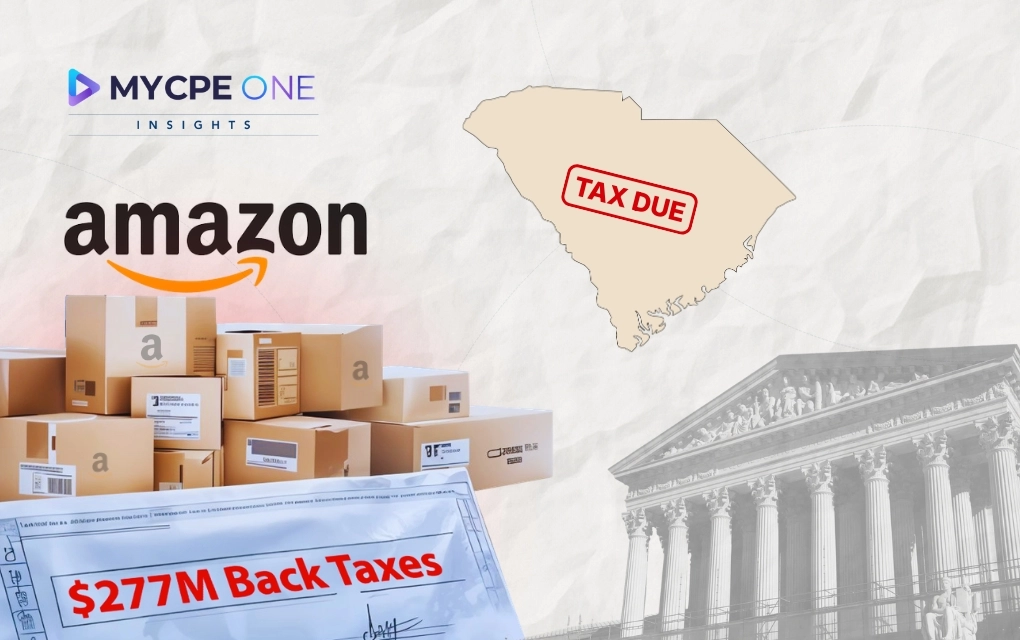
After a decade-long legal battle, the South Carolina Supreme Court has ruled that Amazon is liable for the sales taxes for third-party products sold on its platform within the state, labeling it as the 'seller'. It implies that other states can present similar claims against Amazon, potentially posing up to $277 million worth tax liabilities for the firm. The ruling builds a precedent which affects the interpretations of sales tax liability and extends beyond tax implications to product liabilities, consumer protection, and platform accountability, prompting conversations surrounding business models.
Amazon pulled $716.9 billion in revenue in 2025. So yes, it can easily cut a check for South Carolina. But that’s not why this case matters. The real question sitting underneath this ruling is far more uncomfortable: can states reopen the past and say, “you were the seller all along”? South Carolina just answered that with a quiet but firm “yes.” And if you work in SALT, audit, or advisory, this one should make you pause for a second. Let’s break it down, because this one has layers.
Let’s rewind.
Back in 2010, South Carolina gave Amazon a deal: build distribution centers, create jobs, invest at least $125 million, and you get a five-year sales tax break. Amazon took the deal, built facilities, and grew its footprint. That exemption expired on December 31, 2015. Starting in 2016, Amazon began collecting tax on its own sales. But here’s where things got messy. It did not collect tax on third-party marketplace sales, even though those transactions were happening through Amazon’s platform, payment system, and fulfillment network. The state looked at that and basically said, “Hold on, that doesn’t pass the smell test.” Fast forward through a 10-year legal slog:
The logic was simple, and honestly, a bit uncomfortable for platform businesses. Amazon controlled the transaction from start to finish. Payment, checkout, customer interaction, shipping, everything flowed through Amazon. So, the court said: you’re not just the platform, you’re part of the sale. And that’s how Amazon ends up liable for at least $12.5 million for Q1 2016, with total exposure potentially crossing $277 million through 2019. Wayfair didn’t fix this. It just made future compliance easier. The past was still sitting there, waiting.
Short answer: no. But also, don’t assume this turns into a nationwide sweep.
Here’s the reality. There is no identical case where another state has successfully forced Amazon, as a facilitator, to pay pre-Wayfair taxes like this. That matters. This is not a domino effect yet.
But similar pressure points exist:
So, what’s stopping states from jumping in?
Three things:
That said, this ruling gives state tax departments something valuable: a court saying, “control matters more than labels.” And you know how this goes. Once one state tests a theory successfully, others at least run the numbers.
Let’s not go overboard, but let’s also not ignore the signal. The immediate risk is not a 50-state pile-on. The more realistic outcome looks like this:
Now here’s where it gets interesting beyond tax. If “control = seller” becomes a stronger legal standard, it doesn’t stop at sales tax. You start creeping into:
That’s when this stops being a SALT issue and starts becoming a business model conversation.
Amazon argued the statute was unclear. And to be fair, two justices agreed. The dissent said when tax law is ambiguous, you rule in favor of the taxpayer. That’s long-standing doctrine. There’s also a broader fairness argument floating around: Is it reasonable to impose tax liability retroactively when the rules were not explicitly spelled out? Critics say no. Some even argue retroactive enforcement edges into due process concerns. But the state’s argument is just as strong: If Amazon controls the transaction and collects the money, and if sellers realistically were not remitting tax, then who else was going to? That’s the uncomfortable middle ground. This is not black and white. And that’s exactly why this case matters.
Not really. Let’s put numbers in perspective:
Even if South Carolina pushes this to $277 million, we’re talking about roughly 0.03 to 0.04 percent of annual revenue. Amazon pays this out of operating cash. No drama.
But here’s the real accounting angle.
This is not about one bill. It’s about uncertain tax positions.
Amazon has already disclosed that similar claims from other states could lead to additional liabilities. That means:
That’s straight out of ASC 450 territory.
And no, there is no clean public number for total exposure. Anyone throwing out a big national estimate is guessing.
South Carolina didn’t rewrite sales tax law. But it reminded everyone of something uncomfortable: Old positions don’t stay buried forever. Amazon will pay what it owes. That part is easy. The harder question, and the one worth thinking about, is this: If you had to defend a 2016 sales tax position today, with a state auditor pointing to this case, would your answer still hold up? Because for a lot of businesses, that answer just got a little less certain.
Until next time…
Don’t forget to share this story on LinkedIn, X and Facebook
Subscribe now for $199 and get unlimited access to MYCPE ONE, from CPE credits to insights Magazine
📢MYCPE ONE Insights has a newsletter on LinkedIn as well! If you want the sharpest analysis of all accounting and finance news without the jargon, Insights is the place to be! Click Here to Join
You’ve reached the 3 free-content piece limit. Unlock unlimited access to all News & CPE resources.
Subscribe Today.
Already have an account?
Sign In