Join 250,000+
professionals today
Add Insights to your inbox - get the latest
professional news for free.
Join our 250K+ subscribers
Subscribe17 MAR 2026 / ACCOUNTING & TAXES
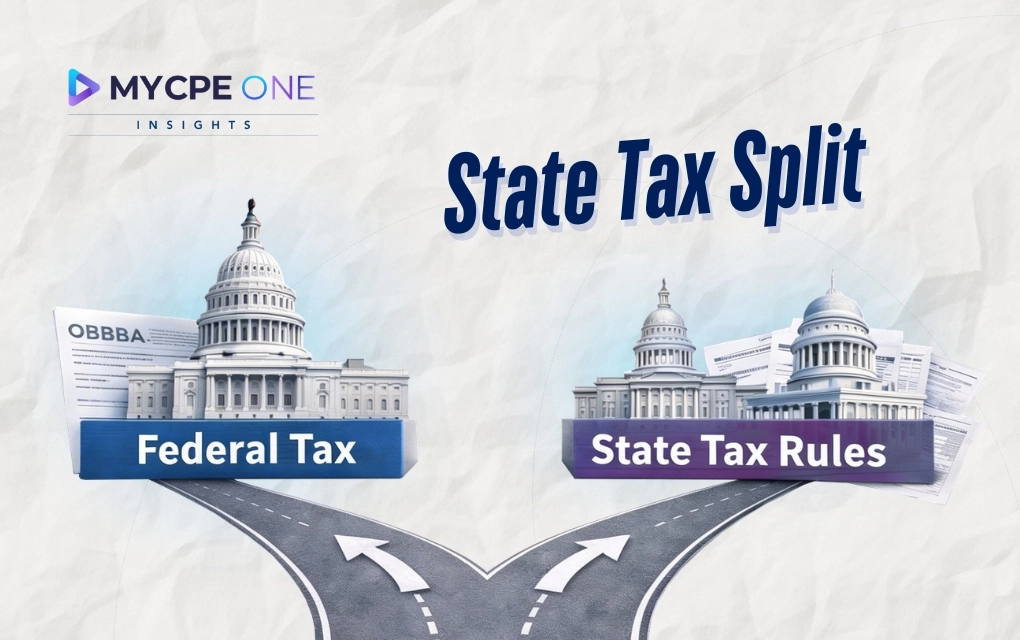
The One Big Beautiful Bill Act passed in 2025 federally provides generous tax relief, including full exemption on tips and overtime. Nonetheless, numerous states have diverged from this tax code according to their individual budget needs, effectively creating a fragmented patchwork of taxation that leaves taxpayers and their advisors in complicated territory.
Picture this. You finally explain to a client that their tips are tax-free. They smile, maybe even call you a genius. Then you add, “Well… federally.” Cue the blank stare. Welcome to 2026, where the tax code feels less like a rulebook and more like a group chat where half the states muted the conversation. The One Big Beautiful Bill Act, passed July 4, 2025, promised sweeping federal tax relief. States? Not so fast. Many are hitting pause, others are cherry-picking, and a few are flat-out saying, “Nah, we’re good.” The result is a patchwork that’s keeping tax professionals on their toes.
At the federal level, the OBBBA rolled out generous provisions. Think full expensing of domestic R&D under Section 174A, permanent 100% bonus depreciation starting January 19, 2025, and even headline-grabbing perks like no tax on tips and overtime. But states don’t automatically fall in line. About half conform to the Internal Revenue Code as it changes. The rest? A mixed bag. Some stick to older versions, others pick and choose like it’s a buffet. Rhode Island wasted no time and decoupled from the entire law. California updated its conformity date to January 1, 2025, conveniently stopping just before OBBBA kicks in. Michigan and Pennsylvania followed suit, opting out of key provisions like R&D expensing and interest deduction changes. Delaware stepped in during a special session to avoid a $400 million revenue hit. You see the pattern. States are doing what they need to balance budgets. Or, in plain English, they’re trying not to blow a hole in their finances.
Why all the resistance? Simple. Money. Federal tax cuts shrink the tax base. States rely heavily on that base to calculate their own revenue. When Washington gets generous, states often end up footing the bill. Take California. Adopting OBBBA’s tip and overtime exemptions could cost about $3.2 billion annually. New York is staring at over $1 billion in potential losses. Illinois? Same story. These aren’t rounding errors. So, states are making tough calls. Some are embracing relief. Iowa, Montana, North Dakota, and Oregon will likely exempt tips and overtime in 2025 due to rolling conformity. Arizona passed a bill to eliminate tax on tip income. Colorado took a middle path, allowing tip deductions but rejecting overtime relief.
Others are drawing a hard line. New York, California, Illinois, Massachusetts, Connecticut, and Hawaii are keeping those dollars taxable. Their logic? You can’t cut taxes if you still need to fund schools, roads, and public programs. Not exactly rocket science.
Because every state plays by its own rules. Let’s say your client operates in five states. One follows federal law. Another partially conforms. A third requires add-backs. A fourth hasn’t decided yet. And the fifth? Still using an older version of the tax code. Fun, right? Even definitions get messy. GILTI, now renamed Net CFC Tested Income, is still called GILTI in several states. Some tax it, others don’t, and a few are still figuring it out. If that sounds confusing, it is. Then there’s timing. Many states ended their legislative sessions right as OBBBA passed. That means decisions are spilling into 2026, sometimes with retroactive effects. Translation: you might file a return today and revisit it tomorrow. And yes, even software is playing catch-up. Not exactly what you want during filing season.
The “no tax on tips” and “no tax on overtime” provisions grabbed headlines for a reason. They’re easy to understand and politically popular. But at the state level, they’re anything but simple. States have three options. Fully conform, partially adopt, or reject entirely. Colorado’s hybrid approach is getting attention. It provides relief for lower-wage workers through tip deductions while protecting revenue by taxing overtime. Smart compromise or just kicking the can down the road? Meanwhile, “wait-and-see” states like Georgia, Maryland, and South Carolina are holding off until 2026. That leaves taxpayers and advisors in limbo. Should you adjust withholding now? Or wait for the next legislative session? No one loves uncertainty, especially during tax season.
Here’s where things get interesting. This isn’t just compliance. It’s a strategy. Choosing where to build a new facility? State conformity to bonus depreciation or Section 168(n) could swing the numbers. Deciding where to expand R&D operations? Whether a state follows Section 174A or sticks to older rules can change the cost equation. Even routine planning gets trickier. Estimated payments, financial reporting, and extension calculations now depend on a moving target.
Track legislative updates like your morning coffee. Clients will ask why their federal and state numbers don’t match. Have a clear explanation ready. Something like, “The IRS gave you a break, but the state didn’t.” Adjust withholding and estimates where needed. And don’t assume consistency across states. That assumption is where mistakes happen. Also, keep an eye on 2026. Many decisions are still pending. The current mess might get clearer, or it might just get… different.
The idea that federal tax changes trickle neatly down to the states? That’s old news. We’re now in a world where tax policy is more fragmented than ever. States are making independent choices, often driven by budget realities rather than federal alignment. For tax professionals, this is both a headache and an opportunity. Yes, it’s more complex. But it also makes your role more valuable. Clients aren’t just looking for compliance. They want clarity in a system that doesn’t always offer it. And if you’re wondering whether this patchwork will settle down anytime soon, here’s a fair question. When has tax ever gotten simpler?
Until next time…
Don’t forget to share this story on LinkedIn, X and Facebook
Subscribe now for $199 and get unlimited access to MYCPE ONE, from CPE credits to insights Magazine
📢MYCPE ONE Insights has a newsletter on LinkedIn as well! If you want the sharpest analysis of all accounting and finance news without the jargon, Insights is the place to be! Click Here to Join
You’ve reached the 3 free-content piece limit. Unlock unlimited access to all News & CPE resources.
Subscribe Today.
Already have an account?
Sign In